5 & 8 EMA Trading Strategy

An exponential moving average strategy, or EMA strategy, is used to identify the predominant trend in the market. It can also provide the support and resistance level to execute your trade.

Now we are going to look on the simple exponential moving average strategy which uses 5 EMA and 8 EMA

This FX trading strategy works as :

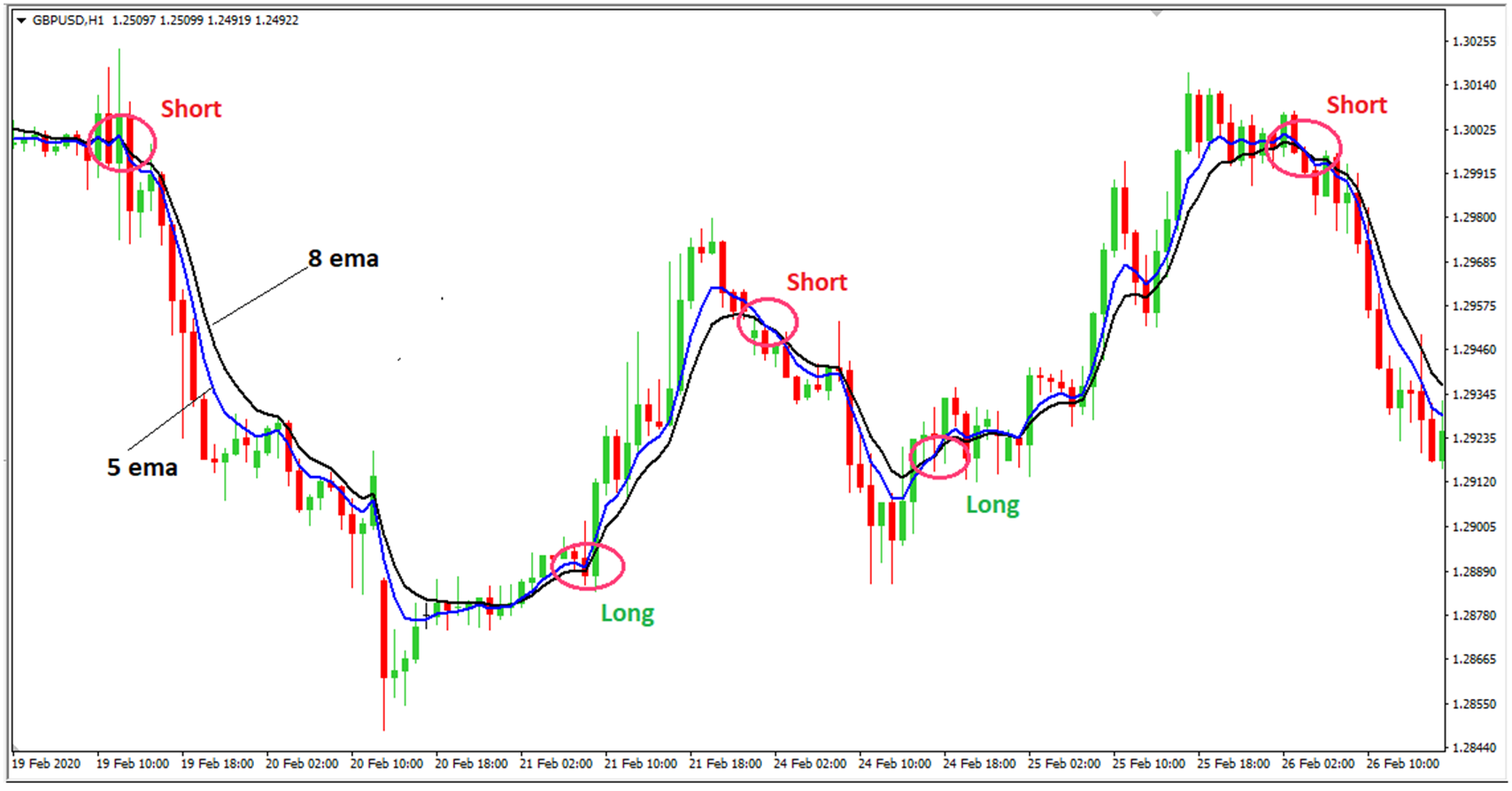
  • Uptrend is indicated if the faster moving average (5 EMA) crosses the slow EMA (8 EMA) to the upside
  • Downtrend is indicated if the 5 EMA crosses the 8 EMA to the downside.
  • Trade entries are taken after the EMA cross-over.


Timeframes : 15 min, 1 Hr
 
Instrument : You can use this strategy for any currency pairs.

Indicators : You need 5 & 8 EMA

Long Entry :

  • Go long when 5 EMA crosses 8 EMA to the upside.
  • Buy at the close of the candlestick that closes after the EMA’s have crossed.
  • You can place stop loss 5-10 pips below the low of that candlestick


Short Entry : 

  • Go short when 5 EMA crosses 8 EMA to the downside.
  • Sell at the close of the candlestick.
  • You can place stop loss 5-10 pips above the high of that candlestick.

Take Profit :

  • Set your profit at least 3 times the risk on that trade
  • or Aim to take profit at the previous swing low for a sell order and a previous swing high for a buy order.


Managing a Profitable Trade :

  • When trade is moving in your favour and you want to lock in the profit then the best option is to move stop loss and place behind the high (or low) of each subsequent candlesticks that forms. For a short trade, move and place stop loss above the high the candlestick that continues to make lower highs. For a long trade, move and place stop loss below the low of each subsequent candlestick that continues to make Higher Lows.
  • You may try to use a 50-80 pips trailing stop on the daily timeframe.
  • Use 25-40 pips trailing stop on the 4 hr time frame.


Pros :

  • You will earn high profit in a strong trending market.
  • Easily understandable strategy apt for beginners


Cons :

  • Poor performance in ranging markets
  • Huge stop loss if you trade in higher time frame so your risk is going to be huge so you have to trade small contracts to keep your risk within acceptable levels.
  • Lagging indicators and therefore every entry taken based on moving averages is effectively “late”.  That means price had already made a big move and you would have not gotten into the trade at the start of that move.
  • By the time the trading strategy gives the entry signal, the market may be reversing temporarily and can knock out your stop loss as well.

CFD Trading and essentials to know before trading it.

A Contract for difference offers investors and traders diverse opportunities to profit in the market from the price movement of assets without owning the asset. This profit is calculated as the difference between the entry point of the trade and its exit point. CFD provides several advantages for traders, considering the number of assets available to trade. However, the number of assets gives traders a whole lot of options on what instrument to trade. These assets include bonds, exchange-traded funds, and commodities. For a CFD to be valid there must be a broker and a client.

In recent years, CFDs have become the most popular way for online investors to trade commodities, indices, currencies, and stocks. Since CFD trading does not involve the actual asset and operates independent of the market, it allows for greater flexibility than traditional trading — for example, access to foreign markets, leveraged trading, fractional shares, and short selling. Contracts for differences is an advanced trading strategy that is used by experienced traders.

What can you trade with CFDs?

While CFD trading, you can open positions on a variety of different asset classes including shares, indices, currencies, commodities and cryptocurrencies – all within one single platform. A trader can enter the stock market without having to deal directly with share purchases, providing greater liquidity and easier execution. This has the added benefit of being able to profit in a falling market by short selling.

Trading CFDs is one of the very few ways to gain access to the indices market. CFDs on indices mirror the composition of a certain index. The FX market is suited to CFDs and leveraged trading due to the relatively small price movements that occur in these markets. Remember to employ risk management techniques when trading at all times and be even more cautious of assets that have a history of being highly volatile like cryptocurrencies.

  • Shares and stocks: You can trade CFDs of shares of companies in the market. This means you can buy the stock of a company by predicting that its price will fall or rise without owning the company’s stock. Stocks comprise the largest category of CFD because of the numerous stocks available throughout the world
  • Index: In trading, it is the measurement of the day-to-day performance of a country’s stock market. Perhaps you may have heard of FTSE China A50, China H-Shares, US Dollar Index, and Hong Kong HS50 Cash Index. These are popular stock indices that most traders trade in the CFD market. Trading tools such as data and analytics and market news are essential when trading index.
  • Bonds: Companies or government debts issue these in exchange for funds borrowed. At times, they are called treasuries or Treasury Bills. Bond prices have an inverse connection with stock market indices. Euro Bund, UK Long Gilt, US 10yr T-Note are the most popular in the CFD market.
  • Commodities: These are categorized as soft or hard commodities. In most trading platforms, they are divided into agricultural commodities (wheat, sugar, cocoa, cotton, coffee, corn, etc.), energy assets (natural gas, crude oil) and metals (palladium, platinum, copper, silver, gold, etc.) These commodities are raw materials used in various industries in the world, with their prices varying. Additionally, they are the most traded in the CFD market and are very volatile.


Equivalence of CFDs and Forex

CFD trading and Forex trading have many similarities. First, both types of trading involve a similar trade execution process. Traders can easily enter or exit the market in both rising and falling markets. Second, both CFD trades and Forex trades are executed on the same platform, using similar looking charts and pricing methods. In both cases, trades are executed in the over-the-counter (OTC) market, which is run entirely electronically within a network of banks, with no physical location or central exchange. Another similarity between CFD trading and Forex trading is that the only cost of trading is the spread, as opposed to other types of trading instruments that charge commissions and other finance fees.

The primary similarity between CFD trading and forex trading is that the trader doesn’t actually have ownership of the underlying asset. When one buys EURAUD, for instance, one is not actually purchasing Euros and selling Australian dollars; rather the trader is simply speculating on the exchange rate. Likewise, when a trader purchases a CFD contract on the FRA40, the trader does not actually own the stocks in the FRA index, but rather is speculating on its underlying price. In many ways, forex is simply another kind of CFD.

Difference between CFD’s and Forex

The main differences between CFD trading and Forex trading is that CFD trading involves different types of contracts covering a diverse set of markets, such as indices, energy, and metals, whereas Forex offers pure currency trading. When you trade CFDs, you have the opportunity to select different contracts that vary in increment value and currency type, depending on the country in which the underlying asset originates. Forex trading is about trading one currency against another currency and always involves trading in uniform lot sizes.

A final difference between CFD trading and Forex trading relates to the general factors that tend to influence the different markets. CFD trading is mostly influenced by specific factors, such as supply and demand of a given commodity or trend changes associated with business sectors. Forex trading on the other hand is mainly driven by global events, like large employment shifts or international political changes.

Have a Smart Plan about your trading 

A trading plan gives you a clear path to follow in your trading journey by outlining the why, what, when, and how. Knowing all these factors before jumping into trading helps you avoid trading on emotions, which can lead to making uninformed decisions that will likely translate into losses. A trading plan needs to cover some important aspects:

  • Your motivation for trading supported by realistic and clearly-defined trading goals
  • Trading style and risk appetite
  • The assets you want to trade. Don’t expect to specialize in trading all the available asset classes.
  • How you will finance your trades and how much capital you will use.
  • Trading strategy with clear rules for trade entry and exit, and risk and money management.
  • Record keeping


A good plan will give you an excellent structure for your day-to-day trading decisions.

Choice is yours

We won’t advise you as to which market you should actually choose, because it should depend on your own analysis of any given asset’s potential. What’s important to note here though is that there are virtually innumerable assets that can be traded via CFDs. These include typical stocks, commodities, forex pairings, and now digital currency as well. While CFDs and forex have many similarities, they also have their key differences. By knowing what makes these two different, investors can make better-informed decisions and decide how best to incorporate CFDs and forex into their trading strategy.

Happy trading!!!

Why are Interest rates so important for forex traders

The exchange rate between two currencies is determined by the interaction of several variables. Some variables have more influence on the determination of currency rates than the others. One such variable is the interest rate.

In general, changes in the interest rate create huge fluctuations in the value of all currencies. In fact all major currency crises have invariably been preceded by a major change in the interest rates. Simply put, money attempts to follow the currency with the highest real interest rate. The real interest rate is the nominal interest rate less inflation. Forex traders must keep an eye on each country’s central bank interest rate and more importantly, when it is expected to change, to forecast moves in currencies.

In this article, we will look why interest rate changes influence the Forex market to such an extent and we touching upon:

  • Definition of Interest Rates and Interest Rates Calculation
  • Forex interest rate differentials.
  • How traders can forecast central bank rates and the impact on the FX market.
  • Key forex interest rate trading strategies.


What are Interest Rates?

Interest rates are the cost of borrowing money. They represent what creditors earn for lending you money. These rates are constantly changing, and differ based on the lender, as well as your creditworthiness. Interest rates not only keep the economy functioning, but they also keep people borrowing, spending, and lending. But most of us don’t really stop to think about how they are implemented or who determines them.

Interest Rates determination

1. Short-Term Interest Rates: Central Banks

In countries using a centralized banking model, short-term interest rates are determined by central banks. A government’s economic observers create a policy that helps ensure stable prices and liquidity. This policy is routinely checked so the supply of money within the economy is neither too large, which causes prices to increase, nor too small, which can lead to a drop in prices.

In the U.S., interest rates are determined by the Federal Open Market Committee (FOMC), which consists of seven governors of the Federal Reserve Board and five Federal Reserve Bank presidents. The FOMC meets eight times a year to determine the near-term direction of monetary policy and interest rates. The actions of central banks like the Fed affect short-term and variable interest rates.

If the monetary policymakers wish to decrease the money supply, they will raise the interest rate, making it more attractive to deposit funds and reduce borrowing from the central bank. Conversely, if the central bank wishes to increase the money supply, they will decrease the interest rate, which makes it more attractive to borrow and spend money.

The Fed funds rate affects the prime rate—the rate banks charge their best customers, many of whom have the highest credit rating possible. It’s also the rate banks charge each other for overnight loans.

2. Long-Term Interest Rates: Demand for Treasury Notes

Many of these rates are independent of the Fed funds rate, and, instead, follow 10- or 30-year Treasury note yields. These yields depend on demand after the U.S. Treasury Department auctions them off on the market. Lower demand tends to result in high interest rates. But when there is a high demand for these notes, it can push rates down lower.

If you have a long-term fixed-rate mortgage, car loan, student loan, or any similar non-revolving consumer credit product, this is where it falls. Some credit card annual percentage rates are also affected by these notes. These rates are generally lower than most revolving credit products but are higher than the prime rate.

Many savings account rates are also determined by long-term Treasury notes.

3. Deposit & Loan Rates: Retail Banks

Retail banks are also partly responsible for controlling interest rates. Loans and mortgages they offer may have rates that change based on several factors including their needs, the market, and the individual consumer.

For example, someone with a lower credit score may be at a higher risk of default, so they pay a higher interest rate. The same applies to credit cards. Banks will offer different rates to different customers, and will also increase the rate if there is a missed payment, bounced payment, or for other services like balance transfers and foreign exchange.

4. Individual Factors

For any individual loan, whether it be a personal loan or mortgage or corporate bond issue, interest rates may deviate from the baseline rates set by the processes above. For instance, a high-risk borrower with a low credit score will pay higher rates on a loan with the same terms as a low-risk borrower with a high credit score. In addition:

  • Longer maturity loans will also have higher interest rates than short term loans.
  • Loans secured by collateral will have lower interest rates than unsecured debts.
  • Bonds with embedded options will have higher interest rates than those are non-callable.


Interest Rates Calculation

Each central bank’s board of directors controls the monetary policy of its country and the short-term rate of interest at which banks can borrow from one another. The central banks will hike rates in order to curb inflation and cut rates to encourage lending and inject money into the economy.

Typically, you can have a strong inkling of what a bank will decide by examining the most relevant economic indicators; namely:

  • The Consumer Price Index (CPI)
  • Consumer spending
  • Employment levels
  • Subprime market
  • Housing market


Predicting Central Bank Rates

Armed with data from these indicators, a trader can put together an estimate for a rate change. Typically, as these indicators improve, the economy will be performing well and rates will either need to be raised or if the improvement is small, kept the same. On the same note, significant drops in these indicators can portend a rate cut to encourage borrowing.

Outside of economic indicators, it is possible to predict a rate decision by:

  1. Watching for major announcements
  2. Analyzing forecasts

Major Announcements

Major announcements from central bank leaders tend to play a vital role in interest rate moves. However, they are often overlooked in response to economic indicators. Whenever a board of directors from any of the eight central banks is scheduled to talk publicly, it will typically provide insights into how the bank views inflation.

Analyzing Forecasts

The second way to predict interest rate decisions is by analyzing predictions. Because interest rates moves are typically anticipated, brokerages, banks, and professional traders will already have a consensus estimate as to what the rate will be.

Traders can take four or five of these forecasts (which should be very close numerically) and average them for a more accurate prediction.

Why interest rates are important

  • Interest rates determine the number of resources needed for related credit expenses, such as paying minimum loan payments towards outstanding debts.
  • The Fed Funds Rate is the main mechanism to implement monetary policy between the government authorities and the market.
  • In modern economies, have a well-controlled monetary policy that is public and transparent provides the flexibility of a free market without overly restricting commerce and trade.


Conclusion

Following the news and analyzing the activities of the central banks should be a high priority for forex traders. As banks determine the monetary policy of their region, currency exchange rates move. As currency exchange rates move, traders have the potential to increase profits not only by earning interest from car carry trades, but also from real fluctuations in the market. A thorough research analysis will help a trader avoid surprise rate moves and deal with them correctly when they inevitably occur.
The myth of trading in summer time

Are you switching from chart to chart in search for a trade, and eventually enter a losing position? Are you eager to take revenge after this losing one? Is your nose becoming too friendly with the screen? Taking a break can help you to refocus. Rest is needed in order to allow them to rebuild and become stronger. You need some time to absorb the intensity that you’ve encountered. And you need time to clean your mind as well. It doesn’t matter if you already turned into a professional full time trader or not.

Taking a vacation from trading will definitely allow you to clean your head. But you don’t always need a full vacation: just some time off. And when you’re back, you’ll be more focused and achieve more in less time. And during the hot summer months, the forex markets also slow down, especially in July and August. The sluggishness during this time of year could be a result of low liquidity conditions, less economic releases, as well as a large number of traders vacationing at this time. During these months the large market players go away on their vacations. The lack of market participants means that volumes can drop, ranges can narrow, and volatility can increase due to the low liquidity patches.

So, we are going to look about how can we place a trade during this summer and what can be avoidable in this time.

Why it is the slow markets

Summer is time for vacations, sea, and sunbathing – anything but work. In the summer, people want to travel, enjoy different types of leisure activities, forget about work and emotionally exhausting trading, and spend time with family and friends at least for a little while.

Does seasonal factor affect the assets? Traditionally, trading in summer is considered to be completely different from other periods and has a pronounced seasonal nature:

  • Lower trading volumes and impact of institutional capital. Large market makers also want to rest: banks and investment funds let their employees go on holidays; private traders with large capital also prefer to go on vacation.
  • Increased volatility. This follows from the previous statement: a decrease in volumes means a decrease in liquidity. A buyer wants to buy an asset, but there are less sellers and vice versa.
  • Lower impact of fundamental factors. The publication of quarterly reports of companies has a local impact, which is not comparable with annual reporting and development plans for the next financial and calendar year. Industry demand does not put pressure on commodity markets (mainly oil and gas, whose consumption is reduced in summer and thus does not put pressure on the price)


How to Trade When the Forex Markets Slowdown

Forex Market1

1. Don’t switch off

The forex market is 24 hour market and it is still active in summer and, although typically quieter, there is still plenty of scope for surprise and opportunity. Remaining switched on to react quickly to any major change in developments could pay dividends for the savvy and attentive investor. So, pay attention to the news which has the potential to disproportionately move markets in slow summer markets.

2. Trade less

The easiest thing you can do during a slowdown is to scale back on your trading. If you had been trading two or three times a week, consider bringing it down to just once or maybe even once in 10 days. Start reducing your frequency of trading from June, so that by July; you are ready for the summer market. Keep an eye on the markets and if conditions are favorable, you could increase your frequency at specific times.

What you should be looking for at this time is quality of your trades, rather than quantity. A slowdown is not the best market condition to open multiple trades. This is also a time that might test your risk tolerance. So, open one position at a time and stick to it. This will not only keep the risk in check, it will also prevent emotional decisions due to the pressure of multiple open positions in a low volatility situation.

3. Set a Clear intraday stop’s

If the limits are narrow, why not use smaller stops? The problem is that low liquidity can lead to sharp price increases that occur in low liquid markets. Prices can fluctuate greatly due to the lack of orders, for no apparent reason. A great example of this type of market is that prices can change quickly in a liquid market when it is open every Sunday. Similar events can occur at summer markets. By placing wide intraday stops, you can ensure that you are not taken out unnecessarily by an unwanted move, only to see price returns in the direction you want.

Of course, if you set wide stops, make sure you lower your level to allow for larger stops.

4. Pay attention to technical levels

The markets still technically behave in the same way and traders will still look to limit and define their risk against key technical levels. Key moving averages to pay attention to are the 100 and 200 period moving averages. Trade ranges are less likely to break in the summer months and the lack of participants, during very quiet times, means that any price breakouts should be viewed with suspicion as false breakouts are more likely during reduced summer trading. This can provide good places to fade the false breaks.

5. Move to a Daily Timeframe

During a slow market, daily charts tend to be more reliable than hourly or even 4-hourly ones. Since trading volumes are low at this time, charts of shorter timeframes might give you false breakouts. With a daily chart, you actually get six different 4-hourly charts, giving you the opportunity to double check any false signals.

Also, remember that during times of low volatility, technical indicators tend to be more sensitive to price movement than usual. The longer this period lasts, the more sensitive the indicators are likely to become. So, even a small move could lead to dramatic signals.

The moment you start looking at trading opportunities because you are bored or craving some action, you are more likely to make mistakes. So, discipline is key at this time. With a daily timeframe, you also get to see how your currency pair is performing across the different trading sessions of the world.

6. Set smaller targets

During the summer months you might consider reducing your targets. Ranges can be limited, so take profit earlier than normal. Say for example you normally took profit at 60% of the daily average true range, you might consider taking profit at 40% of the daily average during the summer.

7. Modify Your Risk-Reward & Check the market moment

Temporarily, while the markets are slow, lower your risk-reward targets. So, if you had been looking at a risk-reward ratio of 1:3, scale it back to 1:2. However, dropping below the 1:2 ratio may also be counter-productive since it will add pressure to grow your capital. For trades that last more than a week, you could look at higher risk-reward.

This is also the time when you should double check to confirm any price action. This will give you the added confidence you need to make a trading decision. This is a time when engulfing bars and pin bars prove to be more reliable than most other charts to confirm price movement. Check the level at which the patterns form. They will provide the right signals, regardless of market volume.

When to take a Break from trading

Forex Market2

Sometimes trade can also frustrate by not reaching profit targets because of the narrower ranges. This article also helps you to be prepared for summer months and when to take break for getting better results in trading.

  • If you are tired – If you’re a morning person, don’t trade at night. The same thing goes the other way around: a night owl shouldn’t trade early in the morning. Trading when you’re tired isn’t efficient, even if it is the most exciting trade session. Don’t worry, there are enough exciting trade sessions at other times – sessions that will feel more natural to you.
  • When the market behavior doesn’t fit you – If you’re into extreme moves, the overlapping European and American sessions on a Friday fit you best. Stay away from the Sydney session. On the other hand, if you prefer range trading, go for other sessions, and skip the most volatile ones. Adapting trading times to your behavior is easier than adapting your behavior. So just rest when conditions don’t work for you.
  • News events – Some people like to trade them, and they should stay away from times that are sparse with events, such as Mondays. Why not enjoy a long weekend? On the other hand, some traders prefer to shy away from uncertainty, at times with many simultaneous releases, so they should skip some Thursdays, which usually have crowded calendars.


Conclusion

The summer months don’t affect the FX markets as much as perhaps the commodities, and even in both instances the markets rarely have a drop in liquidity substantial enough to warrant a cause for caution. If we talk about fundamental analysis, its factors not depend on the season. For example, oil, which in spring, autumn and winter is heavily dependent on OPEC policy and the heating season, was under pressure from geopolitical factors this summer due to the trade wars between the USA and China, sanctions against Iran, etc.

If you owned large capital and understood that small traders are reducing volumes in the summer, would you not be tempted to push the quotes in the right direction? The underlying theory behind this summer month phenomenon from a retail trading point of view is actually rather simple to explain too. We like to take vacations away from work with family, friends or even alone.

Happy trading!!!