10 Widely Shared Forex Myths You Need To Stop Believing Now

If you are a newbie forex trader and you want to learn the truth about forex trading as it applies to you and your trading business, one of the first things you need to understand is that many myths have arisen over the years that relate the topic of trading. Some of these myths have arisen due to the way things used to be in the forex market before online forex trading became available to retail traders.  Others probably arose as exaggerations based on specific cases that were in no way representative of the forex market as a whole. Still other misconceptions seem to have come about due to misunderstandings of basic forex market principles and practices among those less educated in this area.

Keeping this in mind, here are some of the most commonly heard trading myths we thought you should know about in order not to let them scare you: It will focus on those myths that either have no current basis in fact or which seem to be based on infrequent events that are atypical of the forex market in general.

Myth 1 : You Need to Have a Lot of Money to Trade Forex

This myth is actually an outdated truth: back in the day, an average person couldn’t access the Forex market unless they were super wealthy individuals capable of investing 6-7-digit amounts. Interestingly, this myth is one of the modern-day untruths about FX trading that used to more common place. Back when online forex trading was unavailable, retail traders pretty much did not have access to the Interbank forex market unless they happened to be very high net worth individuals who could trade amounts over $1,000,000 and were creditworthy enough to be extended a credit line by a financial institution. Happily, with the advent of online forex brokers, forex trading is now available to just about anyone with a modern computer, an Internet connection, and a modest amount of money to put at risk.

Myth 2 : Leverage is dangerous

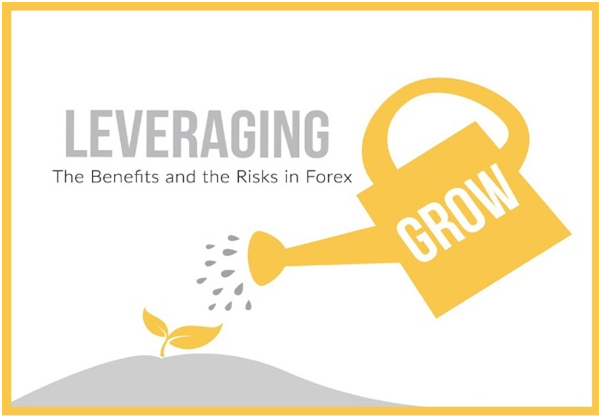
Leverage is often viewed negatively despite the fact that it doesn’t affect trading performance. However, the issue with leverage is the expectations it creates since it lets traders start with a smaller account. Traders who usually think forex trading will get them rich quickly often don’t follow a comprehensive trading plan, and hence tend to use higher leverage. And when high leverage is combined with a lack of a plan and proper risk management, disaster usually follows. Used the right way, however, leverage can be a great tool for growing a trading account rather quickly.

Myth 3 : Trading is Like Gambling

A rather popular forex myth is the idea that trading forex is identical to what gamblers might do at a casino. While forex trading certainly has speculative aspects to it, since it involves putting capital at risk, it also has a more strategic aspect to it that distinguishes it from gambling. Also, the odds of winning as a forex trader can be considerably improved by using well established market analysis methods like technical and fundamental analysis, so it pays to become well versed in these techniques.

Another important way to improve your chances as a forex trader involves using sound money management practices like sizing positions appropriately for your account size and allowing profits to run substantially while cutting losses quickly. Most losing traders approach the market the way most gamblers approach a casino. Basically, while you can indeed blindly take bets within the forex market just like a novice gambler, if you really want to become a successful forex trader, you will want to learn to take strategic risks instead of blind ones.

Myth 4 : Use day trading to make money

Traders tend to gravitate toward day trading for several reasons. Day trading allows a trader to execute more trades, which logic suggests should allow profits to stack up quickly. Because most traders use quite a bit of leverage, they are reluctant to hold their positions overnight due to the increased risk of doing so.

The truth is that day trading may not be right for everyone. Day trading requires a different skillset and a different personality type from swing trading, longer-term momentum trading and investing. Day traders must be able to focus for extended periods of time and make decisions on the fly. They also need to be able to sit through quiet and frustrating periods without letting emotion get the better of them.

If you are more of an analytical or strategic trader, you may be better suited to longer time frames. The fact that you can execute more trades will not help if you are not trading the strategy that is right for you.

Myth 5 : “Only professionals can succeed in trading”

This point is the easiest one to demythologize – just look at hundreds of success stories featuring average people who started with no financial knowledge whatsoever. After all, a bright 7-Eleven salesperson can trade better than someone with a degree in economics can. However, it doesn’t mean you don’t need to learn how things work on Forex. You can ENTER the market as an amateur, but you definitely need to learn and practice if you want to SUCCEED.

Myth 6 : “If you have extra money, you’d better keep it in a bank instead of investing it”

It depends on what scares you have like losing money and never getting a chance to be the boss of your life.

Forex is a complicated investment opportunity, but storing your money in a bank is not even an investment. Technically, investment is oriented toward future returns, and thus entails some degree of risk.

Myth 7 : You Need an Economics or Finance Degree to Trade Forex

If you have ever worked in or visited a professional foreign exchange trading floor, even at the most prestigious financial institutions, then you will already know that this myth is not entirely true. Perhaps one of the more interesting facts of trading currencies is that many professional practitioners do not necessarily have advanced degrees related to this field.

Furthermore, trading currencies seems to be something that even a bright person working in a humble position at a farmer’s market or at a bookie may actually be much better at than a highly analytical person with a PhD in economics from one of the world’s top universities.

Myth 8 : Forex Traders Have to Watch Their Computer Screens All the Time

Virtually no trader can reasonably be expected to watch a market around the clock. Common forex trading misconceptions like this one probably arose due to the fact that the forex market trades on a 24 hour basis from the Auckland, New Zealand open on Sunday afternoon until the New York Close on Friday afternoon.

Most professional forex traders cope with the forex market’s round the clock opening hours by either closing positions out at the end of their trading day or Furthermore, Just placing an order the trader who hold the positions on overnight will simply leave take profit and stop loss orders with their online forex brokers to execute if the market reaches their specified levels. Some retail traders also use an alert service on their mobile devices to let them know when their watched exchange rate levels are approaching or have traded. As a retail trader, if you are going to use bracket orders to manage your existing forex positions, you do not need to constantly watch the market. You can also automate your trade plan’s market analysis procedure to identify trading opportunities for you so that you do not even need to monitor the market yourself for such potentially profitable situations, and can simply monitor your system’s alerts. Some traders prefer to fully automate their trading plans or use forex trading systems that trade without human intervention.

Myth 9 : “Market fluctuations are random and impossible to predict”

It might look so if you look at a certain chart displaying some short-term situation. However, if you take a closer look, you’ll see that the exchange rates move in trends, and these trends are not random at all.

Technical analysis tools will help you analyze the situation, spot the trend, and trade along with it to benefit from it in the end. Obviously, the global economy is too complicated and heavily influenced by multiple factors, which makes it impossible to make correct predictions in 100% of cases. On the other hand, the only thing that matters is whether your trading efforts were beneficial to your bottom line.

Myth 10 : Being unconventional improves your chances of success

Being conventional or unconventional does not have much to do with a person’s chances of success trading forex as much as one’s understanding of the FX market, its drivers and the factors that influence foreign exchange rates. Rather than trying to be unconventional, good traders learn and adapt to the changes in the market, which improves their chances of success.

Conclusion:

To succeed in any financial market, one needs a logical and well-researched approach. This superstitions only create room for errors and subsequent losses. Overall, using foreign exchange as a component of your overall investment portfolio, or to manage the ebbs and flows of running a global operation, can be a strategic way to diversify your assets, but staying informed is critical. Winstone Prime provides comprehensive market news on all the major currency pairs daily and weekly.

“Trade wisely with the help of facts, not myths”.

How to make money with Forex Swaps

Introduction

Holding a position depends on your trading strategy and plan. Swing traders might hold a position for days or even weeks, while scalpers might hold it for a few minutes. When holding a position, the price of the currency pair you’re trading isn’t the only price you need to watch; you should also be aware of the swap or funding charge. When traders open a margin account, they reach some sort of agreement with their Forex broker: they will borrow funds from it and when trading is done, return it.

But, it’s not like such loans come without additional requirements. Here is where the swap meaning in Forex comes in.

Definition of Swap Charges

Swap is an interest fee that is either paid or charged to you at the end of each trading day. Swap are paid or charged either in pips or points. When trading on margin, you receive interest on your long positions, while paying interest on short positions. The net interest difference is known as the carry and traders seeking to profit from this are known as carry traders.

Positive carry results when you receive more in interest than you are required to pay, and is added directly to your account. If the carry is negative, it is subtracted from your account. If you open and close a trade within the same day, the trade has no interest implications.

Example of Swap charges

Let’s take a quick example of how the actual loan work and how it is similar to margin trading. Let’s imagine you want to borrow $5,000 from your bank. You go there and talk to the loan officer, who tells you that the interest rate for your loan will be 2%.

So, you get the loan and start paying it monthly. Let’s say you made the application for a year, which means you have to pay a monthly fee 12 times. You would imagine that the payment must be around $417 per month (5,000/12) and you should return that $5,000 back to the bank. However, that is not how the financial system works. Because you borrowed funds from the bank, which means it gave you $5,000 from its budget, you also need to pay for the service. So, not only should you bring $5,000 back, you also have to put additional interest on top of that. Because the interest rate was 2%, this means that you’ll be returning $5,100 to the bank, where those 100 US dollars will be a service payment. So, that’s basically how swaps work in Forex margin trading. Forex brokers can be considered as banks and traders as borrowers. Swaps are interest rates for leveraged funds.

Types of Swaps

Forex swap is not actually a physical swap. Instead, a swap in Forex is an interest fee which needs to either be paid in or will be charged (added) to your account when the day’s trading comes to an end. So you will either be paid out at the end of the day or you will have to pay in.

There are two types of swaps. The first swap is a long swap. This relates to keeping long positions open overnight. With the long swap, you will likely earn interest on your positions. The other type of swap is a short swap. This one keeps short positions overnight. As you will earn interest on the long positions, you will have to pay interest when you have a short position.

How and When Swap is charged

Based on the fact that the procedure for exchanging a financial asset or liability is carried out in two stages, as we managed to notice earlier, at the last stage, the swap transaction will be closed. True, with one clarification – only if the transaction is not made on one trading day, but is postponed to the next day. That is when making a buyback, let’s say currency, the next day a swap occurs.

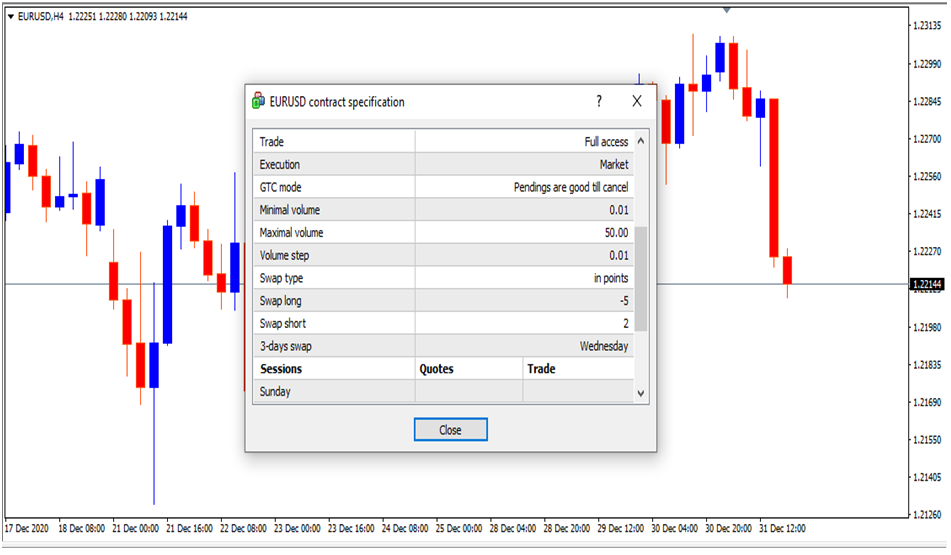
The exact moment at which the swap is charged to your trading account will depend on your broker. For most brokers, it is charged at around midnight, most commonly between 23:00 – 00:00 server time. Something which is not always known, is that sometimes the swap will be charged for maintaining a position over the weekend, even when it is not held over the weekend. To compensate for the fact that the markets are closed over the weekend, the weekend swap is charged on either Fridays or Wednesdays, depending on the specific market. Swap charges might change day to day.

In other words, if you hold your position overnight on the day that weekend swaps are applied, three times the normal swap will be charged on your trade.

To confirm when exactly your broker makes a swap charge on your trading account and on which day 3 days swap are charges, it is best to either look at the contract specifications for the instrument you are trading, or to ask your broker directly. 

Scalpers and intraday traders, working exclusively within the same trading day, do not encounter this concept at all. The topic concerns only those who prefer to hold trading positions for a day or more.

Can you avoid paying a swap Charges?

Losing money is the last thing any trader wants to have to deal with, but with Forex trading, it can happen every close of day if you are consistently having to pay in the difference. Luckily, this can be completely avoided.

Yes you can avoid Swap charges in two ways.

  • Close your position before the end of day. All trade closes at a certain time and once it is closed, you won’t earn interest but you also won’t have to pay in any money.
  • Only trade in a positive interest. This can be easier said than done, especially if you are new to the process and not quite sure about how to only place beneficial trades.


How can make money from swap in Forex trading?

If you’re interested in placing a carry trade, the first step is finding a high yielding and low yielding forex currency pair. Some examples of low yielding (or funding currencies) are the Japanese Yen (JPY), the Swiss Franc (CHF) and the Euro (EUR). As far as high yielding currencies go, the Dollar (AUD) and New Zealand Dollar (NZD) are popular, though more advanced carry traders might look to the South African Rand (ZAR) or other exotic currencies.

Let’s use the Euro and Dollar: rates in the Eurozone are currently below 0, whilst interest rates in are relatively higher, currently 2%. This means that there is an opportunity to earn carry buying AUD with EUR ie going short EURAUD.

Great, simple right?

Sadly it’s not that easy – there is no point earning a pip a day in swap if the pair is moving against you 100 pips / week. That is, if we wanted to perform a carry trade on EURAUD, we would wait until the pair was trending down, sell into any strength and hold for the length of the down trend. Think of swap as an added bonus or incentive for holding a trade long term (or in the case of negative swap, a deterrent).

Want to trade with the best swaps ? Open a Winstone Prime live account today.

Happy Trading!!

How to treat trade like a business

One of the biggest mistakes many forex traders make is that they do not consider forex trading as a business. On the contrary, they consider them gambling addicts rather than quiet and counting merchants. If you want to succeed as a forex trader, you have to think of it as a serious business because it is actually a very serious business.

Forex trading should be treated as a serious business. To be a successful forex trader, it is important that you consider trading as a business. It is not possible for you to keep 50 in one business and convert it to £ 20,000 in the short term. You should apply the same principle to forex trading. One of the biggest reasons traders lose money is the expectation that a small amount will turn into a huge profit at a very low point.

There are costs to being a forex trader like any other business. Your goal as an entrepreneur is to bring in more money (all successful trades) through revenue than you spend on exit. If you can do this, you will make a profit. However, if you allow your expenses (all losing trades) to get out of control, you will eventually lose money and your trading business will go under (and one day your trading account will explode)

Before Enter into the trade

Here is a review of the steps you should take to start your Forex business:

  • Make a business plan.
  • Choose regulated and reliable broker.
  • Available capital for trading & Your trading Goals
  • Practice on a demo account and find suitable and profitable strategies.
  • Start trading with small amounts until you are consistently profitable with real money.
  • Gradually increase your trading size and the time you spend with trading.
  • Always evaluate your performance and try to improve your trading.
  • Find a method that gives you an edge over the market.


Last, not least, get informed to stay ahead of the crowds: this one is very important because like any other business once you become profitable the education does not stop there. The markets are changing and evolving all the time and like all good businesses, you must move with the times. Continually seeking further education and market knowledge will help you stay ahead of any changes to the market.

As we mentioned above, you will have to make sure your winning trades are more than offsetting all your trading costs if you want to be a profitable trader. So, there are basically two ways to accomplish this:

1) Aim to have winning trades that are significantly larger than your losing trades.

or

2) Have a very high percentage of winning trades compared to losing trades

Make a Good trading plan

A trading plan is a comprehensive decision-making tool for your trading activity. It helps you decide what, when and how much to trade. A trading plan should be your own, personal plan – you could use someone else’s plan as an outline but remember that someone else’s attitude towards risk and available capital could be vastly different to yours.

For making a good trading plan for business you will need the following –

  • Discipline
  • Steps for record keeping
  •  Fibonacci levels
  • Supply and Demand Levels
  • Chart Patterns
  • Trending Lines
  • Best Money Management


Conclusion

Not every trader can dedicate enough time to treat trading like a full-time job, but whatever proportion of your life you do give over to trading should be taken seriously. In order to treat your Forex trading like a business, you will need to account for all your costs. Your successful trades not only have to outweigh your unsuccessful ones – and there will be plenty of those over a long enough period of time – but they also have to cover your expenses.

Trading requires hard work: treat trading like a serious business and it will reward you accordingly.

Happy Trading!!

ABCs of leverage in the Forex trading

Trading the forex markets is attractive for several reasons and one of the most important features is leverage. Investors love the idea that they can borrow capital to enhance their returns, at levels that are not available in other capital markets. Whether you are a newbie trader on the Forex market or have solid experience, you have certainly already encountered the concept of leverage. Trading on leverage can significantly increase your profit margins without having to put down a massive initial capital.

But first, you need to know what you’re doing. As Warren Buffett famously said, “When you combine ignorance and leverage, you get some pretty interesting results.” In this article, we will take a closer look at ABCs of leverage in trading, how it works, and how you can use it as part of your trading strategy.

Definition of Leverage

Leverage-2

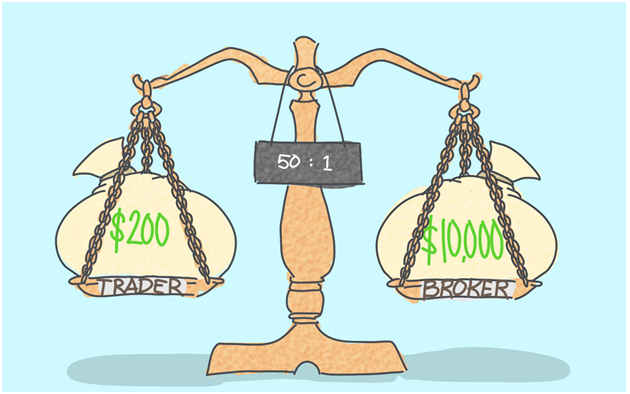
Leverage is the force in trading that enables traders to take exposure to artificially amplified transaction sizes, in order to make more money from each individual transaction. Leverage gives traders the possibility to use borrowed funds to purchase an investment tool. When trading on Forex, borrowed funds are provided by a forex broker. The availability of large leverage on Forex allows traders to manage significant amounts in the market, having just a small part of funds coming from their own deposit used to cover margin requirements. To calculate the leverage amount, you need to divide the overall amount of the transaction by the required amount of margin.

Leverage = 1/Margin = 100/Margin Percentage

Example: If the margin is 0.02, then the margin percentage is 2%, and the leverage = 1/0.02 = 100/2 = 50.

The amount of credit funds available to the forex trader is estimated by the margin requirements of the specific broker. Margin requirements are mostly expressed as a percentage, and leverage is written as a ratio. For instance, the margin requirements of a broker are 2%. This means that to open a position, the amount of the client’s available funds must be at least 2% of the total transaction amount. In this case, the leverage is 1:50. The use of 1:50 leverage lets the trader to operate on the market $ 50,000, having only $ 1,000 in his trading account. For such a leverage, a 2% movement of the trading instrument on the market will either result in total loss of funds or double the account.

How Leverage works

Some of the leverage levels offered by Forex Brokers are 1:25, 1:50, 1:100, 1:200, 1:300, 1:400 and 1:500. If we have a leverage of 1:500, then our initial margin will be 500 times smaller than the contract size. Here’s an example of how leverage works: Suppose a trader’s trading capital is $1,000 and trades at 1:500 leverage. According to his leverage, his trading capital has increased by 500 times, which means he has 500,000 (1,000 x 500) to trade with.

For example, the current exchange rate for the EUR/USD pair is 1.1150, and we want to open 1 lot position (100,000 units) which will be 1.1150*100,000 = 111,500 . If our leverage is 1:500, then the margin required for such orders will be $111,500/ 500 = $223. If the trader wants to open a mini lot position (10,000 units) which will be 10,000*1.1150 = 11,150, then such options are required margin will be  11,150 / 500 = $22.3.

What Leverage Ratio is Good for a Beginner?

Let’s figure out what is the best leverage level for a beginner. Many newbies are attracted to the leverage-based earning strategy as they want to make more money in a short period of time.

However, remember that leverage is associated with certain risks. You need to at least understand the concepts that are directly related to money management in leveraged trading, such as:

  • Balance and Equity of your account;
  • Margin;
  • Free margin;
  • Account Level;
  • Margin Call and Stop Out.


As a new trader, you should consider limiting your leverage to a maximum of 10:1. Or to be really safe, 1:1. Trading with too high a leverage ratio is one of the most common errors made by new forex traders. Until you become more experienced, we strongly recommend that you trade with a lower ratio.

Advantages and Risks of using Leverage

ABC3

First, let’s take a look at the advantages and risks of leverage for a forex trader:

Advantages of Leverage

There are several reasons why brokers offer leverage. Leverage is offered in many instances of capital markets trading, but forex leverage is generally much higher than any other trading vehicle. The leverage that is offered for US equities is approximately 1.5 times the value of the Currency. So your margin is at most 50% the notional value of the trade.

Forex leverage can reach levels up to 500:1. Brokers are comfortable offering this type of leverage for several reasons.

1.   Increases forex trading profits

The basic advantage of trading forex with leverages is that it gives forex traders the ability to trade forex while making a whole lot of profits in return. Leverage provides a greater yield of returns with minimal efforts. Since a leverage has no bounds in the type of financial asset being traded, it provides a medium where traders yield profits by just staking a minimum initial deposit. Leverages offer traders the opportunity to double their initial trading amount used as trade setup in just minutes. When dealing with a long-term investment, leverages which are borrowed funds is always a stepping stone to boosting all available capitals when properly managed. For example, a forex trader who just has a deposit amount of one thousand dollars in his/her account can actually trade forex with fifty thousand dollars with the help of leverages.

2.   Upsurges capital efficiency

Leverage have in the long run proven to not only increase profits but also increase capital efficiency. When trading forex with leverages (borrowed funds), if it originally took a forex trader a maximum of two months to generate profits and returns with personal funds, a broker’s leverage can get the same trader to make double profits in a shorter period of time thereby increasing capital efficiency. This simply signifies that a forex trader’s capital or funds can be re-invested on several occasions in future transactions thereby yielding more returns and profits. With this, we can say that leverages not only provides greater profits in a short trading period but also generate a considerable amount of return over a short period of time.

3.   Remedy against low volatility

One major advantage of forex trading leverage when it comes to trading forex is that is has proven to be a high remedy against low volatility. Volatile forex trades are seen as those that yield greater profits because the market situation of these assets is more dynamic than the market of other instruments. Due to the careful nature of forex traders when trading currencies and factors that cause price fluctuations, the forex market experiences low volatility at these points in time. This is where forex leverages come in. leverages have the ability to counter the effects of low volatility simply by generating greater profits from smaller trade transaction sizes. When trading with high leverages, a small movement in prices can become significantly important where forex traders can give more attention to less significant degrees of price movements.

Risks on Trading with leverage

Since leverage grants the forex trader to trade with volumes that you do not presently have in your account, it can also act as a double-edged sword. Forex trading using leverage can cause a lot of damage to a trade and the account of a trader in general. Although leverages come alongside a reasonable amount of profits, the losses incurred are as great. After bearing losses in percentages, leverage ends up costing a lot more damage than you actually bargained for since it entails playing with more money.

For example, a 0.1 percent loss on a twenty thousand dollar trade using the 100:1 on each trade cost more than you can imagine. As it is possible to gain much further than his initial investment, losses can happen in the same way.

It is crucial to keep track of open positions and apply stop loss and other market orders in order to prevent large scale losses. For this reason no matter how much of an expert you are in Leverage trading. It is always best to use trustworthy crypto Forex trading platforms like Winstone Prime in order to make your trading safer and more accurate. And also make sure you have a good understanding of forex money management, so you can continue trading for years to come.

Conclusion

Leverage is a virtual currency borrowed by a trader from a broker to maximize the balance of a trade. When leverages are working in our favor, it is really good for us and produces higher profits, but when it opposes our interests, it can cause huge losses. Therefore, you should be cautious before using leverage in Forex trading.