How to Choose the Best Forex Affiliate Program

Did you know? You can make money on Forex not only by means of trading different financial assets? There is such a thing known as  Forex affiliate programs, and it’s been gaining popularity recently due to almost unlimited income, full or partial automation of the process, and fast results. Forex affiliate programs can serve as a second income or even turn into an extremely lucrative full-time business. All it takes is a little effort and time. One of the ways to obtain extra income in the Forex market is participation in forex affiliate programs. The core of this partnership for a partner is attracting customers/traders, and for a brokerage company/dealing center–payment of commission to partner’s affiliate account for trading activities of engaged traders.  Indeed, with a properly built referral system, you can earn over $1,000 per month (experienced partners can make tens of thousands of dollars).

In this article, you will learn how to choose the best Forex affiliate, what aspects to pay attention to while looking for a broker to work with, and much more.

Choosing the Best Forex Affiliate:

There are several parameters to take into account when it comes to the choice of a forex affiliate network to join. Over and above the number and size of the different brokers a network might have access to, you need to look at the elements vital to your relationship with the actual network as well. The key points to consider are:

Reliability and Security

Does the forex affiliate network have a good reputation for reliability and security? Do they support their forex affiliates? Are their systems secured? We’re talking about a lot of data and information here, and your referral data being at risk, or even your personal information.

The problem is you can’t just take things at face value. Luckily for you as an affiliate, there are plenty of resources you can use to check the reputation of the network you’re considering. Affiliate forums are a great place to start. Most forums will have rating sections with information about network performance.

One of the most important factors to take into consideration is the network’s reliability. After all, the reason you became an affiliate was to make commissions, right? If the forex affiliate network you’re working with doesn’t track your referrals accurately or doesn’t make payments on time, this will have an impact on your business. As an affiliate, you invest time and energy, and in the case of paid traffic, money.

The only way the relationship works is to sign up with a reliable forex affiliate network.

How Affiliate programs work

Affiliate programs work whereby an affiliate refers clients to a forex broker’s website in return for financial rewards. This is usually done through recommendations, banners, links, content and other types of marketing collateral. The referral works when a potential trader clicks on a link or a banner provided by an affiliate who proceeds to register and trade with the broker. That trader is then flagged as a client of the referring forex affiliate. When the client funds his account and starts trading, affiliates will start receiving commissions into their account for the client’s trading activities.

Becoming an affiliate for a forex broker is a straightforward procedure involving an agreement defining the partnership and commission terms. Forex brokers will provide affiliates with access to a dashboard on their website or personal cabinet where they can access statistics and reports such as commissions, conversion rates, top performing ads, client lists, trading activity and deposits. A broker will also provide a personal affiliate account manager to assist with an affiliate’s requirements. Check winstone prime affiliate page.

Affiliate Network Software

One of the first things successful affiliates look at is the software a forex affiliate network is using. A reliable solution should be able to track all your traffic and leads, from acquisition through the marketing funnel, to a conversion. You should be able to have an at-a-glance look at all your marketing efforts with the ability to drill-down into detailed and specific information.

First of all, the affiliate software has to be easy to use. Setting up the parameters of your campaigns needs to be easy. Different brokers will have different settings for their offers. Some will have CPA (Cost Per Action) payouts, and some will specify CPL (Cost Per Lead) payouts for forex affiliate. Different brokers will have different qualifying requirements for payouts. If you can’t get all the information you need, making an educated choice becomes challenging to do. The more information you can get from the network’s software, the more informed will be your decisions and, ultimately, your earnings will improve.

Tracking is one of the critical components of any profitable affiliate campaign. If you don’t track all your marketing, then there is no way of knowing which of your campaigns are making money and which ones are losing money. Even if all your campaigns are profitable, some will be making more money than others. The best way to maximize your affiliate earnings is to scale your most profitable campaigns. If your network software can’t give you all the details you need to make the best choices for your campaigns, then your overall results will suffer.

If you’re using your tracking domains (and you should) on a separate tracking solution (and again, you should) then to best track your marketing results and affiliate earnings, you must be able to use S2S tracking (Server to Server), also known as Postback tracking. S2S is an extremely accurate and reliable way to track your campaigns since all the tracking and conversion data takes place on the network’s server. It can be quite complicated to set up, though, but it is the most accurate way to track affiliate marketing. Does your forex affiliate network use S2S? Winstone Prime do.

Beyond tracking, however, the software your network uses has to have several other features. Reporting, for example, and Real-Time Updates. Affiliate marketing is a fast-paced and fast-moving world. Reporting plays a massive part in your success, and if you can’t generate the right kind of report, staying ahead of the game will be difficult.

At Winstone Prime, we give all our affiliates access to in-depth reporting. If you can imagine it, you can probably generate a report for it!

Earning Potential

The commission offered to forex affiliates has become very competitive amongst forex brokers due to the popularity of affiliate marketing. There are many different programs to choose from and plenty of opportunities to earn money.

Affiliate schemes are ideal for those looking to broaden their online business and enhance their earning potential from tapping into the forex industry. The industry has soared in recent years, becoming a very popular and potentially lucrative niche amongst traders. With $5 trillion trading volume per day, it is clear how many affiliate marketers generate a good income from online affiliation with best forex brokers.

Withdrawals

OK, you’ve run some fantastic campaigns, had a load of conversions, and now it’s payout time. Is it going to be easy to get paid by your forex affiliate network? You can never overrate the importance of reliable payment methods. You might have based your choice of affiliate network on the range of brokers, offer types, and payouts, but the overall statistics paint a different story.

41% of affiliates who stopped working with a network said payment issues were the main reason.

These are the main factors affiliates look for in network payments:

  • Time to receive payments
  • Withdrawal fees
  • Straightforward verification process
  • The popularity of payment methods


We pay our affiliates four time a month. Yes, make sales, and you’ll get paid every week. We appreciate and value your efforts for us, and the last thing we will do is make your payments without any delay. Sign up with Winstone Prime, and your commissions will be right there for you every week!

We compensate the withdrawal fees. If you choose to be paid by Neteller, then the even the charges levied by Neteller will be compensated in your account

Verification is easy. You need to upload a copy of a photo ID and proof of address. Simple

Withdrawal methods we support:

  • Bank Transfer
  • eWallets


We make it easy for you to promote great brands, and we make it easy to get your money at the end of the day (or week to be exact!).

Choosing a forex affiliate network to work with is the starting point for your affiliate business. You might have great traffic sources and be able to generate amazing campaigns. If your network lets you down, though, all your efforts will come to pretty much nothing.

We’re always available for a chat, so why not reach out to us and see what we have to offer? We’d love to hear from you!

Click here to join Winstone Prime Affiliate program.

Day trading and Forex Market

As a day trader, you can be your own boss. You can trade from home, from an office or even while travelling. Day trading can be practiced in any market, but is most frequently applied to the Forex, stock and index markets. If you are good at it, day trading can be very lucrative. You can generate an income or grow capital with a relatively small account. It can be very exciting too if you have the right temperament. And that’s the secret to day trading – it suits a certain type of personality. 

In this article, we discuss about day trading and some key things to remember before we start it.

Day Trading Definition?         

Day trading is a trading strategy that involves opening and closing positions within the same day. Day traders tend to have no positions held overnight, opting instead to close their positions each evening, and reopen positions the following day. Day trading is a short-term strategy that intends to profit from small, intraday fluctuations in price, instead of longer-term market movements.

The meaning of day trading is in direct contrast to traditional investing techniques of buying low, holding, and then selling high. Day traders therefore have to think differently from investors, focusing on an asset’s price action rather than its long-term potential. This is why day trading strategies are usually based on vast amounts of technical analysis, and require the trader to remain up to date with breaking news that might cause market fluctuations.

Day trading usually refers to the practice of purchasing and selling a security within a single trading day. While it can occur in any marketplace, it is most common in the foreign exchange (forex) and stock markets. Day traders are typically well-educated and well-funded. They use high amounts of leverage and short-term trading strategies to capitalize on small price movements that occur in highly liquid stocks or currencies.

Day traders are attuned to events that cause short-term market moves. Trading based on the news is a popular technique. Scheduled announcements such as economic statistics, corporate earnings, or interest rates are subject to market expectations and market psychology. Markets react when those expectations are not met or are exceeded–usually with sudden, significant moves–which can greatly benefit day traders.

Day traders use numerous intraday strategies. These strategies include:

  • Scalping: this strategy attempts to make numerous small profits on small prices changes throughout the day
  • Range trading: this strategy primarily uses support and resistance levels to determine buy and sell decisions.
  • News-based trading: this strategy typically seizes trading opportunities from the heightened volatility around news events
  • High-frequency trading(HFT): these strategies use sophisticated algorithms to exploit small or short-term market inefficiencies.

To get started you should begin learning about markets and strategies. Read as much as you can about different markets and start following them on a day-to-day basis. At the same time, you can start reading more about the different trading strategies  as mentioned below. While a strategy can potentially have many components and can be analyzed for profitability in various ways, a strategy is often ranked based on its win-rate and risk/reward ratio.

1.  Win Rate Ratio

Your win rate represents the number of trades you win out a given total number of trades. Say you win 55 out of 100 trades, your win rate is 55 percent. While it isn’t required, having a win rate above 50 percent is ideal for most day traders, and 55 percent is acceptable and attainable.

2. Risk/Reward Ratio

Risk/reward signifies how much capital is being risked to attain a certain profit. Making more on winning trades is also a strategic component for which many forex day traders strive. A higher win rate for trades means more flexibility with your risk/reward, and a high risk/reward means your win rate can be lower and you’d still be profitable.         

3. Hypothetical View

Assume a trader has $5,000 in capital funds, and they have a decent win rate of 55% on their trades. They risk only 1% of their capital or $50 per trade. This is accomplished by using a stop-loss order. For this scenario, a stop-loss order is placed 5 pips away from the trade entry price, and a target is placed 8 pips away.

This means that the potential reward for each trade is 1.6 times greater than the risk (8 pips divided by 5 pips). Remember, you want winners to be bigger than losers. While trading a forex pair for two hours during an active time of day it’s usually possible to make about five round turn trades (round turn includes entry and exit) using the above parameters. If there are 20 trading days in a month, the trader is making 100 trades, on average, in a month.

4. Trading Currency Pairs

If you’re day trading a currency pair like the USD/CAD, you can risk $50 on each trade, and each pip of movement is worth $10 with a standard lot (100,000 units worth of currency).

Therefore you can take a position of one standard lot with a 5-pip stop-loss order, which will keep the risk of loss to $50 on the trade. That also means a winning trade is worth $80 (8 pips x $10).

This estimate can show how much a forex day trader could make in a month by executing 100 trades:

  • 55 trades were profitable: 55 x $80 = $4,400
  • 45 trades were losers: 45 x ($50) = ($2,250)


Gross profit is $4,400 – $2,250 = $2,150 if no commissions (win rate would likely be lower though)

Net profit is $2,150 – $500 = $1, 650 if using a commission broker (win rate would be like be higher though)

Assuming a net profit of $1,650, the return on the account for the month is 33 percent ($1,650 divided by $5,000). This may seem very high, and it is a very good return. See Refinements below to see how this return may be affected.

5. Slippage Larger Than Expected Loss

It won’t always be possible to find five good day trades each day, especially when the market is moving very slowly for extended periods.

Slippage is an inevitable part of trading. It results in a larger loss than expected, even when using a stop-loss order. It’s common in very fast-moving markets.

To account for slippage in the calculation of your potential profit, reduce the net profit by 10% (this is a high estimate for slippage, assuming you avoid holding through major economic data releases). This would reduce the net profit potential generated by your $5,000 trading capital to $1,485 per month.

You can adjust the scenario above based on your typical stop loss and target, capital, slippage, win rate, position size, and commission parameters.

As mentioned, having a sound trading plan is essential for success in trading. An adequate trading plan is more than just a strategy, it also specifies risk management measures and a trading schedule. The level of volatility can differ greatly during various trading sessions and on certain times of the day. It is important to know what the characteristics of the times and sessions during which you trade are and to adapt your strategy accordingly.

Some useful guidelines to help you figure out the best time to trade intraday:

  • Monday is a quiet day in the markets. Day trading requires sufficient price movement over a short period of time. If the trading volume is low there may not be enough price movement to execute said trading strategies. Furthermore, the lack of liquidity can lead to sharp movements.
  • Opening of the London trading session is generally a favorable time for short term trading as we usually see a lot of activity during this time period.
  • The last hour of trading (in the London session) often showcases how strong a trend actually is. How the trading day ends is believed to be indicative for continuation of the current move. It is thought to be likely that the after a breakout to the upside will end when it is followed by a low closing price and vice versa for a bearish trend.
  • Most day traders have brief days, working two to five hours per day. Five hours is high. Add on a few minutes each day for preparation, and review at the end of the day and week, and day trading still isn’t very time-consuming.  You will have lots of time to focus on other interests.
  • Check the economic calendar, and make a note on your chart of when major events occur that day. Exit trades at least three minutes before a major economic event.


A breakout strategy can be used when a new maximum or minimum has been reached. Buy at the first pullback after a new high or sell at the first pullback after a new low.

  • Don’t trade on public holidays or late in the day on Fridays.
  • Don’t trade when the market has moved beyond a 20-30 pips range over the course of the day.
  • Sometimes not holding a position in the market is as good as holding a profitable position.
  • The first hour’s range is used as a benchmark for the range in which the price will move throughout the rest of the trading day.


How frequently you trade is dictated by your trading strategy. Let’s say your chosen strategy has a win ratio of around 60%. If you don’t trade setups that meet your rules you are more likely to miss out on winning trades (60%) than losing trades (40%). Be consistent and trade the opportunities that meet your rules, the aforementioned guidelines will help you identify the most favorable times for trading.

Pros of day trading

Day traders can speculate on a variety of markets, including stocks, forex, commodities and futures. Shares are particularly popular, because closing positions at the end of each trading day removes the risk of markets gapping overnight.

In the past, day trading was only carried out by large investment firms. However, the rise of trading technology and increased prominence of margin trading – which amplifies both profits and losses – has made day trading more popular in recent years. Derivative products such as CFDs enable day traders to capitalize on markets that are making negative price moves as well as positive ones.

Cons of day trading

Day trading is not for the part-time trader. It requires focus and dedication, as it involves making fast decisions and executing a large number of trades in a single day. Day traders don’t necessarily need to trade all day, but do need to remain vigilant and stay ahead of the markets.

Day traders can be limited by the costs involved. For example, if you buy and sell shares you will pay a commission fee. As with all types of trading, day trading involves market risk that can be substantial when leveraged instruments are used.

Conclusion

Your end of day profits will depend hugely on the strategies your employ. Most day traders will admit that they love what they do, though. If you know your strategies well, not much will surprise you or get your adrenaline pumping…although the outcome of each trade is unknown when you take it. That does make it fun, but it should never be viewed as gambling.

Stay focused while you trade, but also review each week. Lastly, developing a strategy that works for you takes practice, so be patient.

Chart Pattern

Chart patterns are one of the most effective trading tools for a trader. They are pure price-action, and form on the basis of underlying buying and selling pressure. Chart patterns have a proven track-record, and traders use them to identify continuation or reversal signals, to open positions and identify price targets. As can be seen, these chart patterns might help you determine trend direction, but you should not rely solely on them.

Chart patterns are specific price formations on a chart that predict future price movements. As technical analysis is based on the assumption that history repeats itself, popular chart patterns have shown that a specific price movement is following a particular formation of price (chart pattern) with high probability.

 Types of chart patterns

Chart patterns fall broadly into three categories: continuation patterns, reversal patterns and bilateral patterns.

  • A continuation signals that an ongoing trend will continue
  • Reversal chart patterns indicate that a trend may be about to change direction
  • Bilateral chart patterns let traders know that the price could move either way – meaning the market is highly volatile.


Reversal Chart Patterns:

Reversal patterns are those chart formations that signal, that the ongoing trend is about to change course.

If a reversal chart pattern forms during an uptrend, it hints that the trend will reverse and that the price will head down soon.

1. Double Top

2. Double Bottom

3. Head and Shoulders

4. Inverse Head and Shoulders

5. Rising Wedge

6. Falling Wedge


Trend: Bearish

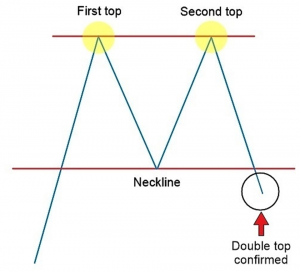
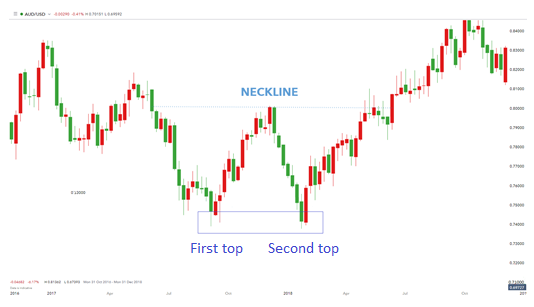
Powerful reversal patterns, double tops and bottoms reverse strong trends. As the name suggests, they mark a top or a bottom, with huge implications on the future price action.

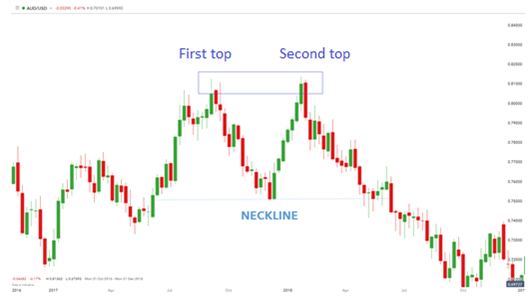
We should mention here that double tops and bottoms in Forex technical analysis do not refer to an exact level. Because of large market volatility, traders refer to an area as the one that defines double and triple tops.

In any case, the way to interpret the two patterns is the same as in any other market. A double top:

  • forms at the end of a bullish trend
  • resembles the letter M
  • has a neckline and a measured move

For a double top formation, the measured move is the distance from the two tops to the neckline, just as illustrated in the image below.

Find the Bearish candlestick chart below:


Trend: Bullish

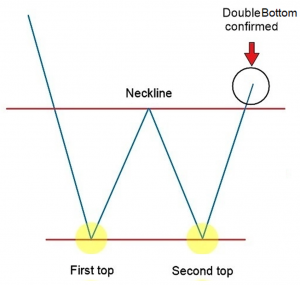
A double bottom is similar as Double Top, only that the interpretation differs:

  • it forms at the end of bearish trends
  • it has the shape of the letter W
  • has a neckline and a measured move

While not mandatory, the price tends to retest the neckline after the break. As such, many traders wait for such a retest before trading the measured move.

Find the Bullish candlestick chart below:


Trend: Bearish

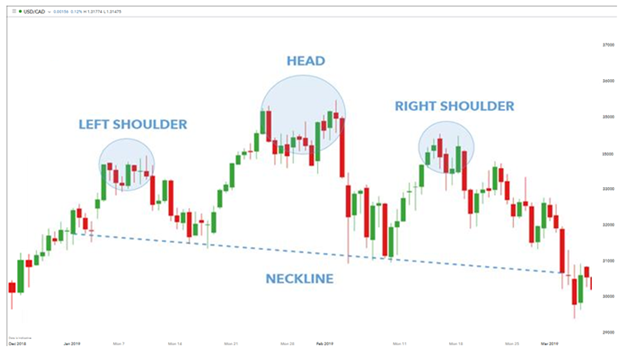
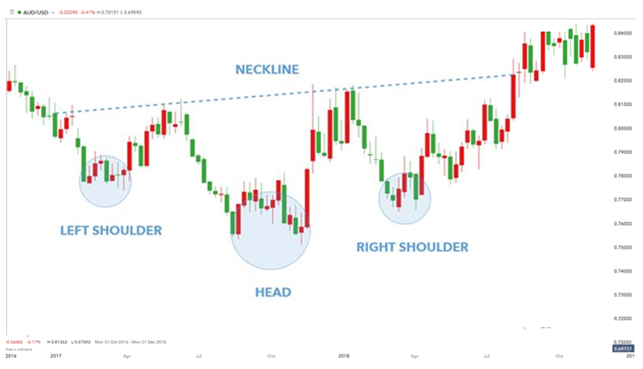
One of the most common reversal patterns seen on daily Forex analysis, the head and shoulders formation has clear and simple trading rules.

It has:

  • two shoulders (left and right)
  • one head
  • a neckline
  • a measured move

The two shoulders represent consolidation areas, with the left shoulder’s price action misleading traders. The problem is that by the time the price breaks higher after the left shoulder’s consolidation, many traders consider the pattern a continuation one.

However, the break higher is quickly retraced, and another consolidation (on the right shoulder) starts. The quick retracement, or the head of the pattern, is the clue telling us that the market forms a head and shoulders pattern.

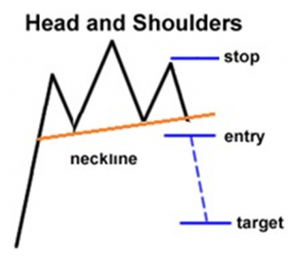
The neckline is a support level. Traders wait for the price to break below support, before entering on the short side and targeting the measured move.

Speaking of the measured move, that’s easy to compute: just measure the distance from the highest point in the head’s formation to the neckline and project it from the neckline. That’s the minimum distance the price should travel to confirm the reversal pattern.

As mentioned above, the head and shoulders pattern is a reversal one. Our example so far shows a bearish pattern, in the sense that it forms at the end of a bullish trend. 

Find the Bearish candlestick chart below:


Trend: Bullish

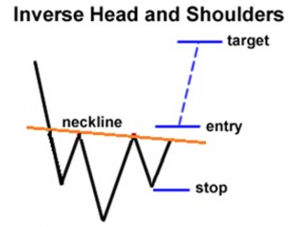
This pattern is the opposite of the popular head and shoulders pattern but is used to predict shifts in a downtrend rather than an uptrend. An inverse head and shoulders pattern is comprised of three component parts: After long bearish trends, the price falls to a trough and subsequently rises to form a peak.

Traditionally, you would trade the inverse head and shoulders by entering a long position when the price moves above the neckline. You would also place a stop-loss order (trade stop at a set point) just below the low point of the right shoulder.

Find the Bullish candlestick chart below:

Trend: Bearish

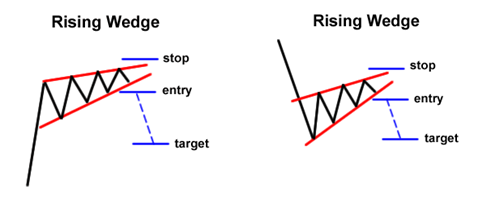
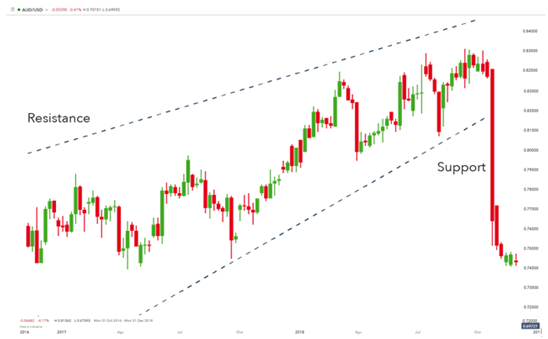
The Rising Wedge is a bearish pattern that begins wide at the bottom and contracts as prices move higher and the trading range narrows. In contrast to symmetrical triangles, which have no definitive slope and no bullish or bearish bias, rising wedges definitely slope up and have a bearish bias.

Note: Wedges can be considered either reversal or continuation patterns depending on the trend on which they form.

Find the Bearish candlestick chart below:

Trend: Bullish

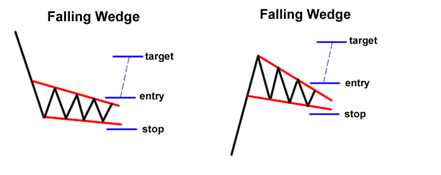
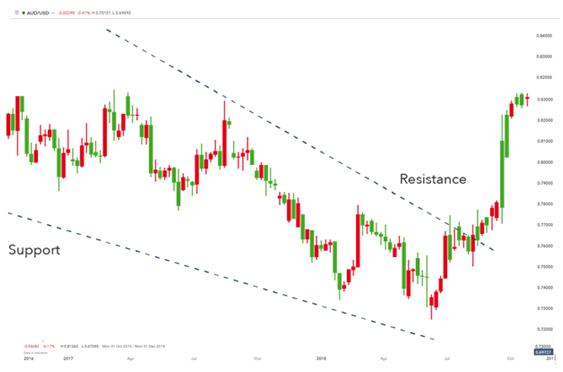
The Falling Wedge is a bullish pattern that begins wide at the top and contracts as prices move lower. This price action forms a cone that slopes down as the reaction highs and reaction lows converge.

If the falling wedge appears in a downtrend, it is considered a reversal pattern. It occurs when the price is making lower highs and lower lows which form two contracting lines. The falling wedge usually precedes a reversal to the upside, and this means that you can look for potential buying opportunities.

Find the Bullish candlestick chart below:

Continuation Chart Patterns:

These chart patterns are those chart formations that signal that the ongoing trend will resume.

  • Bullish Flag
  • Bearish Flag
  • Ascending Triangle
  • Descending Triangle


Trend: Bullish

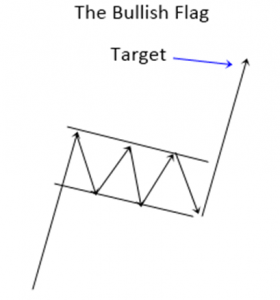
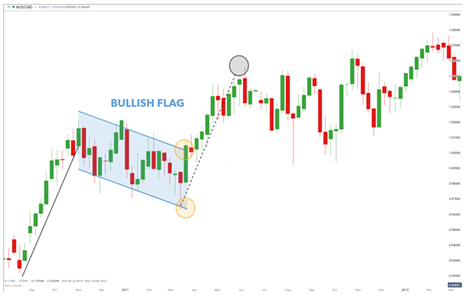
A bull flag pattern is a chart pattern that occurs when a stock is in a strong uptrend. It is called a flag pattern because when you see it on a chart it looks like a flag on a pole and since we are in an uptrend it is considered a bullish flag.

Find the Bullish candlestick chart below:


Trend: Bearish

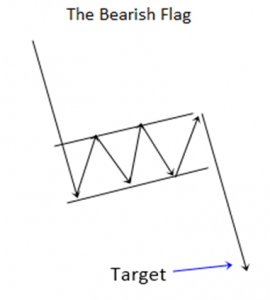
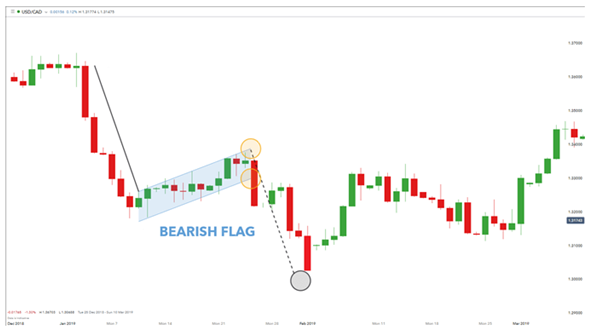
The bear flag is an upside-down version of the bull flat. It has the same structure as the bull flag but inverted. The flagpole forms on an almost vertical panic price drop as bulls get blindsided from the sellers, then a bounce that has parallel upper and lower trendlines, which form the flag.

Find the Bearish candlestick chart below:


Trend: Bullish

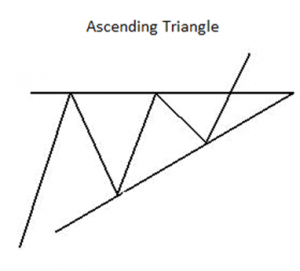
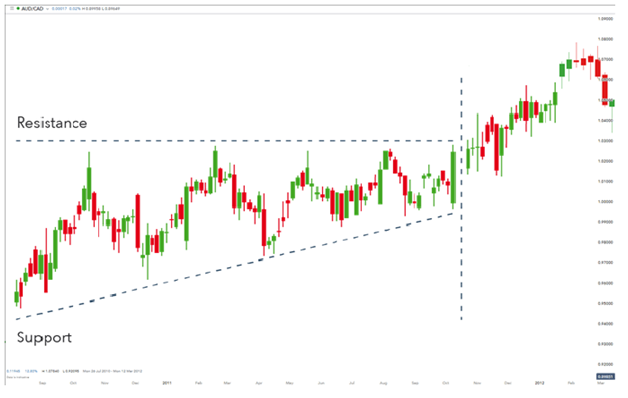
The ascending triangle is a bullish formation that usually forms during an uptrend as a continuation pattern. There are instances when ascending triangles form as reversal patterns at the end of a downtrend, but they are typically continuation patterns.

Find the Bullish candlestick chart below:


Trend: Bearish

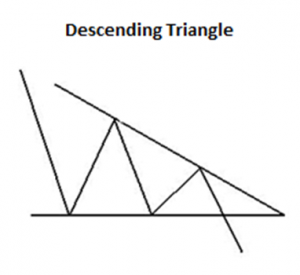
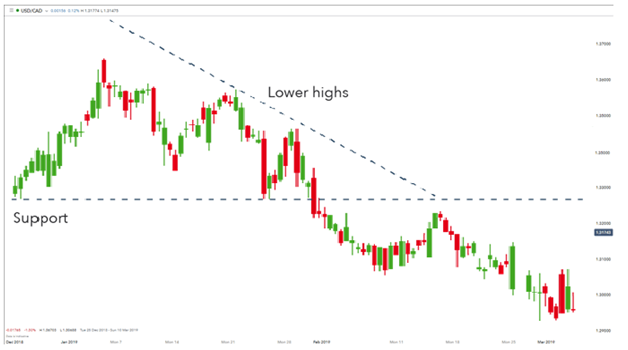
A descending triangle is a bearish chart pattern used in technical analysis that is created by drawing one trend line that connects a series of lower highs and a second horizontal trend line that connects a series of lows.

Find the Bearish candlestick chart below:

Bilateral Chart Patterns:

  • Pennant
  • Rectangle
  • Symmetric Triangle

Trend: Neutral(can be either bullish or bearish, and they can represent a continuation or a reversal)

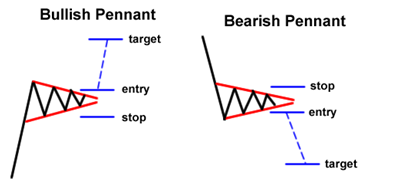
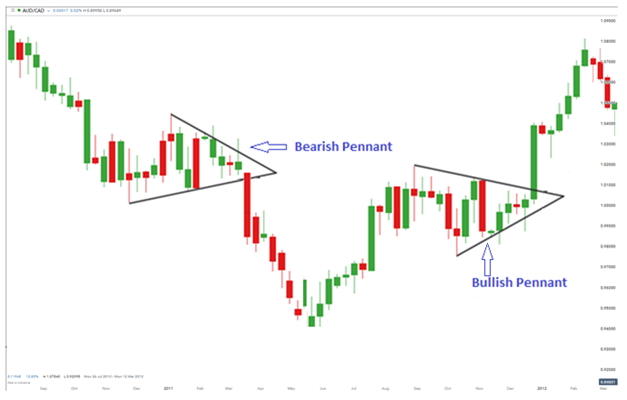
Bullish Pennants are continuation candlestick patterns that occur in strong uptrends. The Pennant is formed from an upward flagpole, a consolidation period and then the continuation of the uptrend after a breakout. Traders look for a break above the Pennant to take advantage of the renewed bullish momentum.

Bearish pennant. Bearish pennants are continuation patterns that mark a pause in the movement of a price halfway through a strong downtrend, offering you an opportunity to go short. The downtrend then continues with another similar-sized fall in price.

Find the Bullish& Bearish candlestick chart below:

Trend: Neutral(can be either bullish or bearish, and they can represent a continuation or a reversal)

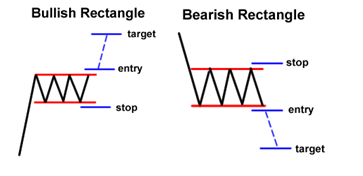
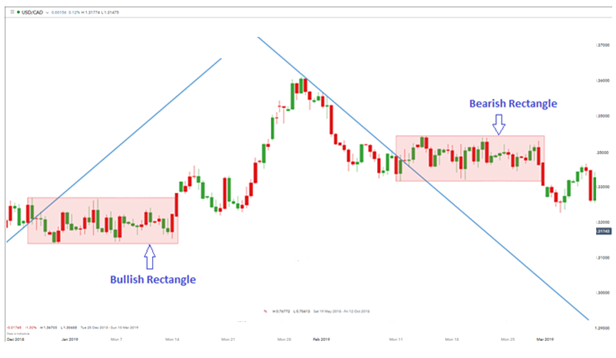
Rectangles are continuation patterns that occur when a price pauses during a strong trend and temporarily bounces between two parallel levels before the trend continues.

The bearish rectangle is a continuation pattern that occurs when a price pauses during a strong downtrend and temporarily bounces between two parallel levels before the trend continues.

Find the Bullish& Bearish candlestick chart below:


Trend: Neutral(can be either bullish or bearish, and they can represent a continuation or a reversal)

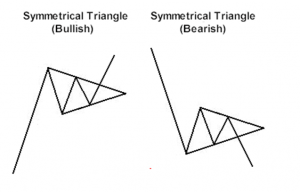
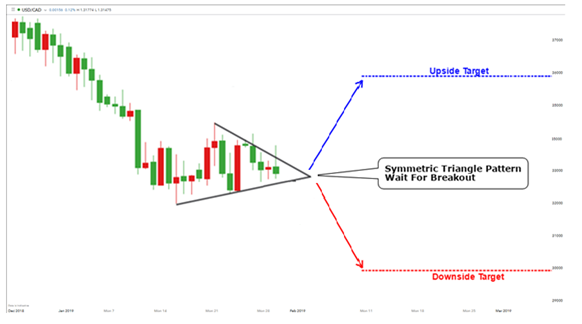
A symmetrical triangle is a chart pattern characterized by two converging trend lines connecting a series of sequential peaks and troughs. These trend lines should be converging at a roughly equal slope.

A symmetrical triangle is a chart formation where the slope of the price’s highs and the slope of the price’s lows converge together to a point where it looks like a triangle. Looks as similar as Pennant.

What’s happening during this formation is that the market is making lower highs and higher lows.

Find the Bullish& Bearish candlestick chart below:

Bullish market vs Bearish market

Bulls and bears are the main participants in the forex market. They differ in market behavior. bullish and bearish are the terms commonly used in the world of finance, trade and investment. In forex trading, both types of traders expect a rise or fall in the exchange rate, buying or selling the base currency against the quoted one. Market participants try to make a profit due to the variable dynamics of the exchange rate. They represent two opposite views, positive or negative, in the financial markets.

Let’s take a closer look at who the bulls and bears are.

Bull in Forex market

Bulls are traders who expect that price will go up. A bull trader opens long positions, thus increasing demand and raising the price of a trading instrument. In the bullish market, the economy is doing well, the unemployment is declining, GDP is rising, and prices are also growing. This market is characterized by optimism, high expectations, and investor’s confidence.

The origin of the name is inspired by an analogy: the bulls thrust its horns up into the air, just as the bull trader “raises” the prices by aggressive purchases.

Bulls are aimed at increasing capital due to market growth. They buy to resell in the future at a higher price. Therefore, when quotes are growing, the market and the trend itself are called bullish. There is a gradual increase in prices over a certain period of time in the bullish market. In other words, the price moves only upwards during the entire time period.

Bull market phases

Analysts and economists talk of three main phases to a bull market:

  • The first stage is referred to as the accumulation phase. It typically comes at the end of a downtrend, when everything seems at its worst. But, it’s also the time when prices are at their most attractive, because by this stage most of the bad news has already been priced in. Informed investors start to enter the market. The accumulation phase can be hard to spot and often comes amid continuing market pessimism, with many investors believing things can only get worse. The start of the accumulation phase sees a period of price consolidation, and during later stages of this phase the price of the market starts to move higher.
  • The second stage is known as the public participation phase. In this period, negative sentiment starts to fade as business conditions improve and economic data becomes stronger. The steady flow of good news encourages more and more investors to move back in, which sends prices higher. The public participation phase tends to be the longest lasting of the three bull market phases, and also the one with the largest price movement. Long positions are taken up by technical and trend traders as the new upward primary trend confirms itself.
  • The third stage of the three bull market phases is known as the excess phase. At this point, the market becomes hot again for all investors, and informed investors start to scale back their positions, selling them off to new market entrants. The last of the buyers to enter the market do so after big gains have already been achieved. They hope that recent returns will continue, but they’re buying near the top. Smart investors look very carefully for signs of weakness in the trend. If the upward moves start to peter out, it could be a sign of an approaching primary downtrend – the onset of the next bear market. Another important to be on your guard for the development of ‘secondary trends’ – short-term changes in price direction that last just a few weeks or months. A market correction is one type of secondary market trend and it’s used to denote a short-term price decline of around 5%-20%.


Bears in Forex Market

Bears are trying to lower the price, ie they are pessimistic about the rise in prices. These market participants expect that prices will fall. Bears sell their assets to buy them cheaper in the future. The bears swipe its paws downward, similarly, the bear trader seeks to reduce prices.

The bearish market is opposite to bullish: the unemployment is rising, GDP is declining, and the prices are also decreasing. Here the prices are constantly falling under the pressure of negative news and the ever-increasing number of positions to sell. The bearish market is characterized by a pessimistic approach and low expectations.

When quotes are falling, the market and the trend itself are called bearish. A steady downtrend is being formed in the market.

Bear market phases

  • In the first phase– around and just after the market top – Investors ignore even the most obvious signs that the market is turning around. The general market averages are not immune from the volatility, as their daily ranges expand significantly along with the volume that accompanies the range expansion. prices and investor sentiment are high, but investors are starting to take profits and exit the market. Confidence in the market remains high.
  • In the second phase, prices begin their rapid descent, trading activity and corporate earnings fall, and economic indicators are below average. Investor sentiment turns pessimistic and some investors panic. Market indices and many securities fall to new trading lows, and trading activity continues to decrease.
  • In the third phase, the very fact that full recognition of market weakness has occurred means that the bull market has now entered bear market territory. At this juncture, participants begin turning away from their holding trades that increase their risk profile even slightly. Prices and trading volume go up a little as speculators start to enter the market.
  • In the fourth and final phase, prices continue to fall, but at a slower rate. When prices become attractive enough to investors, and positive economic indicators start appearing, bear markets eventually give way to bull markets.


Market top and market bottom

It’s worth stressing that a market top (or high) isn’t usually a dramatic event – it just means that the market has reached the highest point it will see for the foreseeable future. A decline then follows, usually gathering in pace as time goes by.

A market bottom is the end of a market downturn, and the start of an upward trend (bull market). A market bottom is also very hard to pinpoint while it’s occurring, and investors who trade during false market bottoms can get caught out if the slide resumes. Baron Rothschild once reportedly advised that the best time to buy is when there is ‘blood in the streets’.

When the market changes

The bearish market may become the bullish one at any time. The reversal usually occurs after the market has moved into the oversold zone and the current price does not suit the sellers. Positive news on the base currency may also lead to the trend change. In this case, the bears will not be able to hold the market and will start closing existing deals.

The bullish market may exist until negative news is released or before moving into an overbought zone.

How to identify the trend

One of the most common ways is to use moving averages as a representation of the overall trend. Generally, when traders do this for trend direction they will use a slower moving or higher period moving average to determine the direction. For example, you may use a 200 day moving average to determine if the overall trend is up or down. The thinking behind this is that a slower moving average like the 200 will change direction much slower than a faster one. The trend is determined by the overall slope of the moving average. The other words, if it is going from lower left to upper right, we are in an uptrend. Of course, it works in the opposite direction as well.

Another common way to determine whether we are in a bowl market or their market is to use weekly trend lines. The support and resistance areas will move along the chart in a diagonal fashion showing which direction the market once the go overall. The higher timeframe the chart, the more reliable these trend lines become. One of the most reliable trend lines to use is one that shows up on a weekly chart. This is because it takes much more information as far as trades in order to push the price around, be it up or down.

Conclusion

Both bear and bull markets will have a large influence on your investments, so it’s a good idea to take some time to determine what the market is doing when making an investment decision. Remember that over the long term, the FX market has always posted a positive return. Much like the rest of the professional world, the Forex world has its own language that all traders speak in order to convey information to one another. Now that you know what a bull market and bear market are, you have an understanding of some of the most basic jargon that is spoken.