Fed Powell’s comment weakens US dollar

  • Less than expected Hawkishness from Fed Powell weakens the US dollar and in turn favor the Cable.
  • Investors remain optimistic with expectation of rate hike from BoE.
  • Fears about UK Brexit Minister Truss having personal reasons to trigger Article 16 creates woes before Thursday meeting.


Pound is trading higher against the US dollar during Wednesday Asian session. The recent strength of the pound takes clues from the Fed Chair Jerome Powell’s testimony in front of the US Senate Banking Committee.

In testimony at his renomination hearing on Tuesday, Powell said the U.S. economy was ready for higher interest rates and a runoff of its asset holdings – dubbed quantitative tightening (QT)  to combat inflation. However, he said policymakers were still debating approaches to reducing the Fed’s balance sheet, which could sometimes take two, three or four meetings for them to make such decisions.

Atlanta Fed President Raphael Bostic said on Monday “High inflation and a strong recovery will require the Federal Reserve to raise interest rates at least three times this year, beginning as soon as March, and warrant a rapid rundown of Fed asset holdings to draw excess cash out of the financial system.”

Analysts said “Powell’s overall message on Tuesday was less hawkish than some investors had expected, especially in light of recent commentary from some other Fed speakers”.

Powell’s comments weakened the US dollar and in turn favored the pound.

Elsewhere, Over the past weeks, investors are hopeful with expectations that the BoE will raise interest rates as early as next month after a surprise hike in December by 15 basis points, to 0.25%.

On the other hand, As per a recent news, British Commentator Henry Hill mentioned that British Trade Minister, who is also the newly appointed Brexit Chief, has the “personal motivation” to force Boris Johnson’s hand on Article 16 “whether he wants it or not.” The reason for this is that Truss is a contender for the Conservative leadership.

Other catalysts working against the pound are the recent high Uk covid cases and the growing fear of wide spread ahead.

GBP/USD 4 Hour Chart:
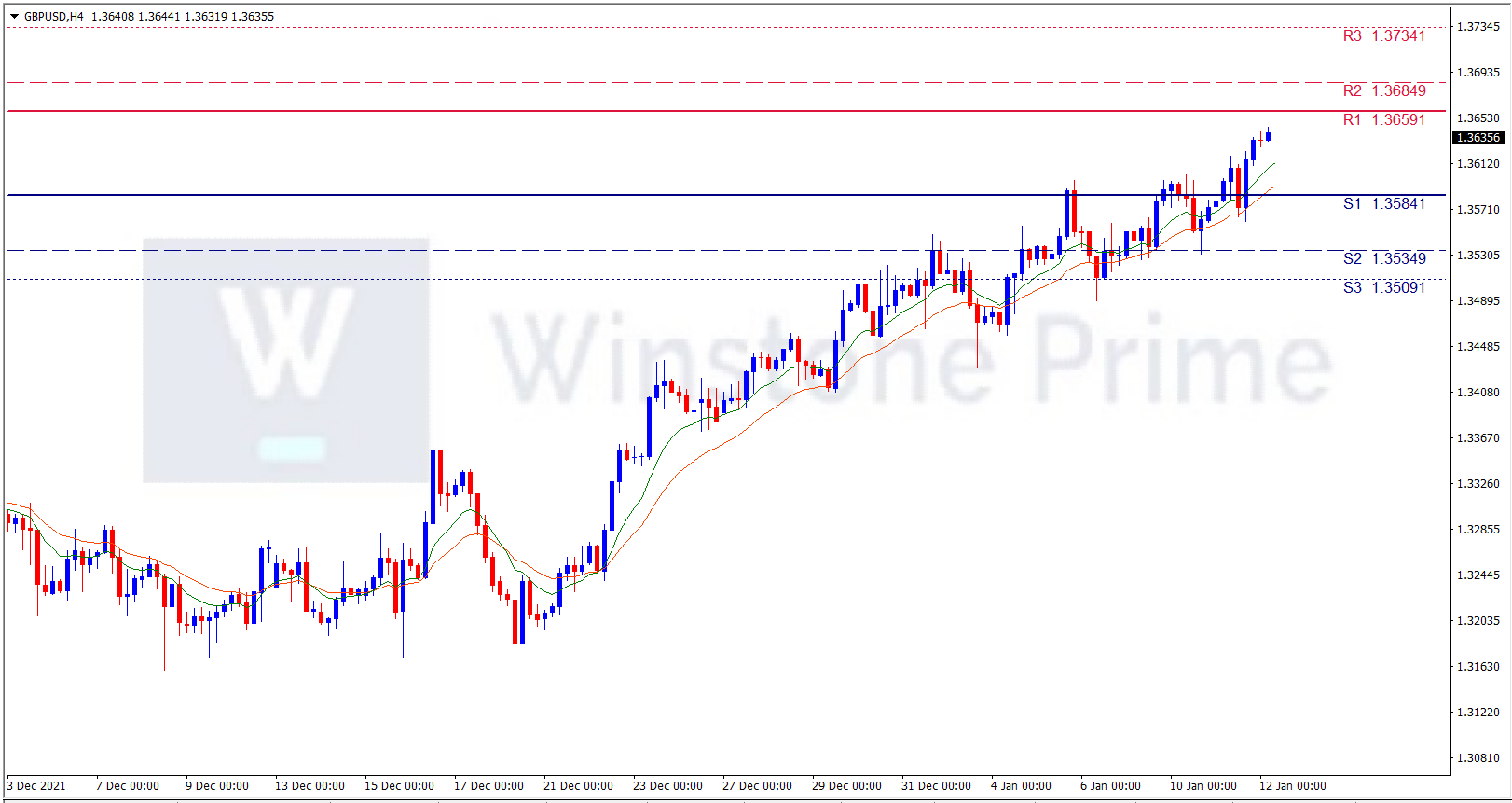
Support: 1.3584 (S1), 1.3535 (S2), 1.3509 (S3).

Resistance: 1.3659 (R1), 1.3685 (R2), 1.3734 (R3).

Cable pair trades higher amid the US dollar weakness and traders now wait for the US CPI data; we expect a bullish trend for GBP/USD.
What is S&P500 and how does it work?

The S&P 500 is a stock market index that measures the performance of about 500 companies which includes many of the largest companies in the U.S. It includes companies across 11 sectors and offers a picture of the health of the U.S. stock market and the broader economy.

What is S&P 500?

Standard and Poor’s 500 is abbreviated as S&P500 and  it is a stock market index that tracks 500 publicly traded domestic companies in the United states. Many investors consider it to be the best overall measurement of American stock market performance.

Standard & Poor’s, which now sponsors a number of market indexes was started as investment information service begun in 1860 by Henry Varnum Poor. In the year 1941, Poor’s original company, Poor’s Publishing, merged with Standard Statistics which was founded in 1906 as the Standard Statistics Bureau and named it as Standard and Poor’s Corporation, a provider of financial information and analysis.

The S&P 500 index was initially called as the Composite Index and later as Standard & Poor’s Composite It was launched on a small scale in 1923 and started tracking 90 stocks in 1926 and expanded to 500 in 1957.

The stocks with a larger market valuation have a greater impact on the overall index. The companies that are listed on the S&P 500 gives a representation of  who’s who of U.S. industry, and additions and deletions from the list often indicate market trends

What companies are included in the S&P 500?

Meeting certain criteria is a must to get included in the index. Among other things, companies must:

  • The Company must have a market capitalization — which refers to the total value of the company’s outstanding shares — of at least $8.2 billion.
  • It should be based in US
  • The company must be must listed on an eligible U.S. exchange. (Real estate investment trusts, known as REITs, are eligible for inclusion.)
  • The company should be structured as a corporation and offer common stock.
  • The company should have positive as-reported earnings over the most recent quarter, in addition to over the four most recent quarters added together.


Because of the above criteria’s most stable corporations and the country’s largest companies can only be included in the S&P 500. The list of the companies is reviewed and updated quarterly.

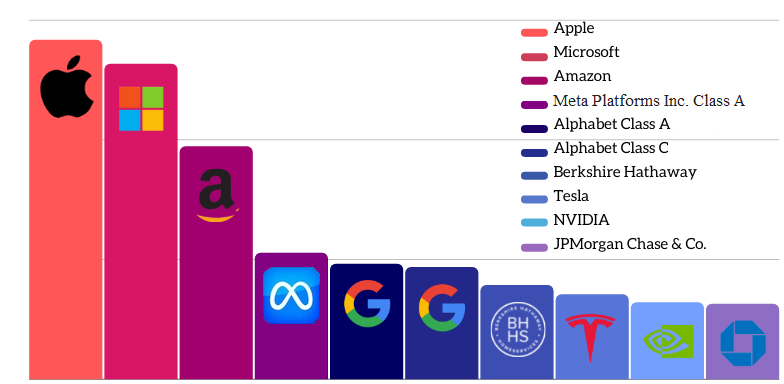
As of December 23, 2021, the 10 largest companies, with a weighted market cap, in the S&P 500 are

1.  Apple Inc.

2. Microsoft Corporation

3. Amazon.com Inc.

4. Alphabet Inc. Class A

5. Alphabet Inc. Class C

6. Meta Platforms Inc. Class A

7. Tesla Inc

8. NVIDIA Corporation

9. Berkshire Hathaway Inc. Class B

10. JPMorgan Chase & Co.

The makeup of the S&P 500 industries reflects that of the economy.

As of December 23, 2021, the S&P 500 sector breakdown included:

  • Information Technology: 27.9%
  • Health Care: 13%
  • Consumer Discretionary: 12.8%
  • Financials: 11.4%
  • Communication Services: 10.8%
  • Industrials: 8%
  • Consumer Staples: 5.6%
  • Energy: 2.9%
  • Real Estate: 2.6%
  • Materials: 2.5%
  • Utilities: 2.4%

Over the past 10 years, the S&P 500 has posted average annual return of 10%. However, kindly note  this doesn’t mean you can expect to get a 10% return on your investment in an S&P 500 index fund every year. In 2020, it posted a return of 15.15%.

As the companies within the index are so diverse and are collectively worth around 80% of all US stocks total value, these performance figures are widely seen as the overall performance of the US stock market.

Advantages:

  • Many of the most successful companies in the world are included in the S&P 500. 8 of the largest 10 technology companies in the world are produced in Silicon Valley. All of these 8 rapidly growing companies are included in the index.
  • The index is the most liquid in the world.
  • The S&P 500 is widely followed and used as a benchmark for funds and the performance of the stock market in general.
  • Trading instruments like CFDs, futures and ETFs which are based on the index are amongst the cheapest and most liquid to trade.


Disadvantages:

  • Performance of certain sectors will have meager effect in the S&P 500 Index as so many companies are included in the list.
  • However S&P 500 index include most of the largest companies of the world, few notable companies that does not headquarters in the US are excluded. 
  • Big technology companies like Apple, Amazon, Microsoft etc. largely influence the S&P 500 Index. Suppose these companies underperform, it will affect the index significantly. However, the effect won’t be so visible since the index acts as a benchmark for most investments to be measured.

Many reasons can be given to invest in the S&P 500 index for the long term. Just one share of an S&P 500 can give indirect ownership of 500 companies. However, while the returns are respectable, they’re relatively modest.

To actively trade the index is one best way to improve returns. With CFD trading of the index, you can make gains from the all the positive and negative short-term movements which ultimately result in modest annual returns.

You can also get benefited by using leverage. As with leverage, you can increase the size of returns , However kindly note use of leverage is risky and may result in the loss of capital invested.

Interesting fact about S&P 500 is Buffett even left instructions for 90% of his estate to be invested in S&P 500 funds upon his death. He said “There’s no better than America.”

Conclusion

If you wish to include only one index in your trading portfolio, it should probably be the S&P 500. Since S&P 500 includes many of the most successful and rapidly growing companies in the world. By choosing  S&P 500 index, you’re trading  Apple, Alphabet (Google), Microsoft, Amazon, Facebook and countless other great companies. Moreover, the index is very liquid and cheap to trade.

However, since it is traded by so many people, trading on very short timeframes is challenging. It is a very good index to trade if your time horizon is 10 to 30 days.

You can trade index CFDs with Winstone Prime. If you want to get started, you can open a risk-free demo account today. This will allow you to get used to the trading platform and learn more about trading the S&P 500 Index at no risk or cost. Open account and start trading S&P 500 if trading is passion already.

Euro is steady ahead of Fed Powell & ECB Largarde

  • EUR/USD is consolidating phase, firm Eurozone data underpins the move.
  • Fed Hawkishness and the Merck’s covid pill update boosts the risk- on mood in the market.
  • Traders are keen to watch the speech from ECB’s Lagarde and Powell’s Testimony.


Euro is in consolidating phase by erasing losses against greenback in Tuesday Asian session. Upbeat Eurozone data is the rationale behind the move.  However market remain cautious ahead of a speech from the European Central Bank (ECB) President Christine Lagarde and a testimony from US Federal Reserve (Fed) Chairman Jerome Powell.

Eurozone’s investor sentiment showed an unexpected improvement in the first month of 2022 with the reading of 14.9 vs expectation of 11.2, the latest data published by the Sentix research group showed on Monday. Eurozone Unemployment Rate of 7.2% for November versus 7.3% prior also turned favorable for the Euro.

The Fed Powell’s hawkish comment before the testimony due later today and the recent Merck’s pill update favors the market mood. As per a recent news, Mercks’s official says “Merck’s COVID-19 oral pill molnupiravir has a mechanism of action that can work against Omicron and any other variant.”

In his prepared opening remarks, released Monday, The Fed Powell says, “The economy is growing at its fastest rate in years, and the labor market is robust.”

Powell also pledged to prevent high inflation from becoming “entrenched,” but will make no mention of plans for the path of monetary policy. However, he will take questions from senators in his bid for a second four-year term. His pledge on inflation raises question on rate hike and in turn weighs on the market sentiment.

Kansas City Fed President Esther George and St. Louis Fed President James Bullard will also speak later in the day, the first from a group of Fed officials speaking throughout the week.

TD Securities strategists said “It seems that the Fed was of the mindset of “sooner rather than later” for both higher rates and running off its balance sheet after ending bond-buying stimulus.” “An affirmation of March 2022 tightening and early quantitative tightening should support dollar firmness overall, though within well-established ranges.”

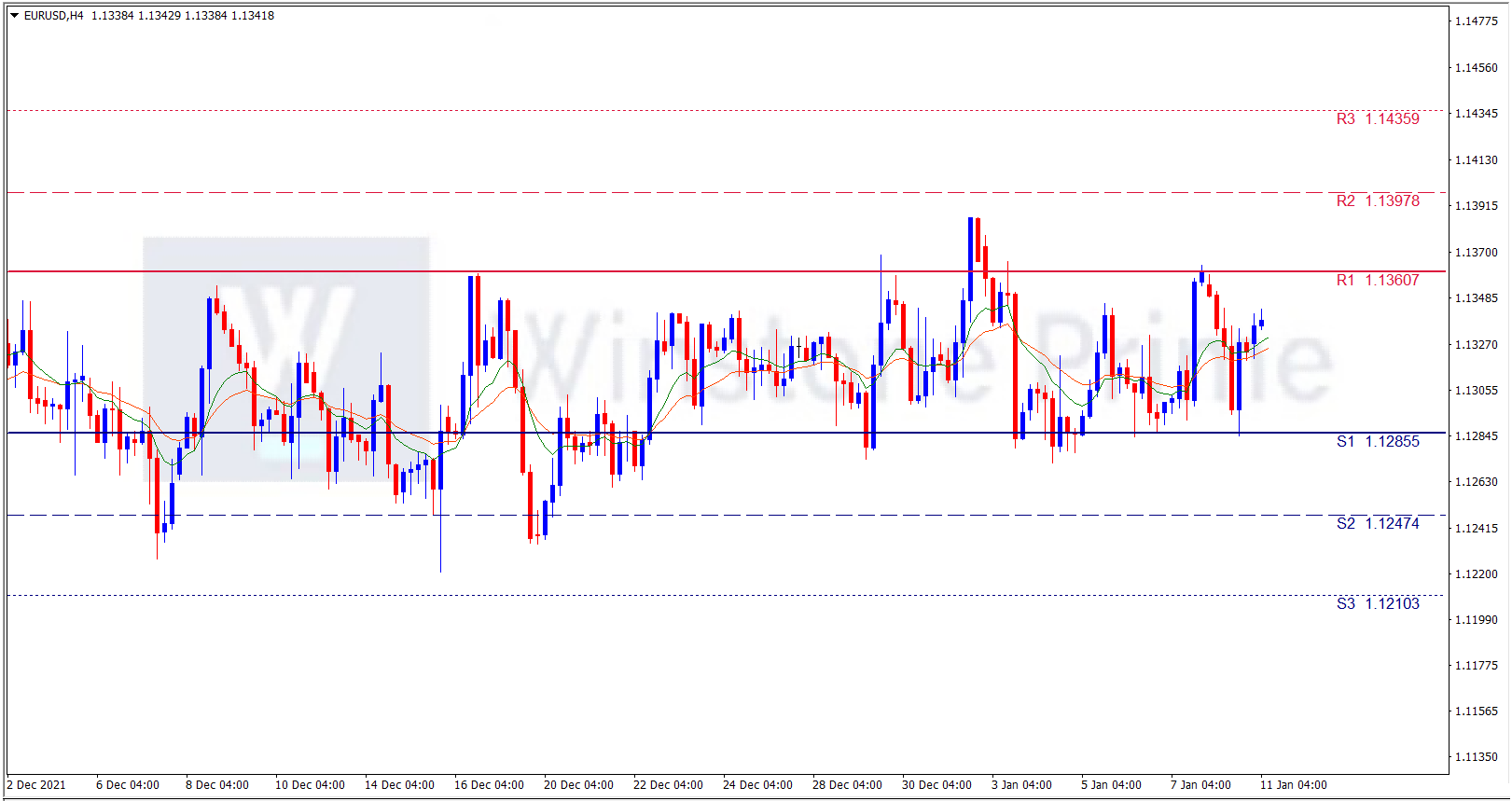
EUR/USD 4 Hour Chart:

Support: 1.1286 (S1), 1.1247 (S2), 1.1210 (S3).

Resistance: 1.1361 (R1), 1.1398 (R2), 1.1436 (R3).

Upbeat Eurozone data favors the euro and creates cautious optimism among buyers in the mixed market sentiment ahead of Fed Powell and ECB Largade’s speech. We expect a bullish trend for EUR/USD.

NFP led disappointment weighs on US dollar

  • NFP disappointment overrules the other upbeat US reports and weighs on the greenback.
  • Market remain cautious with the rising cases of coronavirus in Australia.
  • Fed Powell’s hawkish comments and rising US inflation might recoup the Friday US dollar losses.


The Australian dollar trades high the US dollar on Monday Asian session since US dollar took a step back despite of the rapid spread of covid cases in Australia complicates the economic outlook and the interest rate.

The US dollar came in to sell off on Friday with the disappointing US NFP report despite the rest of the report was strong enough to see markets actually narrow the odds on a March hike from the Federal Reserve.

The headline Nonfarm Payrolls (NFP) report did not meet the expectation of 400k forecasts and recorded 199k However, the Unemployment Rate had a drop with 3.9% vs expectation of 4.1% and 4.2% in November and the U6 Underemployment Rate dropped to 7.3% against November’s downwardly revised 7.7%, and both closed in the pre-pandemic levels. The Unemployment Rate and U6 Underemployment Rate did not favor the US dollar due to NFP-led disappointment.

Elsewhere, Market is priced at a June rate rise from the Reserve Bank of Australia (RBA), despite the central bank has long argued that a move was unlikely until at least 2023.

On the other hand, market becomes cautious by the explosion in coronavirus cases in Australia to 100,000-plus a day, compared to just a couple of thousand a month ago. The virus had pushed Queensland to delay the yearly school reopening by a month to early February.  Virus conditions are getting worst all over the world even as policymakers cite scientific studies to remain hopeful. On the positive note, Australia begins vaccinations for 05-12 years children from Monday.

Federal Reserve chair Jerome Powell and governor Lael Brainard are about to testify before Senate committees this week regarding their nominations as chair and deputy chair at the Fed. U.S. inflation figures are due on Wednesday, with headline CPI seen climbing to a red-hot 7% year-on-year. The dollar might recoup with the Friday losses with hawkish Fed chair commentary and US inflation figure.

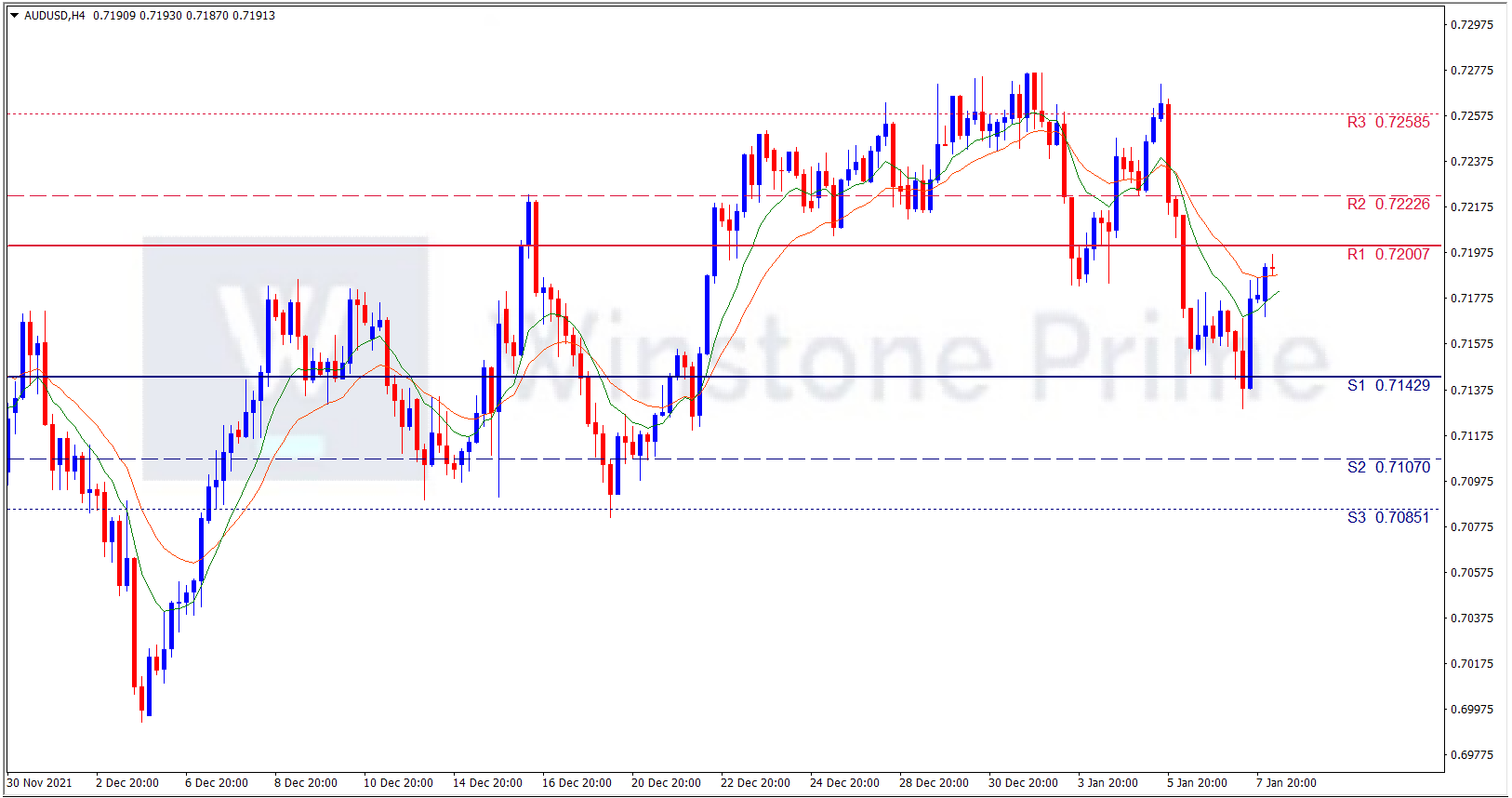
AUD/USD 4 Hour Chart:

Support: 0.7143 (S1), 0.7107 (S2), 0.7085 (S3).

Resistance: 0.7201 (R1), 0.7223 (R2), 0.7259 (R3).

The US dollar’s step back due to disappointing NFP data underpins the AUD/USD uptrend. We expect a bullish trend for AUD/USD.