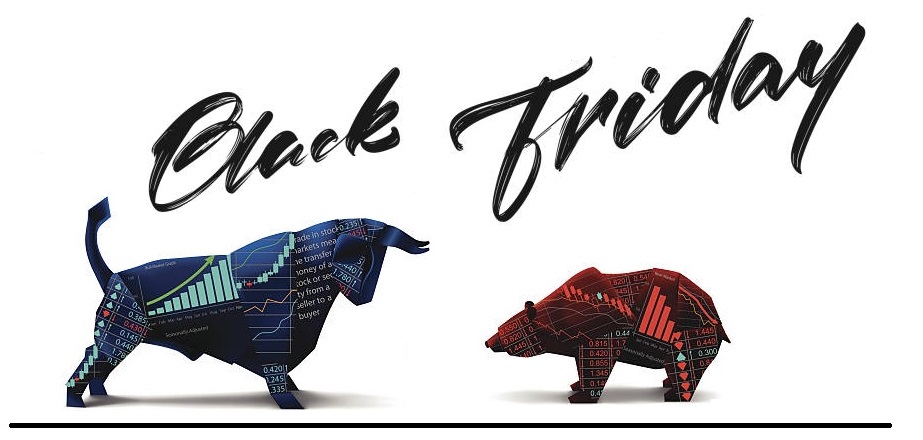
What is Black Friday?
Black Friday is referred to the day following the U.S. Thanksgiving holiday, which has also traditionally been a holiday itself for many employees. Retail stores typically open early and offer huge discounts. In the year 2020, 186.4 million US customers shopped online and in store, despite of disruption caused by the pandemic. Black Friday is considered as the beginning of the holiday shopping season.
Speaking on Economic front, the sales made on Black Friday are often watched as a test for the overall economic condition of the country and a way for economists to measure the confidence of the average American when it comes to discretionary spending.
Understanding Black Friday?
Traders await for the black Friday late November every year as an event that keeps the economy moving and also keeps the stock markets ringing.
In case you are a consumer, you will look for ways to satisfy your taste for goods. In case of business owner, you will look for ways to invite more clients to buy your goods or service by creating valuable and attractive offers.
Now lets talk from a trading perspective, we will look for the most tactful strategy to place orders and benefit from market swings possibly making the case for an interesting session with plenty opportunities. This article will discuss some interesting topics surrounding the Black Friday.
Black Friday has magic ability as it converts even inactive shoppers to active consumers. Consumers come up with a reason to search for deals that they can benefit from , even if they don’t really have need of a specific item. In this case however, the benefit is not only on the side of the consumer, but also on the side on the business. Black Friday helps the businesses to create a bundle of products to satisfy the need of a big crowd of consumers. This will also help the businesses to get rid of the product that had been mounting on their shelves for some time. With these circumstances, shops can entice consumers to buy more products/services at better prices.
Black Friday in most countries of the world has been seen as an event that consumers look forward to physically going down to the shops and spending most of their hours there.
Retailers followed the concept of post-Turkey Day sales which was started long before “Black Friday.” With an view kicking off holiday shopping season with a bang and attract hordes of shoppers, stores promote major deals the day after Thanksgiving for decades, based on the fact that many companies and businesses gave employees that Friday off.
Why it was named as Black Friday? Few say the day is called Black Friday as an homage to the term “black” which refers to profitability as in old book keeping, black ink were used to record profits and red ink to record losses. The agenda of retail businesses is here is to sell on this Friday (and the following weekend) to put themselves “in the black” for the rest of the year.
However, long before appearing of this theory in advertisements and commercials, Philadelphia police officers who overworked coined the word – Black Friday. In 1950s, City of Brotherly Love was flooded with crowds of shoppers and visitors flooded the day after Thanksgiving. Along with the Philadelphia stores touting major sales and the unveiling of holiday decorations on this special day, Army-Navy football game was also hosted on Saturday of the same weekend. Hence, traffic cops were asked to work 12-hour shifts to deal with the crowd of passengers and pedestrians, and even they were refrained from taking leave. Over time, the annoyed officers referred this dreaded workday as Black Friday. However this concept is no longer acceptable.
Finally, in the mid-1990s started celebrating the positive connotation of black ink—”Black Friday” swept the nation and appeared in print and TV ad campaigns across the United States.
In 2000s Black Friday was officially designated the biggest shopping day of the year. Till that period title had gone to the Saturday before Christmas. Yet, as more retailers started touting “can’t miss” post-Thanksgiving sales, and the Black Friday discounts grew deeper and deeper, American consumers could no longer resist the pull of this big shopping day.
In the year 2011, Walmart made an announcement that, instead of opening its doors on Friday morning, it would start sales on Thanksgiving evening. That was just a beginning later big-box retailers followed the suit. Today, Black Friday is a longer event—a Black Weekend.
Impact of Black Friday in trading
Black Friday sales are all about retail sector. There is a strong correlation with the retail sector than the broader stock market.
It is argued Black Friday can be an important indicator of the US economic outlook by few economists. Normally, they depend on supply-side considerations, focuses on how the level of retail sales over the period can be an indicator of how much Americans are willing to spend.
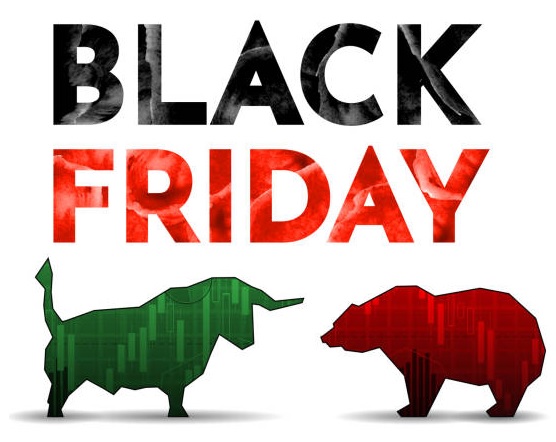
Other countries who follow the Black Friday event where retail sales are expected to increase might also follow a identical pattern. Suppose if the sales beat expectations, then the theory says that consumers are likely to keep driving the economy. Hence it would boost the stock market. As a result, it would also mean a shift away from safe havens in forex over the rest of the quarter.
Usually the retail sector tends to outperform the benchmark S&P500 in the ten days after the holiday.
Whereas on the other hand, if sales underperform, that could be an indication that the economy is weaker than anticipation. we could see the market drifting lower and traders get attracted to the safe haven in forex through the rest of the year.
Last year was the first time that the retail sector underperformed the S&P500 following Black Friday. However, this was mostly because of the impact of covid.
Our View :
A cautious approach is recommended for traders on Black Friday the days before and after. Other events that are imminent nearby Black Friday are the US Thanks Giving holiday on Thursday and the following Cyber Monday.
A good metric for traders to make decisions is to observe the major stock indexes reaction upon the opening, while focusing on currency indexes can also be helpful in this case. Traders can also focus on the results derived from the Black Friday event especially considering the sales in terms of money and consumers.