EUR/USD Weekly Forecast (20th December 2021 – 24th December 2021)

Fundamental view:

The Euro traded downside against the greenback during the trading course of the week.  Both the Central banks – The US Federal Reserve and the European Central Bank made an announcement of their monetary policy decisions and gave fresh forecast on inflation. Market was keen on the findings; however both of them’s tapering-related measures fell short of triggering directional movements. The Fed made an increment in the reduction in bond-buying on a monthly basis to $30 billion, from $15 billion as announced in November, starting from January 2022. Which means that the central bank will stop buying  $20 billion Treasuries and $10 billion Mortgage-Backed Securities per month, and also means sooner rate hikes. Elsewhere, The Fed’s dot-plot now implies three rate hikes in 2022 and three more in 2023. Moreover, the inflation forecasts have been raised to 5.6% for 2021 and 2.6% for 2022, up from 4.2% and 2.2% previously.

On the other hand, the ECB made a confirmation that it will end the Pandemic Emergency Purchase Program on March 2022 as previously anticipated. The Government Council made a decision to expand its Assets Purchase Program to €40 billion per month in the second quarter of 2022 and to €30 billion in the third quarter of the year, to partially compensate the end of the monthly  €60 billion bond-buying through PEPP.  ECB forecast inflation increasing from 2.6% this year to 3.2% the next one. But it said price growth would then fall to hit 1.8% cent in 2023 and will be maintained at that level in 2024 while lowering growth forecast in 2022 to 4.2% from 4.6% previously.

Eurozone Industrial Production monthly report on 14th December and US Initial Jobless Claims on 16th December favored bullish trend whereas US PPI monthly report on 14th December and Eurozone CPI monthly report on 15th December favored bearish trend for the pair in this week.

The major economic events deciding the movement of the pair in the next week are Eurozone PPI monthly report at Dec 21, US GDP quarterly report, US CB Consumer Confidence Index, EIA Crude Oil Stocks Change at Dec 22, Eurozone GDP quarterly report, US Core Durable Goods Orders monthly report, US Initial Jobless Claims and Michigan Consumer Sentiment at Dec 23.

EUR/USD Weekly outlook:
Technical View:

Last week’s high was 0.0.5% higher than the previous week. Maintaining high at 1.1360 and low at 1.1221 showed a movement of 139 pips.

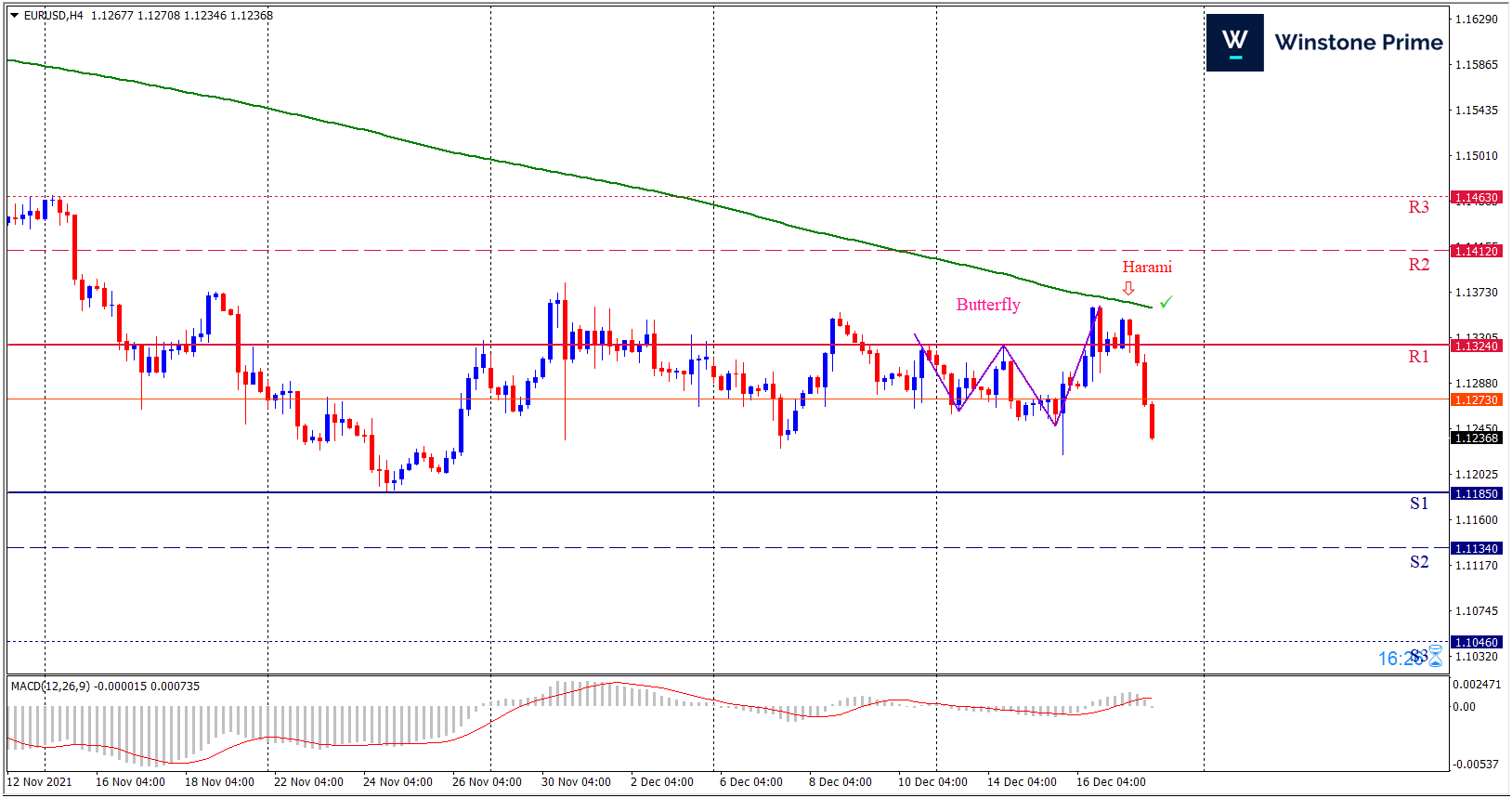
In the upcoming week we expect EUR/USD to show a bearish trend. The currency pair is trading below the 200 Simple Moving Average and the MACD trades to the downside. Should 1.1185 proves to be unreliable support then the pair may fall further to 1.1134 and 1.1046 respectively whereas a solid breakout above 1.1324 will open a clear path upward to 1.1412 and then will further raise up to 1.1463. Chart formation of a Bearish butterfly pattern in H4 chart sets prospects for a bearish trend. Bearish harami formation in H4 chart escalates the expectation for a bearish trend.

Preference
Sell: 1.1236 target at 1.1115 and stop loss at 1.1329


Alternate Scenario
Buy: 1.1329 target at 1.1462 and stop loss at 1.1236

Why boring is wonderful in trading

Many people enter in the arena of trading just because of the excitement. Trading is often imagined as spending spare time from work and family in trades where you can make brilliant trades that will move your lifestyle up a notch on the scale of success. Only thing you need to learn about is – study how the market works, just jump in and outwit everyone with your dynamite moves. Eventually, you will get better with days and will make your part-time hobby into a full time job – a job which you can take with you as you travel the world and can make handsome money!

But Is this real? Is this the way actual traders with experience think? Of course No.

it can be exciting, but all the time when you trade ? Definitely not! In fact, if you are looking for wild and crazy trading experience, you will be disappointed, because trading world is far from that.

Unlike all the images created by the pop media, trading in the market can be a boring affair. Trading in the market is no different as most of the time you will be doing nothing. However if you want to be a successful trader, you need to get used to doing nothing. You should even enjoy doing nothing. Things that seem boring are wonderful in trading. Here are some of the reasons why you should not rely on fun element while trading and enjoy the boredom.

1. To avoid having higher expectations

Entering in the trading arena with the expectation of trading to be a fun roller coaster ride is the big mistake a trader makes. You are going to face a great disappointment if you are entering the trading world with this expectation.

Trading can be quite boring as once you enter the trading world, your only job is to just watch and wait. You need to examine patterns, pips, trends, and prices. Since you have nothing to do, trading is often considered boring.

People, who enter the trading world with high expectations, hope to make a big deal of the market trends. This will lead them to obsess every little pattern or turn the market takes, and make unnecessary investments.

A successful trader stays composed and knows what to expect the market each day and knows what to do if it takes an unexpected turn. If being composed seems boring then boring is wonderful in this situation as you are making money over the long run.

2. Stay Calm

Many traders think trading as gambling. Thus they consider excitement and emotional challenges important in the trading world. But trading is not like playing in the casino.

You should have strong determination and focus in trading to become successful rather depending on luck factor. Of course, you’re not always going to get the best from trading, and there will be times when you lose money.

Trading on emotions is one of the worst mistakes traders can make. When you get impatient and can’t sit it out any longer, you might enter a trade a short time to soon and watch as your money disappears. It is better to calm down and wait it out.

3. Following a healthy routine

To be successful in the trading world, you need to spend a regular time in the market. You need to select the markets you want to trade and also your trading hours. To be in the market daily (you don’t want to miss that elusive perfect opportunity), you need to maintain a regular daily routine.

Making the routine healthy with proper sleeping and eating habits is also important as a healthy habit also will help you stay alert and vigilant not only in the market but also out of it. This is important as trading world is highly susceptible to economic, political, and other influences beyond our control. You need to be aware of the happenings around the world habitually.

However, developing regular work and personal habits and adhering to a routine may seem boring but they are more likely to yield a steady return that random and undisciplined trading cannot do.

4. Monitoring Charts

Actually trader’s life is boring. They get up early and check out the market trends and make a move accordingly. Most of their time is spent waiting.  There might be days when you will have nothing else to do other than monitoring the charts. It is undoubtedly boring to watch a trade unfold but you cannot attempt something dramatic like overtrading out of boredom.

Trading due to boredom can make lose trade and money with it. On contrary, If you are embracing the boring act of watching a trade unfold over days or weeks, you might be rewarded your planned way and that means you will make good profit and will be a successful trader.

Final words :

“Boring” word in the trading world is wonderful since the traders are not in a hurry or excitement , emotional roller coaster. The trader will focus on what the market has to offer and make success in the trading world, this makes the boring wonderful in trading.

With this boring routine, A trader will make good profits which is an exciting thing to be happen and happy ending!!!

Gold climbs up, despite hawish fed

The yellow metal prices climbed on Friday and this week turned to the best week for gold since mid-November, the dollar weakened despite the Hawkish U.S. Federal Reserve decision.

The Fed delivered on the expected doubling of the taper pace and said Wednesday that it will begin reducing its asset purchases by $30 billion per month starting in the month of January, up from the current $15 billion pace, amid rising inflation and continued recovery in employment. The central bank’s Federal Open Market Committee said after its two-day meeting it would cut monthly Treasury securities purchases by $20 billion and agency mortgage-backed securities acquisitions by $10 billion per month.

Meanwhile, Fed policymakers made a lift in their projections for core inflation, expecting to finish this year at 5.3%, up sharply from the 4.2% average forecast in September. Next year, inflation is expected to slow to 2.6%, but that was higher than the 2.2% seen three months ago.

The dot plot was far more hawkish than the market expectation and it was above where it was priced. The dot plot now shows a 75bp increase in 2022, above the 50bp consensus, along with that the US President Biden also made it clear that officials are ready to start raising rates well before the labor market returns to its pre-COVID state.

On the other hand, Disappointing releases of the US Weekly Initial Jobless Claims data – 206 K vs expectation of 198k and previous data of 188 k, and Philly Fed Manufacturing Index – 15.4 Vs expectation of 27.0 underpinned the bullish trend of XAU/USD. Apart from this, declining US Treasury bond yields turned out to be another factor that also underpinned the trend.

However, Fears of Omicron seem to challenge the gold buyers of late. But the catalysts that favor the buyers are comments from the Chinese Ambassador who conveyed dislike for the US actions against Chinese entities over Xinjiang-related issues.

Elsewhere, A record-high daily Covid cases in the UK leads to the the return of stringent mask mandates in Australia’s Queensland to portray the virus-linked fears. US President Biden earlier mentioned that Omicron is going to start spreading more rapidly.

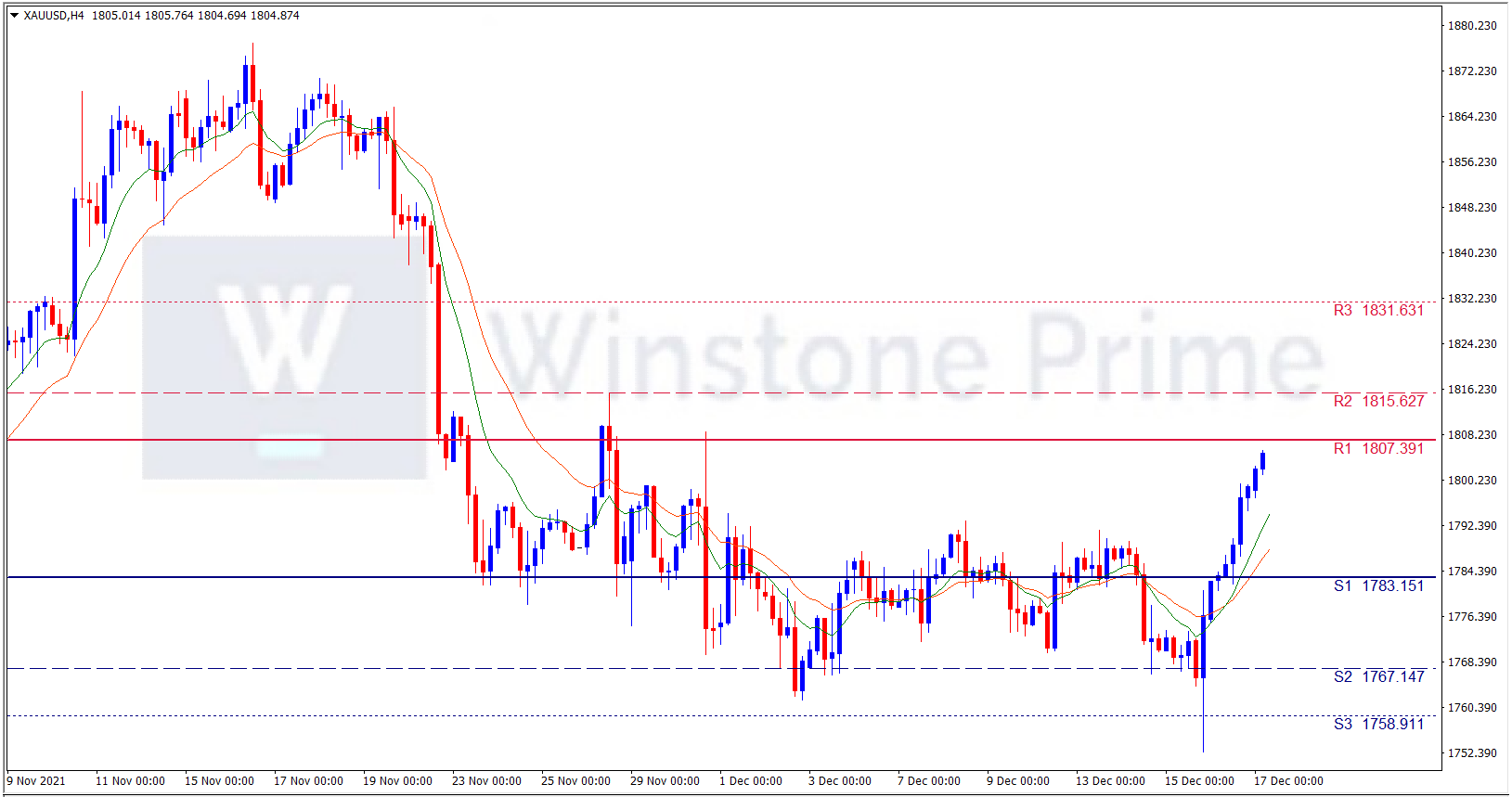
XAU/USD 4 Hour Chart:

Support: 1783.2 (S1), 1767.2 (S2), 1758.9 (S3).

Resistance: 1807.4 (R1), 1815.6 (R2), 1831.6 (R3).

Yellow metal is up as the dollar weakens as it appears to have been a “buy the rumour, sell the fact” reaction to Fed hawkishness. We expect a bullish trend for XAU/USD.

Upbeat employment data favors AUD

Australian dollar edged higher against the American dollar during the Early Asian session. This moves comes after the strong jobs data which rises the likelihood of the central bank to wind down its pandemic-era bond buying early next year, following in the foot steps of the U.S. Federal Reserve.

Australia Unemployment Rate dropped to 4.6%, below 5.5% forecast and 5.2% prior, whereas the Employment Change rose to 366.1K from +200K exceeding the -89.1K forecast and -56.0 k previous readout. Further, the Participation Rate also crossed 64.6% market consensus and prior record with 66.1% figures.

Along with the upbeat employment data favoring the Aussie, the speech by  Reserve Bank of Australia (RBA) Governor Philip Lowe coming hours after the Fed said its bond buying program may end by February, also favored the quote AUD/USD.

RBA is is open to ending bond buying as early as February should the economy recovery quicker than currently expected but it is unlikely that interest rates will need to rise in 2022.

In a speech in regional New South Wales, Reserve Bank of Australia (RBA) Governor Philip Lowe said the spread of the Omicron variant was a downside risk, but expected the economy to weather any headwinds thanks in part to a massive build up in household savings.

Lowe repeated that the bank would not raise the 0.1% cash rate until inflation was sustainably within its 2-3% target band and Australia was still “a fair way” from that point. “In our central scenario, the condition for an increase in the cash rate will not be met next year,” he also added. “It is likely to take time for that condition to be met and the Board is prepared to be patient.”

Lowe also said the “RBA Board had discussed options for its bond buying, or quantitative easing, which currently stands at A$4 billion ($2.87 billion) a week and is set to be reviewed at the Feb. 1 policy meeting.”

Marcel Thieliant, a senior Australia and New Zealand Economist for Capital Economics, said in a note “The remarkable recovery in Australia’s labour market following the recent lockdowns suggests that the Reserve Bank of Australia will end its asset purchases altogether in February.”

Furthermore, Australia’s Commonwealth Bank (CBA) released preliminary PMI data for December. The activity numbers showed Manufacturing gauge rose past 57.1 forecast to 57.4 but easing below 59.2 previous readouts. Further, the Services PMI also stepped back from 55.7 to 55.1, dragging the Composite PMI to 54.9 from 55.7, versus 53.7 market consensus.

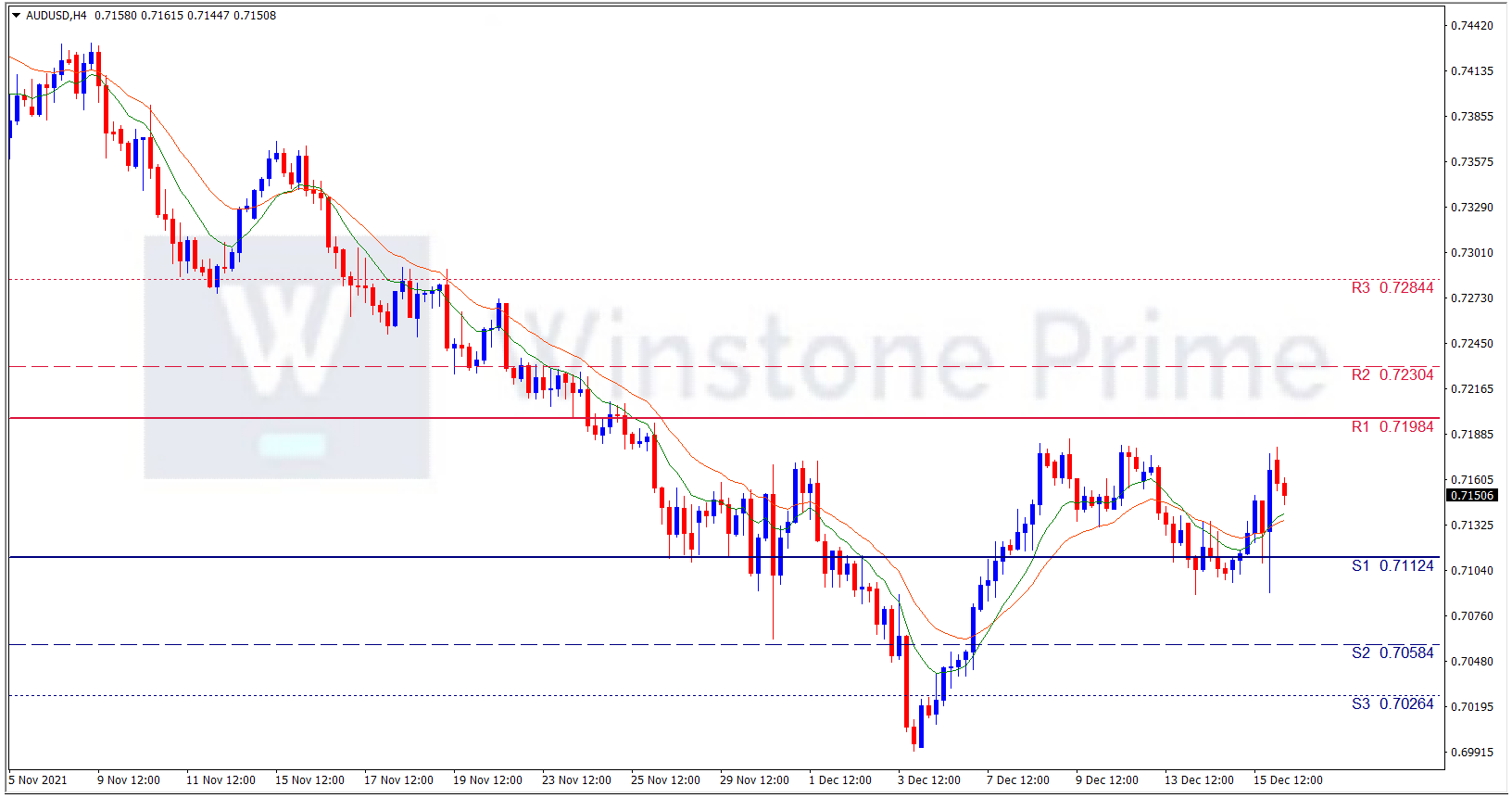
AUD/USD 4 Hour Chart:

Support: 0.7112 (S1), 0.7058 (S2), 0.7026 (S3).

Resistance: 0.7198 (R1), 0.7230 (R2), 0.7284 (R3).

The record surge in Australian jobs favors the Aussie. We expect a bullish trend for AUD/USD.