USD/JPY edges higher on Fed- BOJ divergence

  • The Japanese yen hit a 20-year low against the dollar on Tuesday backed by high U.S. Treasury yields.
  • Contrast in monetary policy between a hawkish Fed and an dovish Bank of Japan strengthens USD against JPY.
  • Fed’s James Bullard said inflation is “far too high.”


The dollar rose against the Japanese yen during Tuesday trading session as the greenback set its latest 20-year high on the yen supported by high U.S. Treasury yields and expectations of good economic data.

It is worth noting that US dollar has risen 4.5% on the Japanese currency so far this month, which would be its second-biggest monthly percentage gain since 2016 behind March’s 5.8%. The greenback also climbed against Japanese currency, highlighting the contrast in monetary policy between a hawkish Fed and an ultra-dovish Bank of Japan.

The US dollar is strong supported by the expectation  have of an aggressive rate hike along with hawkish guidance for the rest of the year. St. Louis Fed President James Bullard on Monday stated that the Fed needs to elevate the interest rates to 3.5% and that too by the end of the year. A higher-than-expected hawkish gesture by the Federal Open Market Committee (FOMC) member James Bullard has favored the greenback.

St. Louis Fed President James Bullard said that inflation is “far too high” while repeating its case of hiking rates to 3.5% by the end 0f 2022. He also added that the Unemployment Rate can continue to fall even with aggressive rate hikes, repeating his view that now at 3.6%, unemployment will go below 3% this year.

On the other hand, the BoJ has repeatedly said that it remains ready to use powerful tools to avoid long-term interest rates from rising too much. In fact, the Japanese central bank last month offered to buy unlimited 10-year Japanese government bonds to defend the 0.25% yield cap. The Bank of Japan (BOJ) preference on maintaining an ultra-loose monetary policy as the economy has yet not reached the pre-Covid-19 level, thus widening of the divergence of Fed- BOJ monetary policy.

Moving further, market will keep an eye on the speech from Fed chair Jerome Powell that will give clues on the Fed’s actions in its May monetary policy.

USD/JPY 4 Hour Chart:
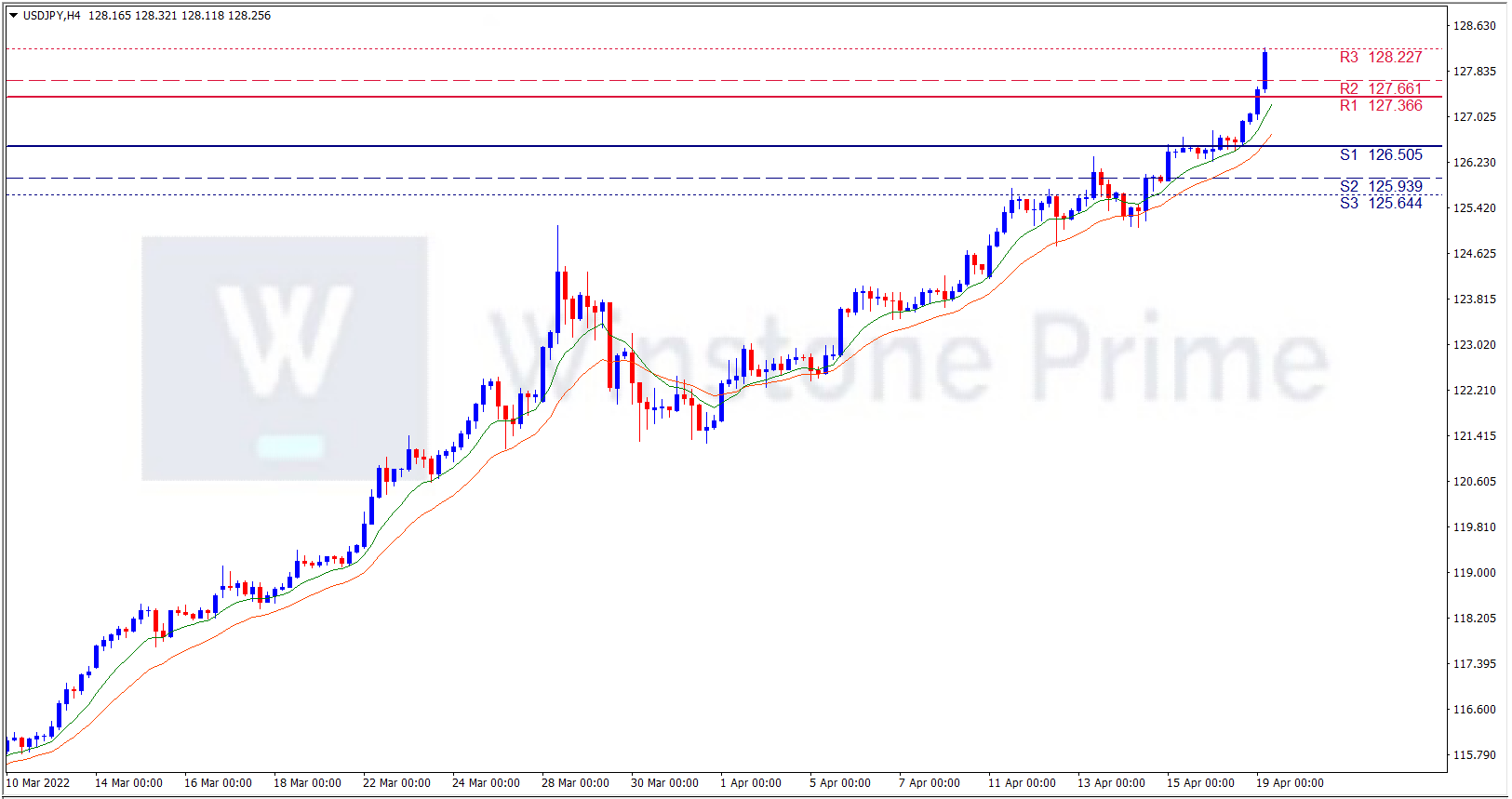
Support: 126.51 (S1), 125.94 (S2), 125.64 (S3).

Resistance: 127.37 (R1), 127.66 (R2), 128.23 (R3).

The Strong dollar supported by the high U.S. Treasury yields and Hawkish fed weighs on the Japanese yen. We expect a bullish trend for USD/JPY.

Demand for safe-haven favors Gold

  • Gold Price edges higher as Easter Monday notices flight to safety.
  • Russia – Ukraine crisis and the recession risks favors the safe-haven assets.
  • Market will keep an eye on the FOMC Bullard’s speech due later today.


The yellow metal traded high against the US dollar during Monday trading session as investors flock towards ultimate safe haven amid a protracted Russia-Ukraine war and recession risks.

On Saturday, Russia’s warplanes bombed Lviv and its missiles struck Kyiv as Moscow followed through on a threat to launch more long-range attacks on Ukrainian cities after the sinking of its Black Sea Fleet flagship. Ukraine’s military said Russian warplanes that took off from Belarus had also fired missiles at the Lviv region near the Polish border, where four cruise missiles were shot down by Ukrainian air defences.

Russia said it also struck a military vehicle repair factory in Mykolaiv, a city close to the southern front. The attacks followed Russia’s announcement on Friday that it would intensify long-range strikes in retaliation for unspecified acts of “sabotage” and “terrorism”, hours after it confirmed the sinking of its Black Sea flagship, the Moskva. Kyiv and Washington say the ship was hit by Ukrainian missiles, a striking display of Ukraine’s military success against a far better-armed foe. Moscow says it sank after a fire.

Whereas, The European Union’s forthcoming sanctions on Russia will target banks, in particular Sberbank SBER.MM , as well as oil, the head of the European Commission Ursula von der Leyen told a German newspaper. The EU has so far spared Russia’s largest bank from previous sanctions rounds because it, along with Gazprombank, is one of the main channels for payments for Russian oil and gas, which EU countries have been buying despite the conflict in Ukraine. The European Union’s forthcoming sanctions on Russia will target banks, in particular Sberbank SBER.MM , as well as oil, the head of the European Commission Ursula von der Leyen told a German newspaper.

Meanwhile, China is expected to report a sharp deterioration in economic activity in March as COVID-19 outbreaks and lockdowns hit consumers and factories, although first-quarter growth may have perked up due to a strong start early in the year.

U.S. stock investors are worried that geopolitical uncertainty and the Federal Reserve’s fight against inflation could dent economic growth are heading for defensive sectors they believe can better weather turbulent times and tend to offer strong dividends.

Market will focus on the speech from the St. Louis Fed President and FOMC member James Bullard, which will provide insights into the likely monetary policy action by the Fed.

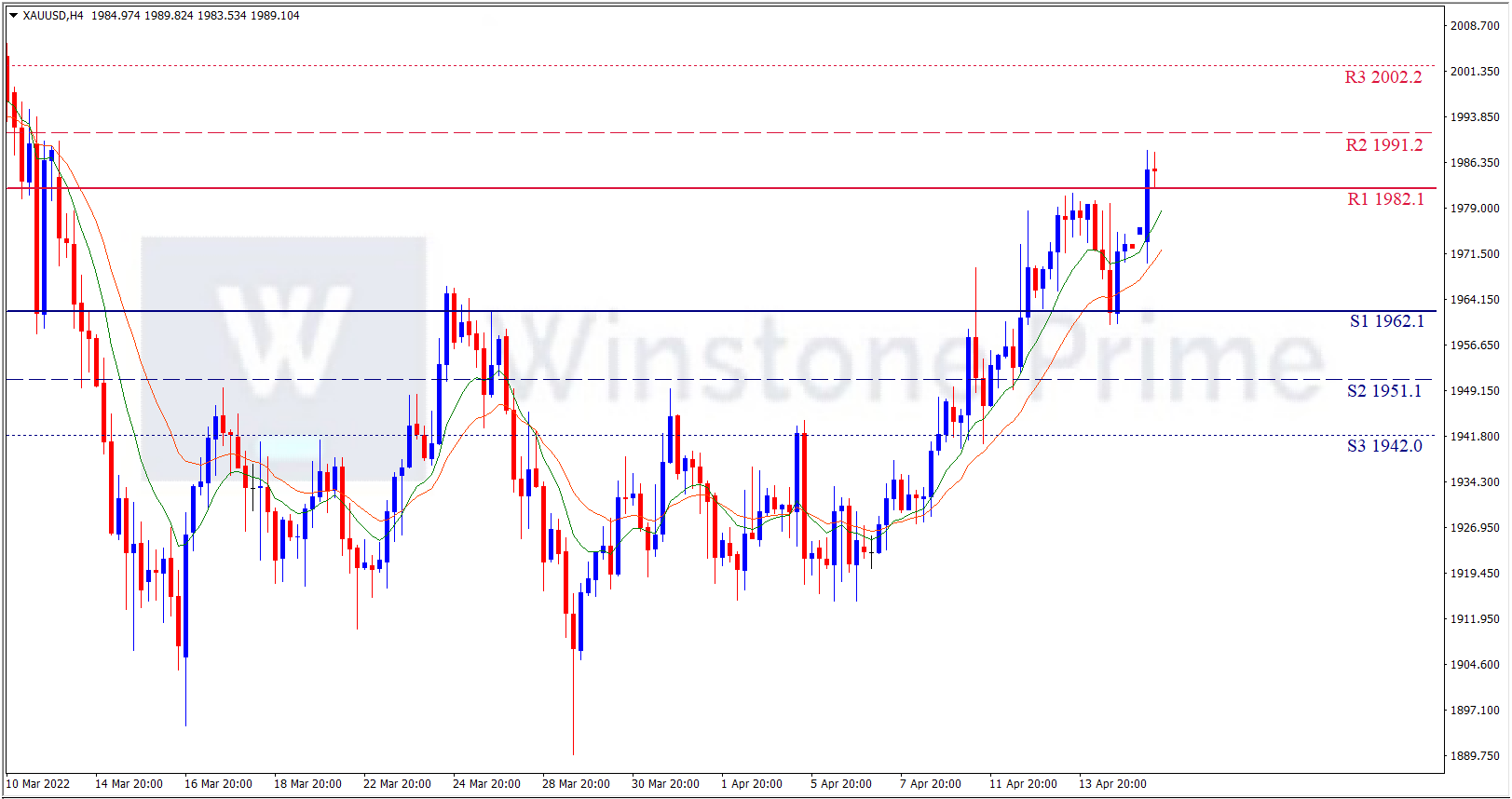
XAU/USD 4 Hour Chart:

Support: 1962.1 (S1), 1951.1 (S2), 1942.0 (S3).

Resistance: 1982.1 (R1), 1991.2 (R2), 2002.2 (R3).

Amidst all the catalysts favoring the demand for safe haven, we expect a bullish trend for XAU/USD.

BTC/USD Weekly Forecast (18th April 2022 – 22nd April 2022)

Fundamental view:

Bitcoin dropped against the US dollar during the trading course of the week. The Crypto king traded low this week with US inflation data, possible moves by the US Federal Reserve (Fed), and bearish-looking technology stocks all weighing on investors’ sentiment and causing worry about the way forward. Bitcoin is trading near the $40,000 support level, which runs through the lows of the first three months of the year. Analysts said bitcoin could see more choppy price action in the coming months.

On the other hand, The Fed policymakers reiterated a 50 bps rate hike in May and paved the way for a reduction of the balance sheet .New York Fed President John Williams said that a half-point hike at the May 4 meeting  was a “very reasonable option” but that the pace of increases depends on the economy. Meanwhile, the Australian data was mixed this week. Commenting on the outlook for the US economy, Cleveland Fed President Loretta Mester said that she believes a US recession can be avoided even as the Fed continues to tighten. “It’ll be challenging, but we can do it,” she said, per a Bloomberg report.

The major economic events deciding the movement of the pair in the next week are Building Permits at Apr 19, EIA Crude Oil Stocks Change, Fed Beige Book at Apr 20, Philadelphia Fed Manufacturing Index, Initial Jobless Claims, Fed Chair Powell Speech at Apr 21 and S&P Global Manufacturing PMI at Apr 22 for US.  

BTC/USD Weekly outlook:

Technical View:

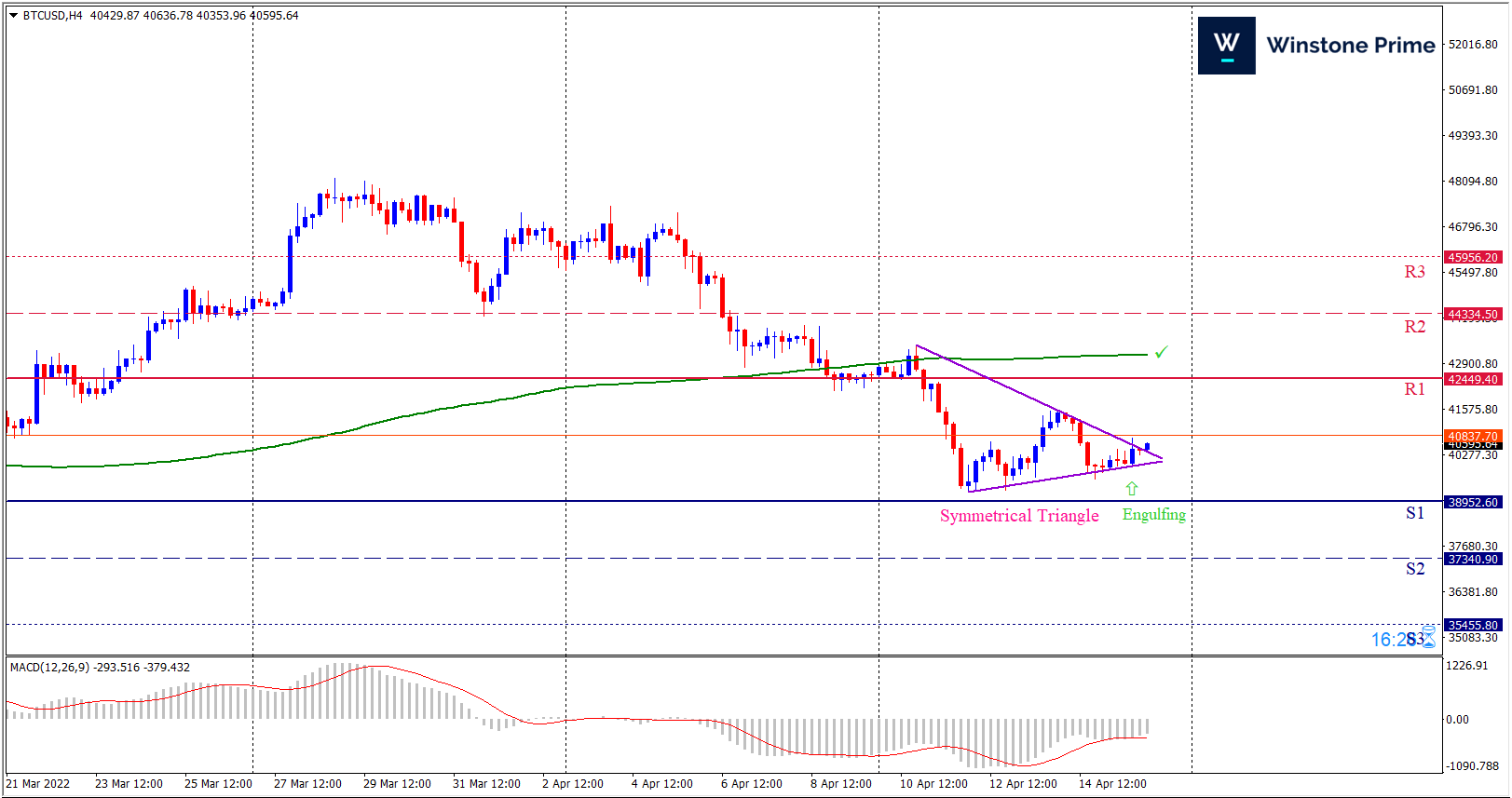
Last week’s high was 9.85% lower than the previous week. Maintaining high at 42722.9 and low at 39226.1 showed a movement of 3496 pips.

In the upcoming week we expect BTC/USD to show a bullish trend. The Instrument is trading below the 200 Simple Moving Average and the MACD trades to the downside. A solid breakout above 42449.4 may open a clean path towards 44334.5 and may take a way up to 45946.2. Should 38952.6 prove to be unreliable support, the BTCUSD may sink downwards 37340.9 and 35455.8 respectively. In H4 chart symmetrical triangle breakout favors prospects of a bullish trend. Bullish engulfing pattern constructs a bullish outlook for the pair in the upcoming week.

 Preference
Buy: 40838.7 target at 44333.5 and stop loss at 38948.6


Alternate Scenario
Sell: 38948.6 target at 35456.8 and stop loss at 40838.7

XAU/USD Weekly Forecast (18th April 2022 – 22nd April 2022)

Fundamental view:

Gold ended in the positive territory this week. Inflation fears, geopolitical tensions helped the safe haven flow thus favoring the precious yellow metal. Fading hopes about Russia and Ukraine reaching a peace agreement, the ongoing coronavirus-related lockdowns in China and inflation fears forced investors to move towards the safe haven gold. President Vladimir Putin has said that diplomatic talks are at a dead-end, as Kyiv has broken the agreement reached in Turkey. Attacks continue, and western nations keep piling up sanctions on Russia.

The US Bureau of Labor Statistics reported that inflation, as measured by the Consumer Price Index (CPI), surged to a new multi-decade high of 8.5% on a yearly basis in March from 7.9% in February. In the same period, the Core CPI edged higher to 6.5% from 6.4%. Moreover, The European Central Bank (ECB) announced that it left its policy settings unchanged after the April policy meeting. The ECB decided to stick to its plan of reducing net asset purchases under the Asset Purchase Programme (APP) to €20 billion in June before concluding the QE in the third quarter. 

The major economic events deciding the movement of the pair in the next week are Building Permits at Apr 19, EIA Crude Oil Stocks Change, Fed Beige Book at Apr 20, Philadelphia Fed Manufacturing Index, Initial Jobless Claims, Fed Chair Powell Speech at Apr 21 and S&P Global Manufacturing PMI at Apr 22 for US. 

XAU/USD Weekly outlook:

Technical View:

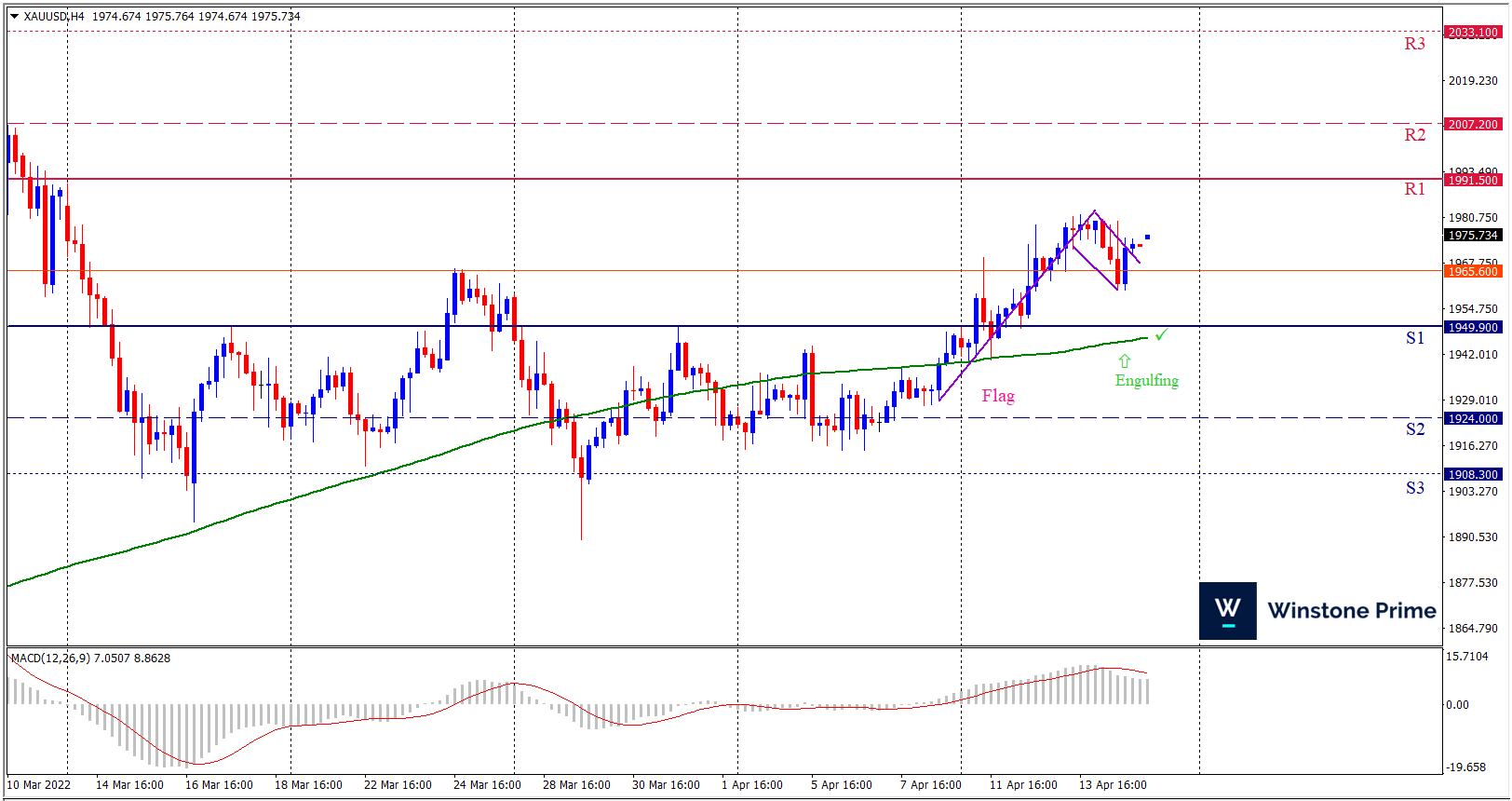
Last week’s high was 1.70% higher than the previous week. Maintaining high at 1981.4 and low at 1939.8 showed a movement of 416 pips.

In the upcoming week we expect XAU/USD to show a bullish trend. The Instrument is trading above the 200 Simple Moving Average and the MACD trades to the upside. A solid breakout above 1991.5 may open a clean path towards 2007.2 and may take a way up to 2033.1. Should 1949.9 prove to be unreliable support, the XAUUSD may sink downwards 1924.0 and 1908.3 respectively. In H4 chart bullish flag pattern formation favors prospects of a bullish trend. Also to be noted Bullish engulfing formation exerts the expectation of uptrend for the pair.

Preference
Buy: 1975.7 target at 2012.2 and stop loss at 1960.9


Alternate Scenario
Sell: 1960.9 target at 1925.4 and stop loss at 1975.7