GBP/USD Weekly Forecast (13th December 2021 – 17th December 2021)

Fundamental view:

The British pound has went back and forth against the greenback during the trading course of the week. As far as central banks are concerned, It is expected that the Fed will double the pace of tapering to $30 billion a month. US policymakers will keep rates on hold, but pulling off support programs is the first step towards tightening, that means the chances of one or two rate hikes in 2022 have increased. On the other hand,  All eyes are on the Bank of England’s decision on Thursday. Elsewhere, The sterling had already been under struggle with Johnson’s intentions to enact new restrictions in the face of rising COVID-19 cases in Britain. Waning immunity from vaccines, winter conditions and potentially a broader spread than the thought of the new Omicron variant are the main catalysts.

Positive update regarding the virus also joined in this week. The latest researches have suggested that Omicron is highly contagious but probably it is milder than previous variants. According to vaccine-makers Pfizer and BioNTech, three shots of their jab should provide sufficient protection.

Britain Markit/CIPS Construction PMI on 6th December and US CPI monthly report on 10th December framed downtrend whereas RICS House Price Balance on 9th December and Britain Manufacturing Production monthly report and Michigan Consumer Expectations on 10th December framed uptrend for the pair in this week.

The major economic events deciding the movement of the pair in the next week are UK Claimant Count Change at Dec 14, US Retail Sales monthly report, Fed Interest Rate Decision at Dec 15, BoE Interest Rate Decision, US Initial Jobless Claims, Fed Industrial Production monthly report at Dec 16, UK Retail Sales monthly report and Fed Governor Waller Speech at Dec 17.

GBP/USD Weekly outlook:

Technical View:

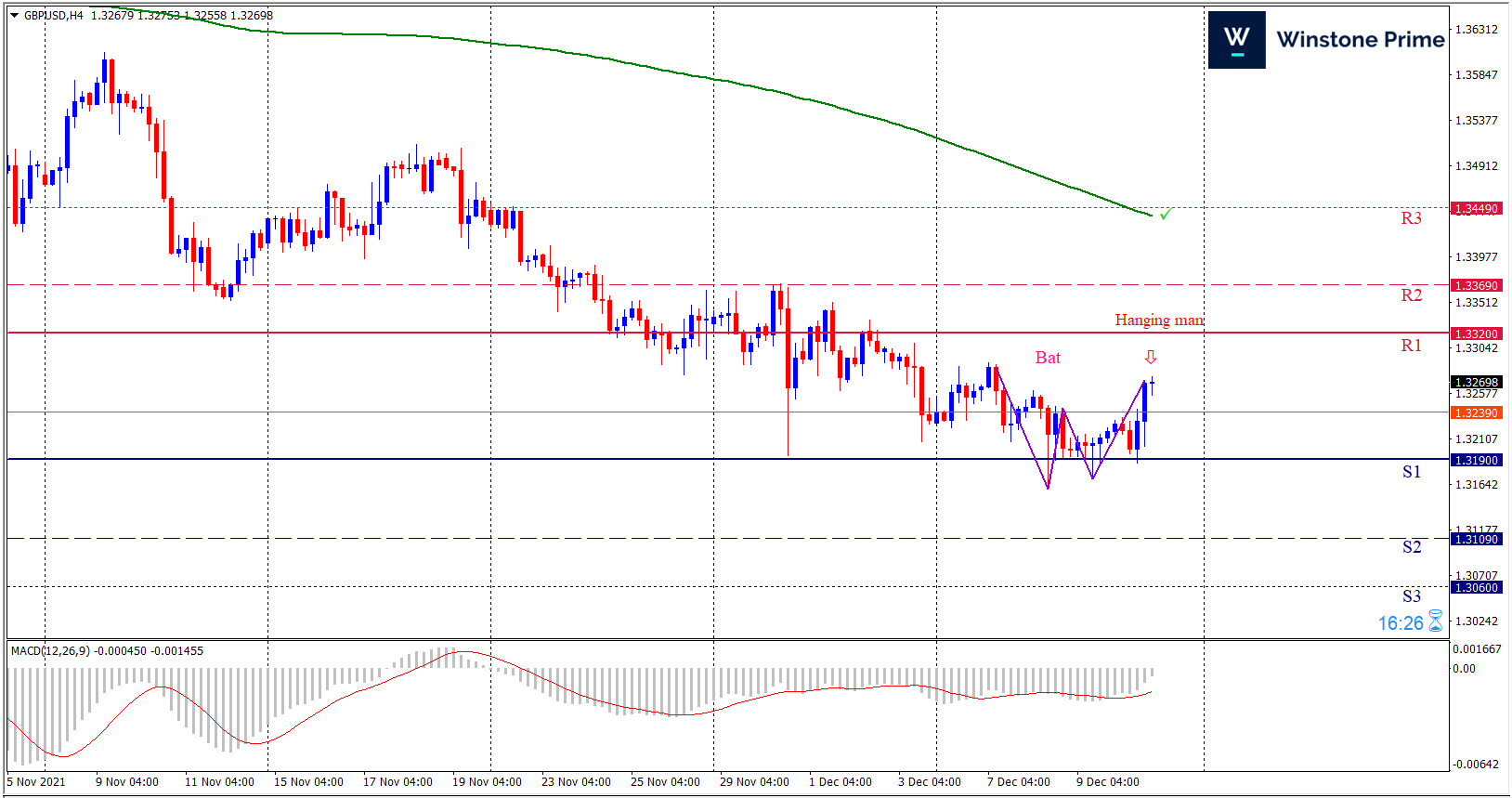
Last week’s high was 0.61% lower than the previous week. Maintaining high at 1.3289 and low at 1.3159 showed a movement of 130 pips.

In the upcoming week we expect GBP/USD to show a bearish trend. The currency pair is trading below the 200 Simple Moving Average and the MACD trades to the downside. Should 1.3190 proves to be unreliable support then the pair may fall further to 1.3109 and 1.3060 respectively whereas a solid breakout above 1.3320 will open a clear path upward to 1.3369 and then will further raise up to 1.3450. Chart formation of bearish bat pattern in H4 chart favors prospects of a bearish trend. Hanging man pattern formation further escalates the expectation for a bearish trend.

Preference
Sell: 1.3265 target at 1.3141 and stop loss at 1.3325


Alternate Scenario
Buy: 1.3325 target at 1.3448 and stop loss at 1.3265

EUR/USD Weekly Forecast (13th December 2021 – 17th December 2021)

Fundamental view:

The Euro has gone back and forth during the course of the week again, same as it did in the previous two weeks. Market is priced at the speculation of US Federal Reserve likeliness of announcing a doubling of its bond-buying program tapering. It is expected that the Fed will double the pace of tapering to $30 billion a month. US policymakers will keep rates on hold, but pulling off support programs is the first step towards tightening, that means the chances of one or two rate hikes in 2022 have increased. On the other hand, the European Central Bank has maintained a wait-and-see stance, President Christine Lagarde says that a rate hike would be unlikely in 2022, and warns that the central bank must not rush into premature tightening.

And with the increase in cases of Omicron, European governments have announced some restrictive measures, most of them involving the use of a “green pass” to access certain places and forcing unvaccinated people to take the shots to access a more normal life.

Eurozone Industrial Production yearly report and Eurozone Trade balance on 7th December and Initial Jobless Claims on 9th December framed bearish trend Whereas  ECB President Lagarde Speech on 8th December and Michigan Consumer Expectations on 10th December framed bullish trend for the pair in this week.

The major economic events deciding the movement of the pair in the next week are US Retail Sales monthly report, Fed Interest Rate Decision at Dec 15, ECB Interest Rate Decision, ECB Monetary Policy Press Conference, US Initial Jobless Claims, Fed Industrial Production monthly report at Dec 16, Eurozone Ifo Business Climate and Fed Governor Waller Speech at Dec 17.

EUR/USD Weekly outlook:

Technical View:

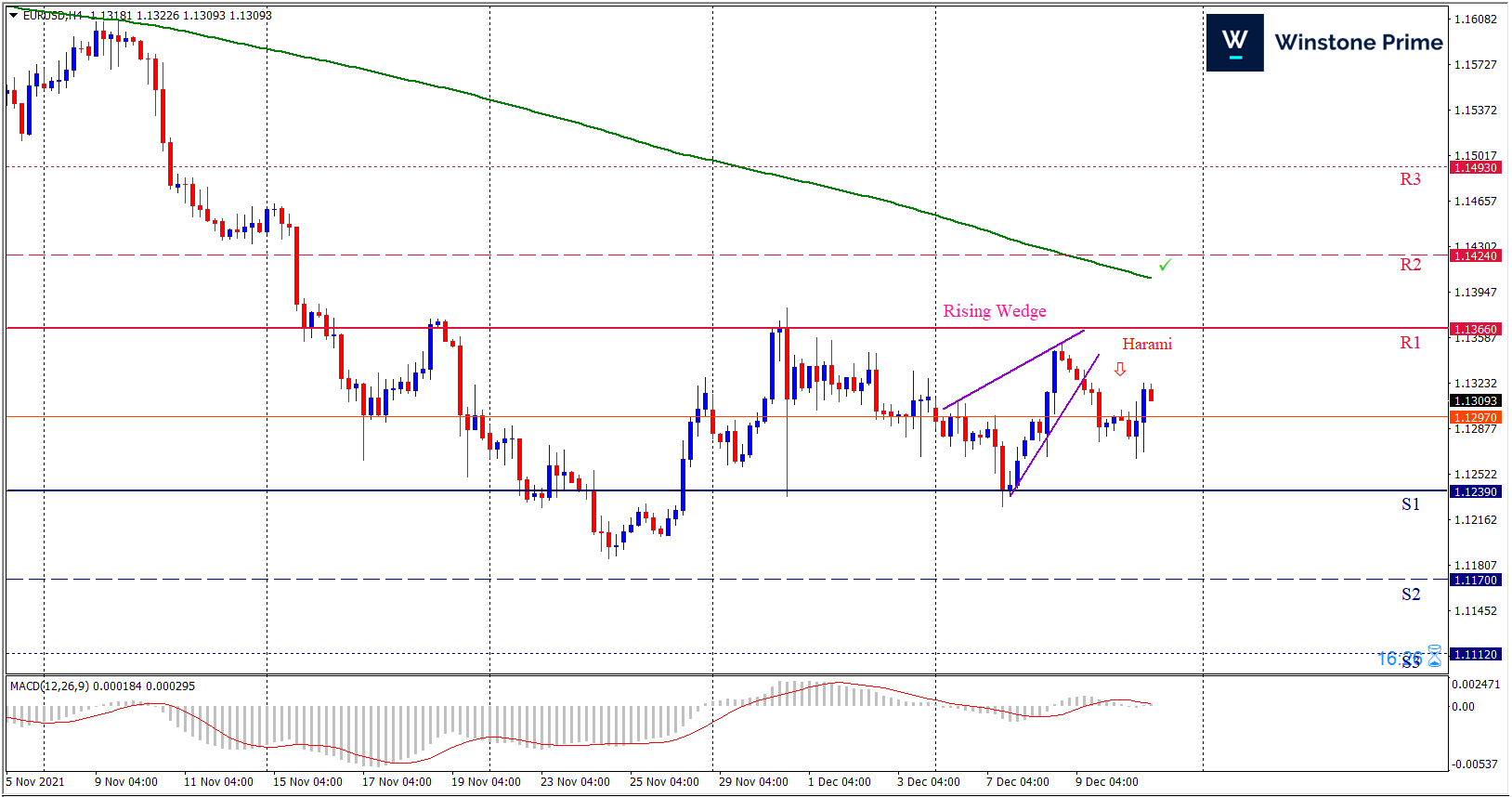
Last week’s high was 0.25% lower than the previous week. Maintaining high at 1.1354 and low at 1.1227 showed a movement of 127 pips.

In the upcoming week we expect EUR/USD to show a bearish trend. The currency pair is trading below the 200 Simple Moving Average and the MACD trades to the downside. Should 1.1239 proves to be unreliable support then the pair may fall further to 1.1170 and 1.1112 respectively whereas a solid breakout above 1.1366 will open a clear path upward to 1.1424 and then will further raise up to 1.1493. Chart formation of a rising wedge pattern breakout in H4 chart sets prospects for a bearish trend. Bearish harami formation in H4 chart escalates the expectation for a bearish trend.

Preference
Sell: 1.1296 target at 1.1171 and stop loss at 1.1371


Alternate Scenario
Buy: 1.1371 target at 1.1492 and stop loss at 1.1296

Financial adviser warning weighs on BTC

Bitcoin trades downside against the greenback during Friday Asian session. The warning from the Financial adviser seems to pressure the Bitcoin.  The president of Payne Capital Management, Ryan Payne has warned that crypto is “one of the biggest bubbles ever.” Stressing that the crypto market is “becoming a bigger and bigger casino,” he predicts that the bubble will eventually burst and “It’s going to be ugly.”

Elsewhere, Berkshire Hathaway Vice Chairman Charlie Munger, who is often called Warren Buffett’s right-hand man, also commented on cryptocurrency, particularly bitcoin. He commended China for banning crypto and said he wishes crypto had never been invented.

Payne noted that bitcoin can still go higher, adding: “There’s too much money out there that can funnel into this market. It’s just becoming a bigger and bigger casino.” “At the end of the day, we’re not using it for that much more commercial use. It’s just more people speculating,” he continued, adding that “it’s very analogous to when the tech bubble burst.”

Another recent news weighs on the crypto king, The White House announced Monday, “In line with the president’s direction, the Biden-Harris administration is releasing the first-ever ‘United States Strategy on Countering Corruption.’” The 38-page report outlines the U.S. government’s strategy to fight corruption globally.

One of the key strategies is to “enhance enforcement efforts,” which includes a section on “cryptocurrency and corruption.” The report states: “DOJ will utilize a newly established task force, the National Cryptocurrency Enforcement Team, to focus specifically on complex investigations and prosecutions of criminal misuses of cryptocurrency.”

On the other hand, Some traders use the strategy of buy the dip for bitcoin.  El Salvador has stacked 150 Bitcoin after BTC price crashed below $50k. Following the footsteps of El Salvador, the government of Zimbabwe is considering the mainstream use of Bitcoin. As reported, retired Brigadier Colonel Charles Wekwete, the permanent secretary and head of the office of the president and cabinet’s e-government technology unit, confirmed that discussions with businesses are already underway.

According to Wekwete, the authorities intend to develop regulations to protect consumers against financial threats such as unregistered cross-border transfers, externalization of money and money laundering.

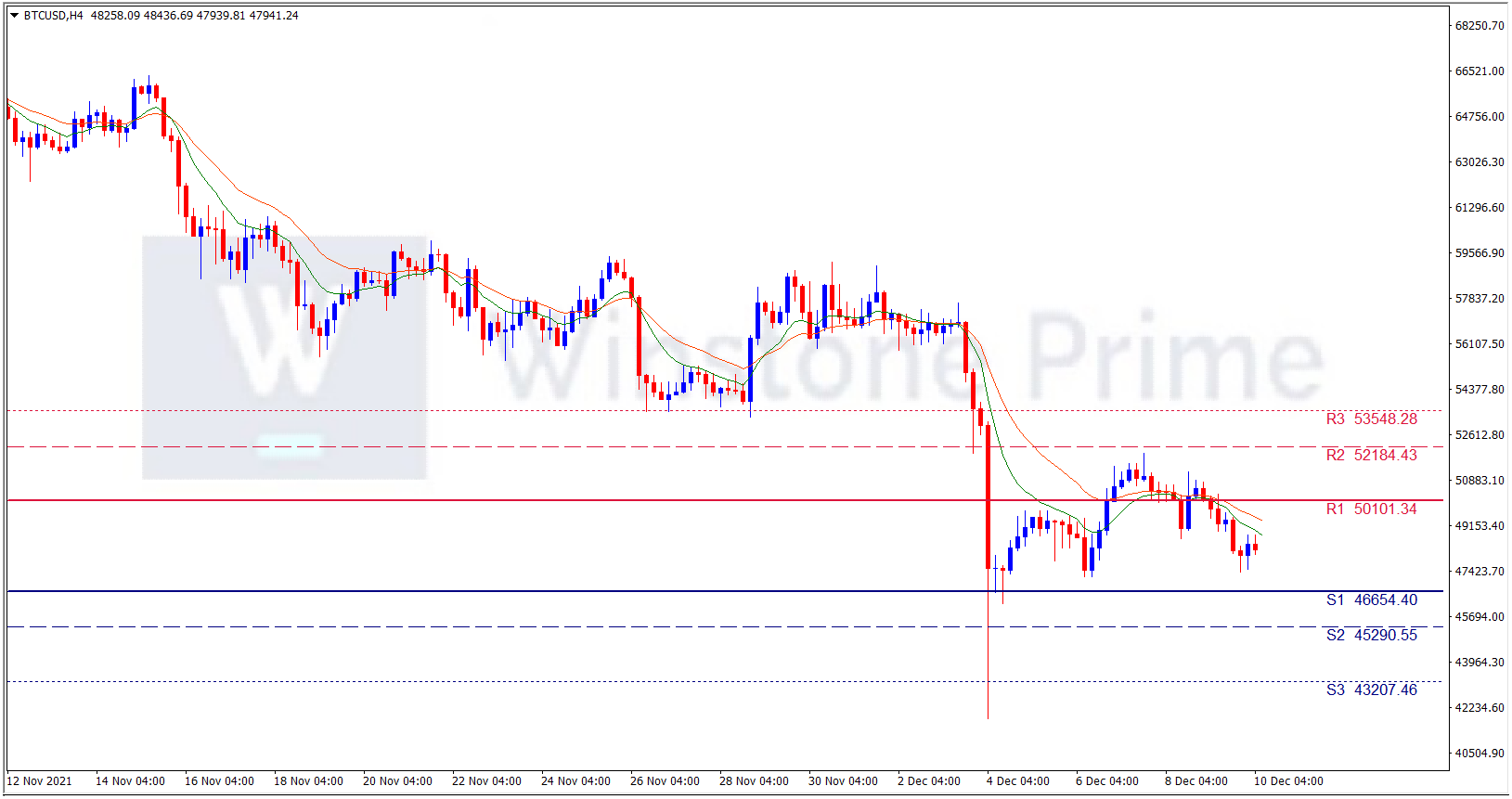
BTC/USD 4 Hour Chart:

Support: 46654.4 (S1), 45290.6 (S2), 43207.5 (S3).

Resistance: 50101.3 (R1), 52184.4 (R2), 53548.3 (R3).

Bitcoin trades downside due to the recent unfavorable news, additionally the US dollar strength also underpins this move. We expect a bearish trend for BTC/USD.

10 Principles of Winning trader’s mindset

What separates a winning trader from a losing trader is their right trading mind set.

Having the right trading mindset is an integral part of surviving in the financial markets. With the help of correct set of attitudes, beliefs, and habits, you will have a better chance of being able to successfully tackle the obstacles in the trading world.

To develop a winning mindset is not always that easy, Moreover, If you have faced recent losses than it becomes more hard to remain positive and to develop right mindset.

We have listed 10 important Principles of Winning trader mindset here, each of the principle below is important, but when they work together the effects are strong. Keeping them in mind will help in creating right mindset thus greatly increasing your odds of succeeding in the markets.

1. Develop and stick to a Trading Plan

A trading plan is a written set of rules which specifies a trader’s entry, exit, and money management criteria for each and every trade.

Develop your trading plan and backtest the trading plan using historical data and determine if it is viable. Once a plan has been developed and backtested which shows good results, the plan can be used in real trading.

The main key is to stick to the plan. Taking other trades outside of the trading plan, even if they turn to be successful are considered poor strategy.  Also, keep in mind that the plan must be adapted to your strategy at all times – so be ready to adjust it!

2. Don’t rush and be patient

Like any other business, rush in trading will also head you towards a certain demise. Even though you have good knowledge of trading, you should never rush for a trade or a day of trading. This way you cannot become a expert or senior trader.

A successful trader will always trade their last deal just as they did their first; with enough patience and constantly being aware of the possibility of losing. Winning traders are always patient when trading regardless of their portfolio and capital.

3. Trade like a business

Approach trading as a full- or part-time business to be successful. Don’t treat trading as a hobby or a job. If trading is treated as a hobby, you will not be committed to learn. If it is approached as a job, it can be frustrating because there is no regular salary/paychecks.

Trading is a business and incurs expenses, losses, taxes, uncertainty, stress, and risk. To trade like business, you are like a small business owner and you must do research and develop strategize to maximize your business’s potential.

4. Safeguard your Trading Capital

To save enough money for a trading account will require a lot of time and hence it is a better idea to protect the trading capital instead of doing it twice.

Do not risk your entire capital in a trade, keep a mark say maximum of 2% of your portfolio per trade. It is important to note that protecting your trading capital is not synonymous with never experiencing a losing trade. Every traders have losing trades.

Along with keeping a mark of certain percentage per trade Protecting capital entails not taking unnecessary risks and doing everything you can to preserve your trading business.

5. Risk Only Affordable Loss

Always invest the amount in trading that you can afford to lose. Thus save enough before starting to trade with real cash.

Money in a trading account should not be allocated for the paying the mortgage or to pay any grocery bills. Traders must always avoid to think they are simply borrowing money from these other important obligations.

Losing money is traumatic enough, It is even more so if it is capital that should have never been risked in the first place.

6. Avoid trading under pressure

Suppose for example you get a tip that says buying a certain currency will guarantee profit  , the majority of traders would just go for it.

Whereas on the other hand, The winning trader, will rarely trade based on tips and, most importantly, will never trade unless they feel it’s the right.

7. Always have a watch on the News

Social media can be a good friend for you while trading. However, you cannot compare blogs and online journals that talk about trading and the latest movements of the markets.

You need to ultimately spend half of the time in the trading world on reading the news and getting informed and thus planning your next move and investment accordingly.

8. Stay Flexible

It’s vital for a trader to remain flexible and consider experimenting from time to time. For example, you might consider using options to mitigate risk.  A best way a trader can learn is by experimenting (within reason). The experience may also help reduce emotional influences.

Traders should also periodically assess their own performances.  After reviewing their returns and individual positions, additionally traders should reflect on how they prepared for a trading session, how up to date they are on the markets, and how they’re progressing in terms of ongoing education.

This self assessment can serve helpful to a trader for correcting mistakes, change bad habits, and enhance overall returns.

9. Be ready to stop trading if needed.

There are mainly two reasons for stopping trade: an ineffective trading plan, and an ineffective trader.

A trading plan which shows much loss than were anticipated in historical testing is an ineffective trading plan. The reason behind this would be Markets may have changed, or volatility may have lessened. For whatever reason, the trading plan simply is not performing as expected.

Stay unemotional and businesslike in this scenario. It’s time to reevaluate the trading plan and make a few changes or to start over with a new trading plan. An unsuccessful trading plan is a problem that need to be rectified.

A trader who makes a trading plan but not stick it to it is called an ineffective trader. External stress, poor habits, and lack of physical activity can all contribute to this problem.  On facing such problem, a trader should consider taking a break. After any difficulties and challenges have been dealt with, the trader can return to business.

10. Accept Wins and loss in same manner

Beginner traders usually end up quitting the trading after their first big loss. Of course, that’s not the mentality of a winner.  The first big loss is only the first step towards countless future wins – but you have to know how to treat this loss/mistake.

Once a trader accepts wins and losses as part of the business, emotions will have less of an effect on trading performance. That is not to say that we cannot be excited about a particularly fruitful trade, but we must keep in mind that a losing trade is never far off.

The Bottom Line:

Trading is really a difficult game which requires a lot of time and effort to master. Only a few people become highly successful at it.

But remember it is virtually possible for anyone to develop a winning trader mindset as long as they are willing to make the necessary effort.

Put some thought into these principles and incorporate them into as many aspects of your life as you can. Trading is a fantastic teacher of life’s greatest lessons. Allow the trading journey to shape you into the person you want to become.