Dollar strength weighs on yellow metal

The yellow metal is trading low against the greenback today. The metal witnessed a volatile session on Tuesday that plucked away multi-day peak of the pair towards the heaviest daily loss in a fortnight.

Yesterday’s volatility could be linked to the Upbeat US retail data,  Fedspeak trying to suppress the reflation fears and the start of the virtual meeting between US President Joe Biden and his Chinese counterpart Xi Jinping.

The US monthly Retail Sales exceeded the expectation and recorded a strong growth of 1.7% in October. Excluding autos, core retail sales also climbed by 1.7% in October which is also higher than market expectations of 1%.

Federal Reserve officials said on Tuesday that they are vigilant of the ways that higher inflation can affect U.S. households and dampen consumer sentiment and want to get it under control. Which also underpinned the US dollar strength.

Elsewhere, U.S. President Joe Biden pressed his Chinese counterpart on human rights in a video call which lasted for more than three hours, while Xi Jinping has warned that China would respond to provocations on Taiwan, according to official accounts of the exchange.

US Treasury yields reached fresh weekly highs, with that on the 10-year note reaching 1.63%,  further supporting the dollar’s demand.

Hawkish comment from the St. Louis Fed President James Bullard also underpinned the US dollar strength. He said “If inflation happens to go away we are in great shape for that. If inflation doesn’t go away as quickly as many are currently anticipating it is going to be up to the (Federal Open Market Committee) to keep inflation under control.”

“The inflation rate is quite high,” Bullard said. “It behooves the committee to tack in a more hawkish direction in the next couple of meetings so that we are managing the risk of inflation appropriately.” 

XAU/USD 4 Hour Chart:
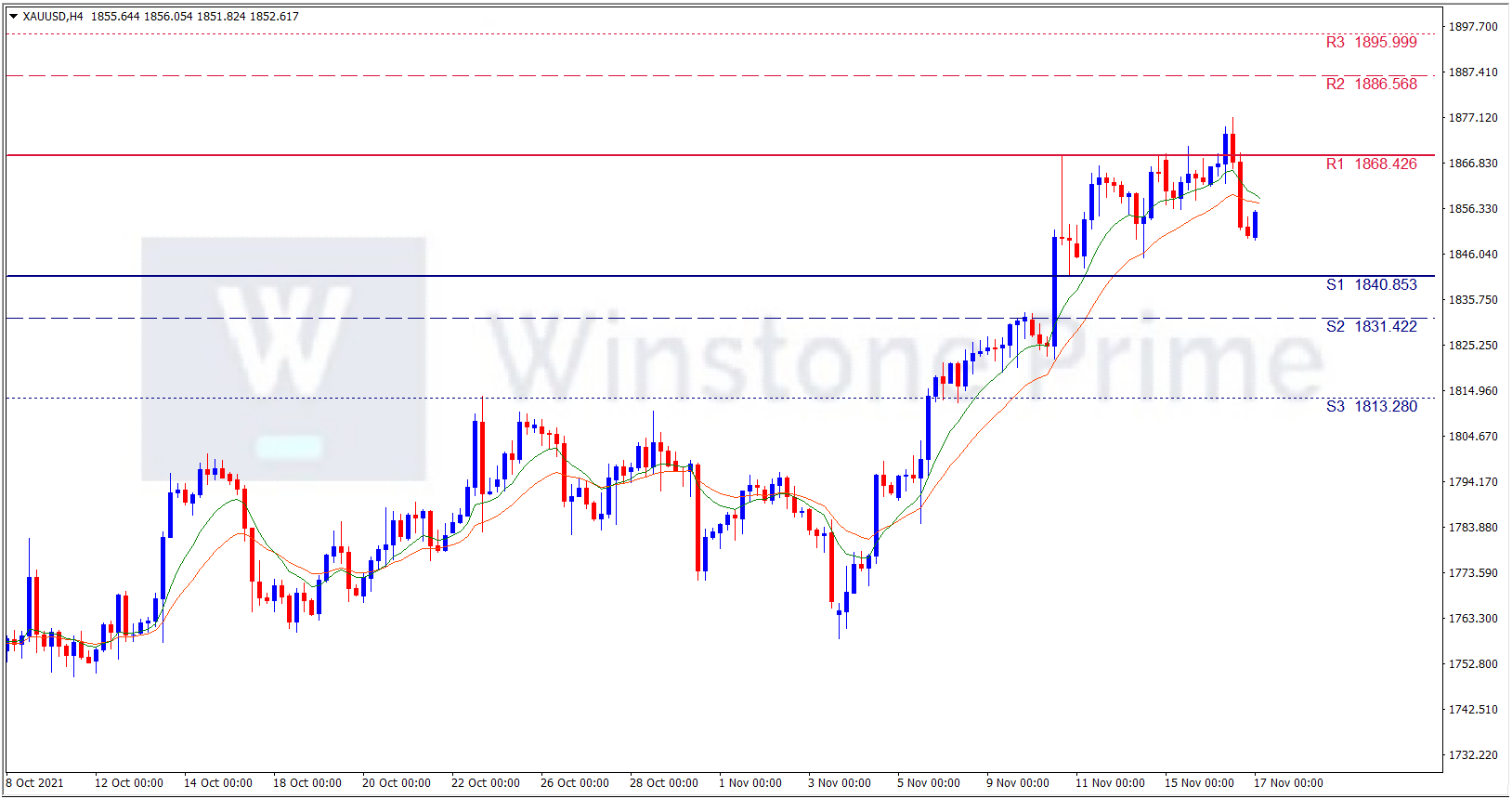
Support: 1840.9 (S1), 1831.4 (S2), 1813.3 (S3).

Resistance: 1868.4 (R1), 1886.6 (R2), 1896.0 (R3).

Meanwhile, strong US Retail Sales along with the Fedspeak favors the US dollar and weighs on the yellow metal. We expect a bearish trend for XAU/USD.
Brexit concerns impact sterling

Pound is trading in the positive node on Tuesday but struggles near 1.3420 level. The pound seem to trade higher against greenback although post-Brexit trade arrangements for Northern Ireland remain a risk which could drag the pound down.

Relations between the UK and EU have been tattered due to the British threats to trigger Article 16 an emergency plan of the Northern Ireland Protocol.

European Commission’s Maros Sefcovic said “The EU will consider all tools at its disposal if the UK Government triggers Article 16. If the British Government suspends the Northern Ireland Protocol, it will have serious consequences for the region and Brussels’ relationship with the UK.”

On the positive side, He said that, “Last Friday, I held my fourth weekly meeting with David Frost on the EU package of solutions”. He also acknowledged and welcomed the change in tone of this discussion compared to previous ones. 

Elsewhere After a small break in the Covid cases, the UK has again started witnessing the rise in new cases which would push the regulators to announce the extension of booster shots for people over the age of 40. If the cases continue to rise, it might lead to another lockdown.

Meanwhile, Bank of England Governor Andrew Bailey, speaking before the UK Parliament Treasury Select Committee TSC, said that all future BoE policy meetings are now “in play” for a rate rise. He added that, given the very high uncertainty in economy, it would be hazardous to give specific forward guidance about when exactly these hikes might come.

Traders will be keen to watch the UK jobs and Earnings data, US Retail Sales figure and the Fedspeak scheduled later in the day which will play a key role in directing the pair further.

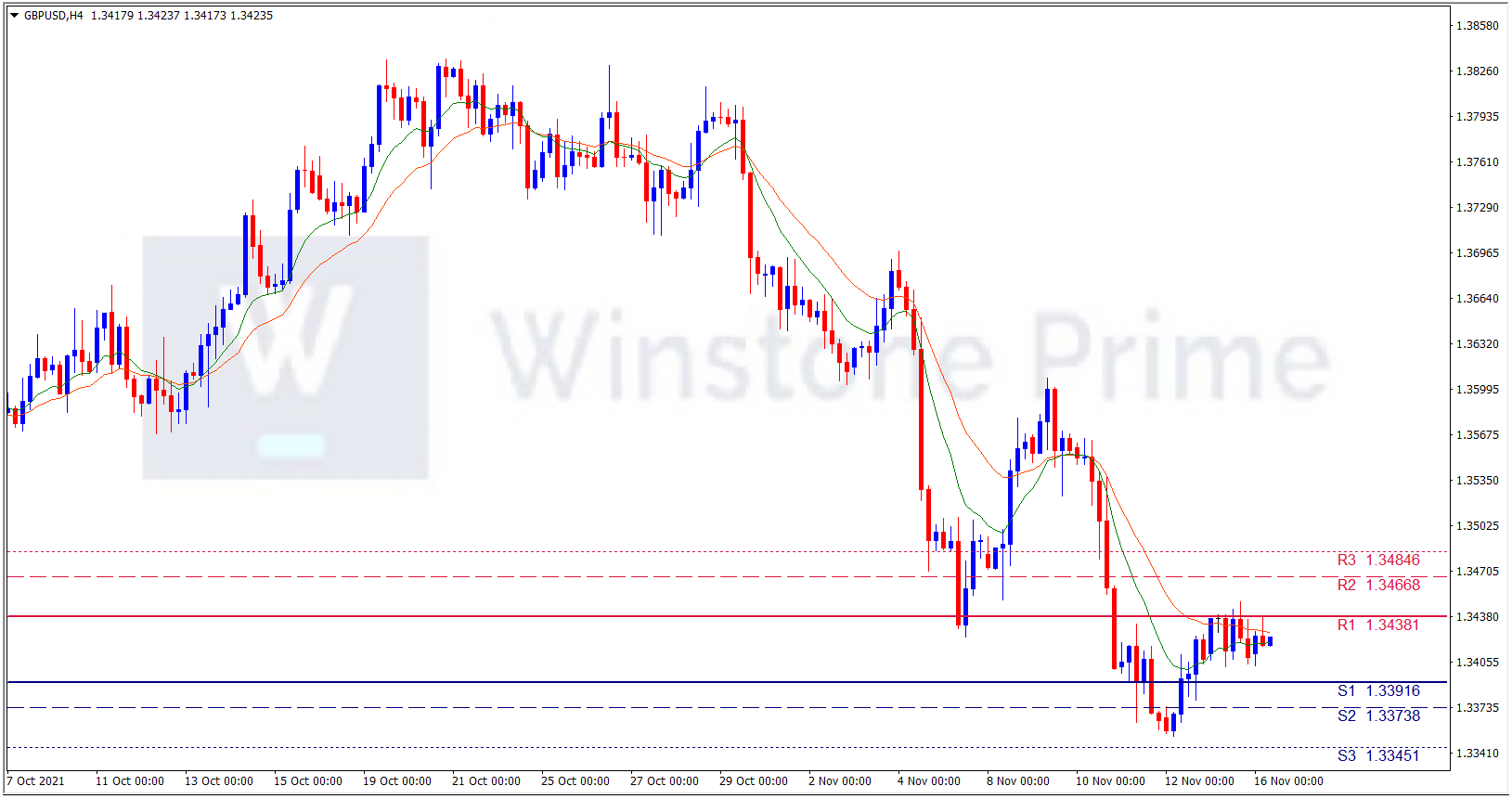
GBP/USD 4 Hour Chart:

Support: 1.3392 (S1), 1.3374 (S2), 1.3345 (S3).

Resistance: 1.3438 (R1), 1.3467 (R2), 1.3485 (R3).

The Pound seems trade on positive node but seem to struggle and started consolidating ahead of UK jobs data, we expect a mixed trend for GBP/USD.

What is Take Profit and Stop loss?

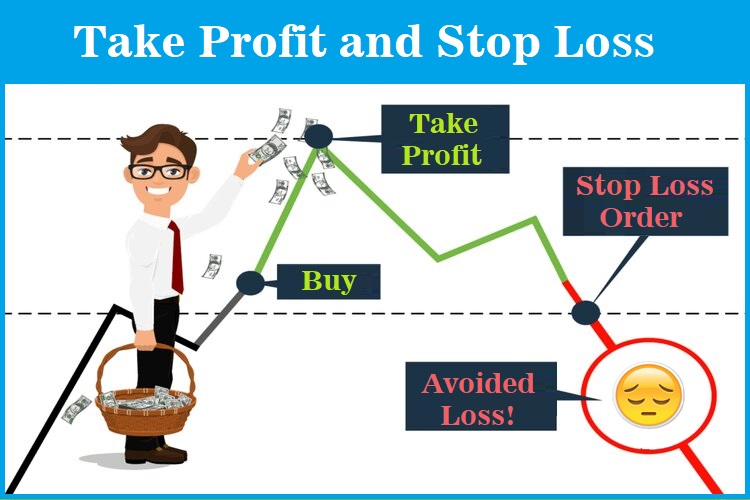
Take Profit: A take-profit order (T/P) is a type of limit order that specifies the exact price at which to close out an open position by booking a profit. If the price of the security does not reach the limit price, the take-profit order does not get filled.

Take-profit orders are the most efficient way of executing a trade and taking the human element out of managing an open position and very popular with short-term traders who monitor daily or even hourly price moves.

Stop loss: No one wish to lose money when they’re playing in the market. Thus it is important to set a floor for your position in a security. This is where stop loss comes in. A stop-loss is designed to limit an investor’s loss on a security position. 

By using stop loss and take profit orders in tandem you can control the risk Vs reward ratio of any trade you enter.

Basics of a Take-Profit/Stop loss:

Most traders use take-profit in conjunction with stop-loss to manage their open positions. If the security rises to the take-profit point, the Take profit is executed and the position is closed for a gain. If the security falls to the stop-loss point, the Stop loss is executed and the position is closed for a loss. The difference between the market price and these two points helps define the trade’s risk-to-reward ratio.

Take-profit orders/Stop loss is executed at the best possible price regardless of the underlying security’s behavior. On the other hand, If the security could start to breakout higher, but the T/P order might execute at the very beginning of the breakout and Stop loss might get executed even at small market fluctuation, resulting in high opportunity costs.

Take-profit/Stop loss orders are best used by short-term traders interested in managing their risk. This is because they can get out of a trade as soon as their planned profit target is reached or the price drops to the acceptable loss, these traders do not risk a possible future downturn in the market. Traders with a long-term strategy do not favor such orders because it cuts into their profits.

  • Maximize profit with Take profit: Take Profits allows the user to maximize the profit by exiting a trade as soon as the market is at a favorable price.
  • Stop Losses can limit losses: Stop-loss helps in preventing you from losing too much of your investment in a single trade. They benefit you because the market is very unpredictable. At one moment everything could be going very well, and in another, it could start falling without any reason. It allows you to decide what amount you are willing to risk.
  • Control of your account: By Setting Take profit and stop loss, you can have better control of your account.
  • Monitor multiple deals: By setting Take profit and stop loss, you can manage multiple trades easily.
  • Executed automatically, at any time: The benefit of using a take-profit and stop loss is that the trader doesn’t have to worry about manually closing a trade or second-guessing themselves.
  • Easy to implement: It is simple to use the Take profit and stop loss.
  • Miss out of higher profit: Although you’d be walking away with a profit, it is possible that a take-profit order would be executed just before prices continue to rise further, meaning you’ll miss out on a healthier margin. 
  • Not good for long-term traders: Take profit and Stop loss are a short-term strategy to guarantee you make some level of profit quickly which is not suitable for long term traders.
  • Market fluctuation: The main disadvantage is that a short-term fluctuation in a security’s price could easily activate the stop loss. After the stop loss is triggered, Market might reverse direction and rally in our intended direction.
  • Slippage: In high volatile times, stop loss might be triggered at the next available which might led to more loss than desired.
  • Control to Computer: The biggest problem with stop losses and take profit is that you have given up control of your order to the computer as sometimes human control can work well in unpredictable market moves.

How to use Take profit and Stop loss?

As already discussed, Both Stop Loss and Take Profit orders are basically you as a trader telling your broker when to close your trades. 

Both stop loss and take profit orders might seem very easy at one glance. 

You simply have to take note of how much you are willing to lose or gain and set them accordingly, right? Speaking technically, yes. But without proper research on how to book profits in trading, it’s likely that you will miss out on the majority of gains.

Stop loss and take profit orders may seem very easy to learn but they are quite hard in practice. They require months of learning about technical analysis. This is when a trader need to look at charts of different assets, and through calculations with different formulas determines when a currency pair can reach its peak price, and when it could possibly decrease too much.
 
Most traders usually go for stop-loss orders only in the beginning. This helps them experience the market much more even though they lose a bit for not placing take profit orders.
 
It’s important to remember that no matter how confident you are about the trade, a profitable trade position can go bad within seconds, and a small loss can turn into a large one in just a fraction of minutes. Stop loss and take profit are simply unavoidable tools to use when trading.

Moving on to placing stop loss and take profit, we will first try to understand types of setting them.

Types of Stop loss/Take profit:

A percentage stop loss/take profit order is exactly as the name sounds. Instead of instructing the broker at what exchange rate you’d like your order to be closed, you simply instruct the percent of your entire invested amount you are ready to lose in case of Stop loss or ready to get as reward in Take profit.

For example imagine that you are trading at $10000 and are ready to lose $1000 from it. Without telling at what exchange rate the stop loss has to be set, you simply say that your stop loss is 10%. It is exactly the opposite for take profit. This is how to use stop loss/take profit in percentage.

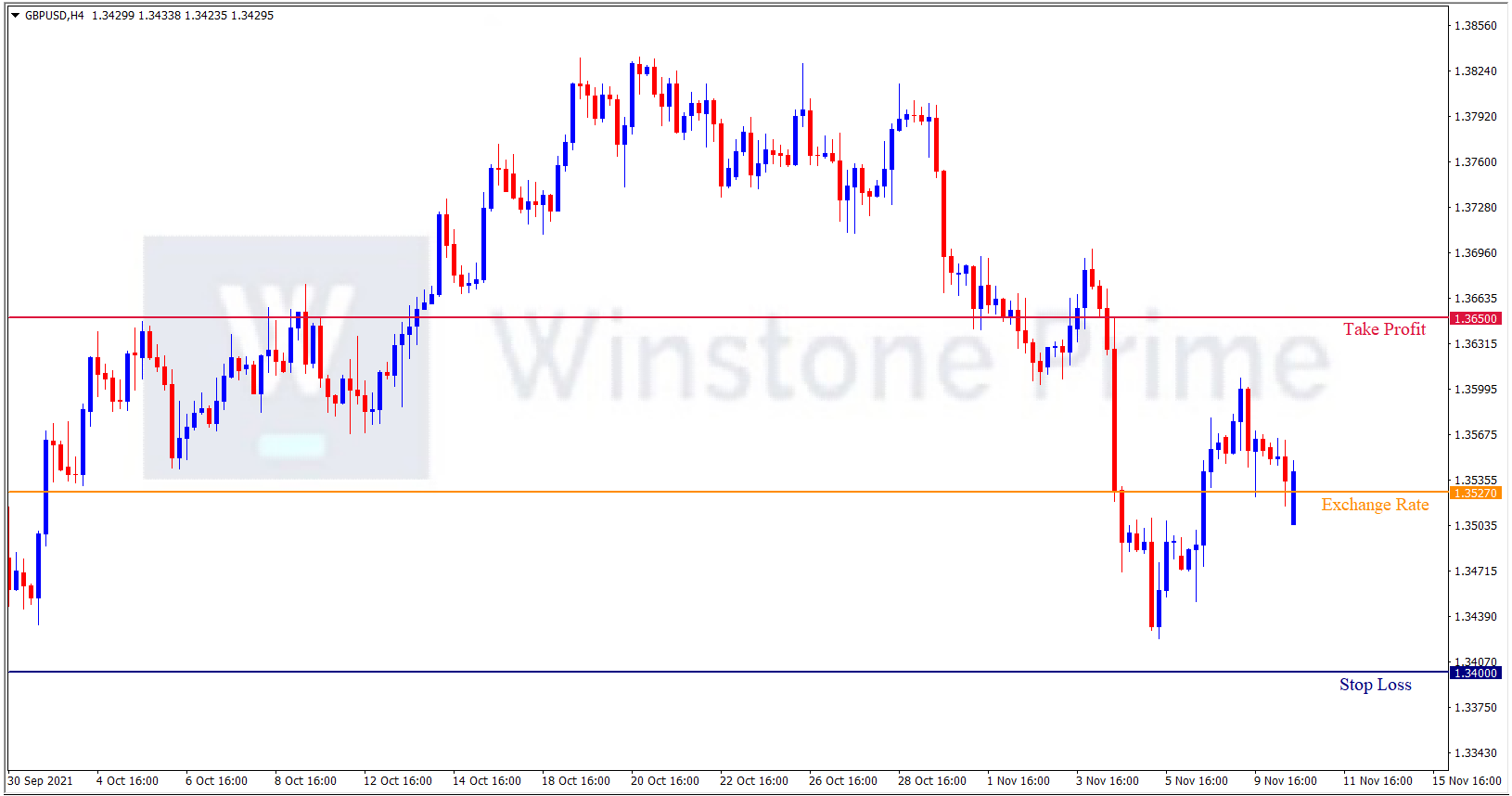
A chart stop loss/take profit is commonly used by the traders. In this, suppose you are looking at a GBP/USD chart. The exchange rate is 1.3527, but you think that it may increase to a maximum price of 1.3650 in an hour but you’re not really sure and you also predict that it might drop to 1.3400. So, what you do is you place a take profit at 1.3650 and stop loss order at 1.3400. If the exchange rate raises to the placed amount then the trade might automatically close with booking the profit or it drops to this amount, then it might as well cut your losses short with this order.

Technical knowledge is required for predicting this, but why not use take profit/stop loss in Forex trading when it can earn/save you so much?

A volatility stop loss/take profit is when a trader tells how much volatility of an asset is fine for them. Volatility means the frequency and timing of the change in the price of a currency pair. If it does so every second with quite a lot of pips, then it’s considered to be high volatility. The opposite would be considered low volatility.

It is up to you to calculate how much volatility is too much for you and tell your broker your preferences on the volatility level.

These are the different ways of setting stop loss/take profit i.e telling your broker on when to exit your trade. You can choose any of the above whichever seems comfortable for you.

Final words:

Do not forget Take profit/Stop loss is an important trading tool in your rich trading portfolio. Stop-loss prevents you from losing too much of your investment in one trade. Take profit helps you to lock-in what you’ve already earned. They are very beneficial to you because the market is very unpredictable. At one moment everything might seem favorable for you and in another, it could start falling without any reason.

Moreover, you’re not always near your computer, so you can’t close trades that have caused loss. A stop loss would close them for you and prevent your account from taking too much damage.

Rely on it in order to get better control of your deals and emotions. It may take some time to learn the basics of SL/TP orders but when it is done, you are left with another must-have trading skill so start practicing it now.

Happy trading!

Downbeat Michigan Sentiment impacts USD

Euro is trading high against greenback and the pair EUR/USD is hovering around 1.1450 level in the early Asian session.  On Friday, the major currency pair dropped to a fresh 16-month low 1.1432 before bouncing. The bounce of the Euro can be related to the cautious market mood amid the downbeat Michigan Consumer Sentiment.

The dollar was down on Monday morning in Asia.  The mixed concerns about the US stimulus and inflation along with the Fed rate hike after the f Friday’s surprisingly downbeat Michigan Consumer Sentiment data which slumped to a 10-year low; seem to create the cautiously optimistic market mood which pulled the dollar down.

Elsewhere, latest comments from the Federal Reserve Bank of Minneapolis President Neel Kashkari also underpinned the cautious market mood. Minneapolis Federal Reserve Bank President Neel Kashkari said on Sunday he expects higher inflation continuing over the next few months but warned that the U.S. central bank should not overreact to elevated inflation as it is likely to be temporary.

He said “The math suggests we’re probably going to see somewhat higher readings over the next few months before they likely start to taper off.”

Also Fed rate hike woes remain elevated which ignores the policymakers transitory outlook for inflation, as inflation fears and consumer confidence data portray the reflation fears.

On the other hand, On Friday, Governing Council member of ECB Gediminas Shimkus said that inflation will fall below target in 2023 by adding that it is not in line with the forward guidance conditions. Whereas His fellow Official at the ECB Olli Rehn said the same day that the relief on supply bottleneck may not arrive until toward the end of 2022.This mixed comments from the ECB policy makers also helped the Euro.

Investors now await U.S. retail sales data, which will be released on Tuesday. National Australia Bank (OTC:NABZY) head of FX strategy Ray Attrill said that “It will be important to watch what still cashed-up U.S. consumers do rather than what they say,” considering readings of sentiment were at odds with actual spending during the summer.”

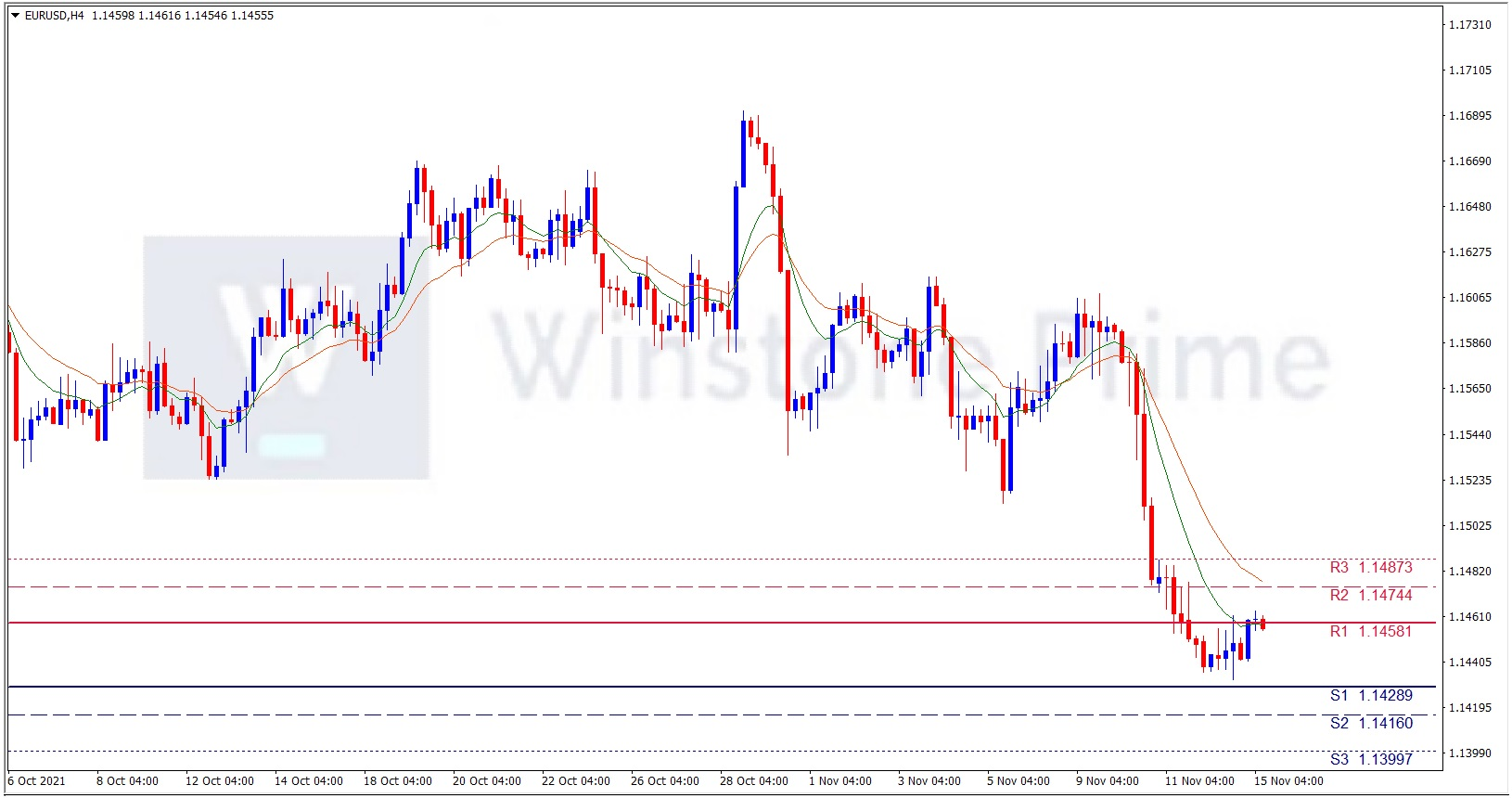
EUR/USD 4 Hour Chart:

Support: 1.1429 (S1), 1.1416 (S2), 1.1400 (S3).

Resistance: 1.1458 (R1), 1.1474 (R2), 1.1487 (R3).

Amidst all the catalysts dragging the traders towards optimistic cautious mood favoring the Euro, We expect a bullish trend for the EUR/USD.