GBP/USD Weekly Forecast (15th November 2021 – 19th November 2021)

Fundamental view:

Pound had a fall against the greenback in this week reaching a fresh 2021 low. This is mainly due to the US dollar strength as investors are pricing a 72% chance of a Federal Reserve rate hike by June 2022. Now the pair’s potential recovery depends on Brexit developments. A positive update comes in, the UK Times claimed that David Frost, the British minister responsible for implementing the Brexit deal, looks to engage in intensive talks with the EU over the next few weeks to reach an agreement. But this brexit positive update did not favor the GBP so far.

Michigan Consumer Sentiment on 12th November and BRC Retail Sales yearly report on 9th November favored bullish trend whereas US Core CPI yearly report on 10th November and Britian construction output on 11th November favored bearish trend for the pair.

The major economic events deciding the movement of the pair in the next week are UK Claimant Count Change, US Retail Sales monthly report, Fed Industrial Production monthly report at Nov 16, US EIA Crude Oil Stocks Change at Nov 17, Initial Jobless Claims at Nov 18, UK Retail Sales monthly report and Fed Governor Waller Speech at Nov 19.

GBP/USD Weekly outlook:
Technical View:

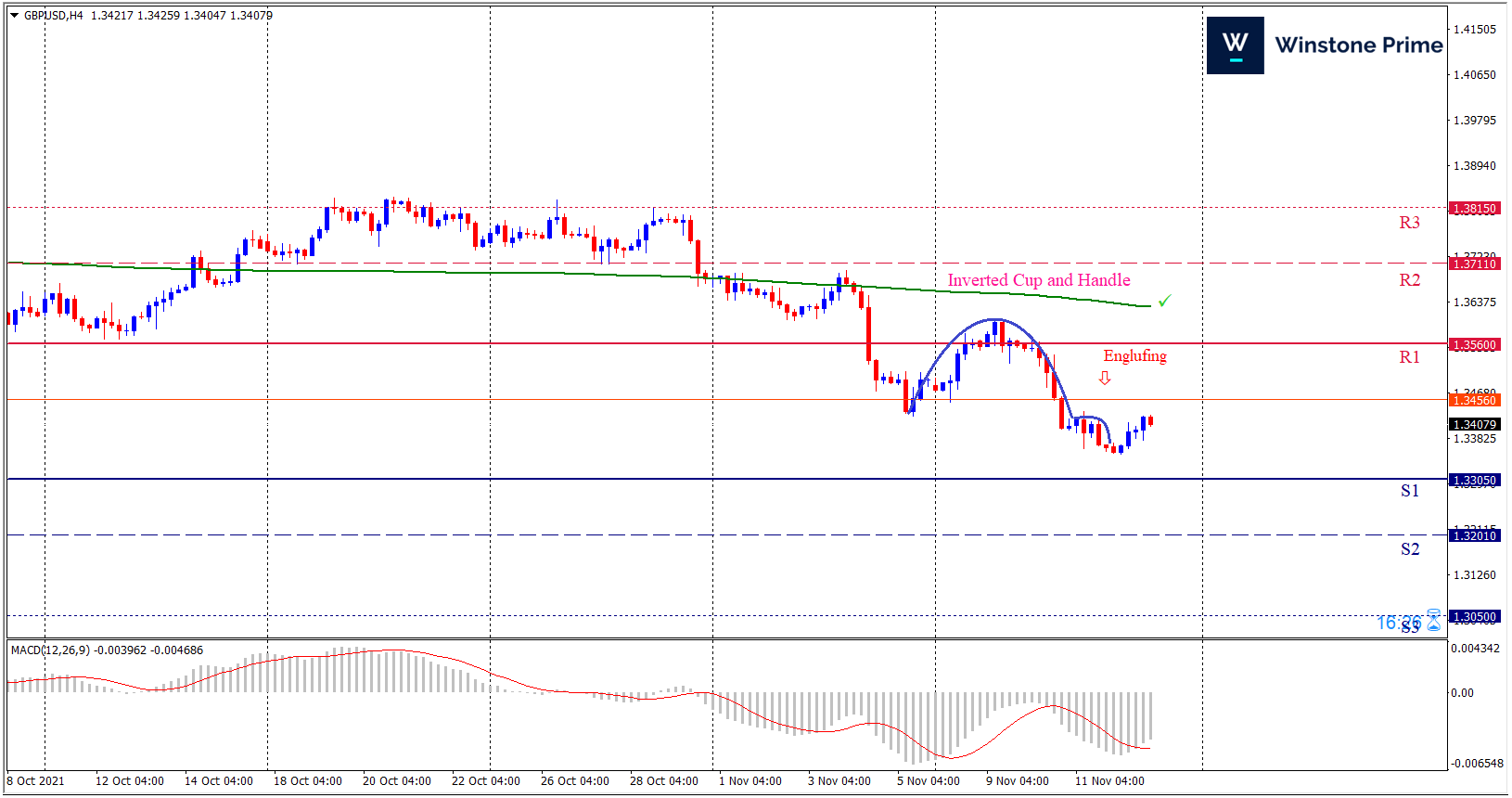
Last week’s high was 0.66% lower than the previous week. Maintaining high at 1.3608 and low at 1.3353 showed a movement of 255 pips.

In the upcoming week we expect GBP/USD to show a bearish trend.  The currency pair is trading below the 200 Simple Moving Average and the MACD trades to the downside. A solid breakout below 1.3305 might make a fall to 1.3201 and may take a way down to 1.3050. Should 1.3560 prove to be unreliable resistance, the GBPUSD may raise upwards 1.3711 and 1.3815 respectively. Chart formation of inverted cup and handle pattern in H4 chart favors prospects of a bearish trend. Bearish engulfing pattern formation further escalates the expectation for a bearish trend.

Preference
Sell: 1.3408 target at 1.3202 and stop loss at 1.3565


Alternate Scenario
Buy: 1.3565 target at 1.3814 and stop loss at 1.3408

EUR/USD Weekly Forecast (15th November 2021 – 19th November 2021)

Fundamental view:

Euro initially tried to rally against the greenback but later fell beyond 1.15 crucial level. The American dollar reached the fresh 2021 highs against its European rival in this week. Federal Reserve is more than likely going to continue its tapering program, driving up interest rates in general which helped the US dollar. When the US Federal Reserve announced its latest decision on monetary policy in early November, Chair Jerome Powell  made a note  that inflation was the main theme, adding that current price pressures are frustrating. Moving on to ECB, the European Central Bank retains its conservative stance, pledging to maintain stimulus for as long as needed.

Eurozone Sentix Investor Confidence on 8th November and US Core PPI yearly report on 9th November created bullish trend whereas Eurozone Trade Balance on 9th November and Federal Budget Balance on 10th November created bearish trend for the pair.

The major economic events deciding the movement of the pair in the next week are Eurozone Employment Change quarterly report, Eurozone GDP quarterly report, US Retail Sales monthly report, Fed Industrial Production monthly report at Nov 16, US EIA Crude Oil Stocks Change at Nov 17, Initial Jobless Claims at Nov 18 and Fed Governor Waller Speech at Nov 19.

EUR/USD Weekly outlook:

Technical View:

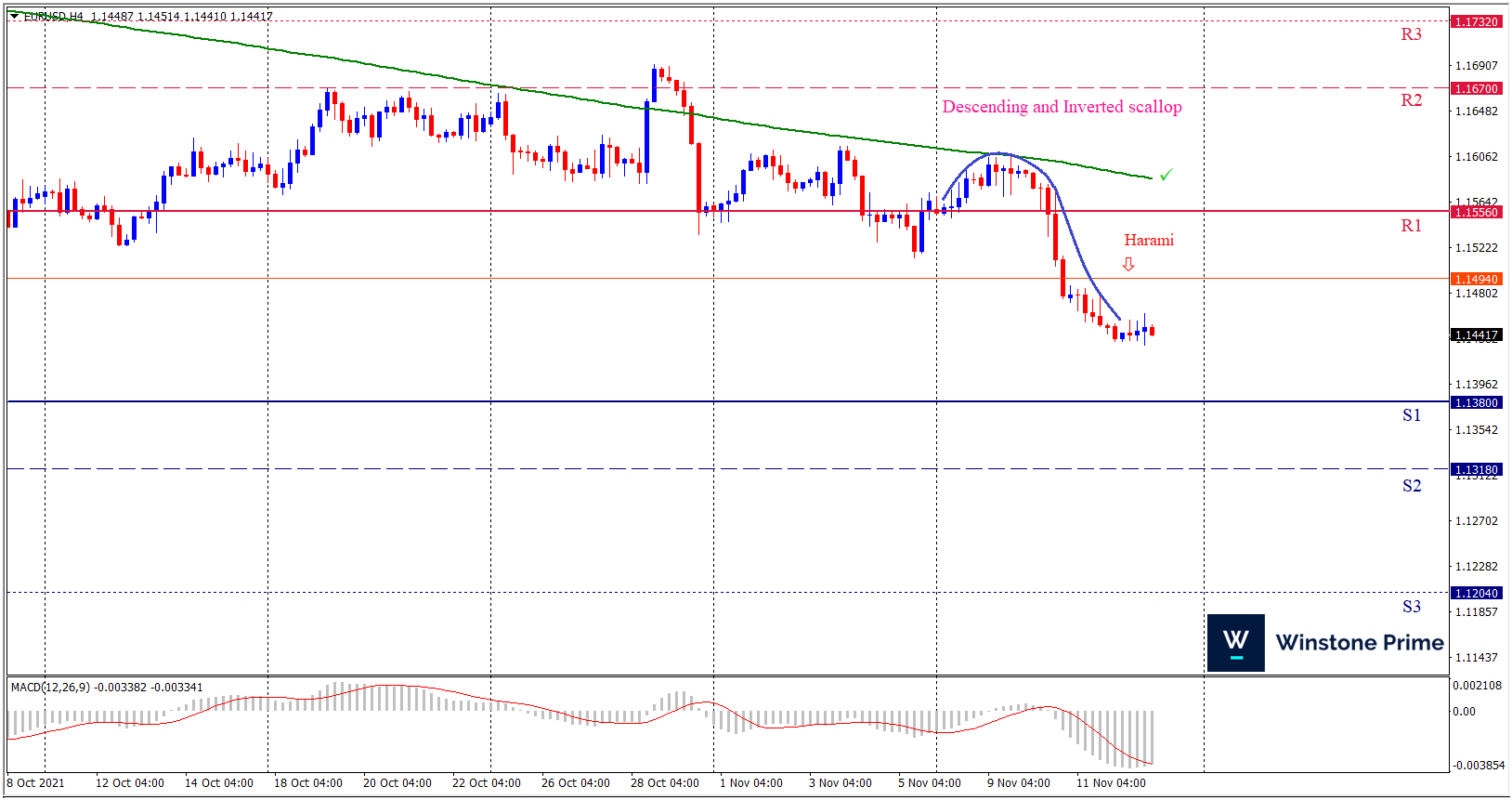
Last week’s high was 0.07% lower than the previous week. Maintaining high at 1.1608 and low at 1.1432 showed a movement of 176 pips.

In the upcoming week we expect EUR/USD to show a bearish trend. The currency pair is trading below the 200 Simple Moving Average and the MACD trades to the downside. A firm breakout below 1.1380 might make a fall to 1.1318 and then take a way down to 1.1204. Should 1.1556 prove to be unreliable resistance, the EURUSD may raise upwards to 1.1670 and 1.1732 respectively. Chart formation of a descending and inverted scallop pattern in H4 chart sets prospects for a bearish trend. Bearish harami formation in H4 chart escalates the expectation for a bearish trend.

Preference
Sell: 1.1442 target at 1.1268 and stop loss at 1.1561


Alternate Scenario
Buy: 1.1561 target at 1.1730 and stop loss at 1.1442

Ethereum 2.0

Ethereum 2.0 also known as Eth2 or “Serenity,” is a collective term for a set of upgrades that are currently underway on the Ethereum blockchain which will help to process more transactions per second, use less energy, and become more secure.

These upgrades will help to address scalability challenges, high gas fees (transaction fees), and congestion in Ethereum’s existing PoW blockchain.

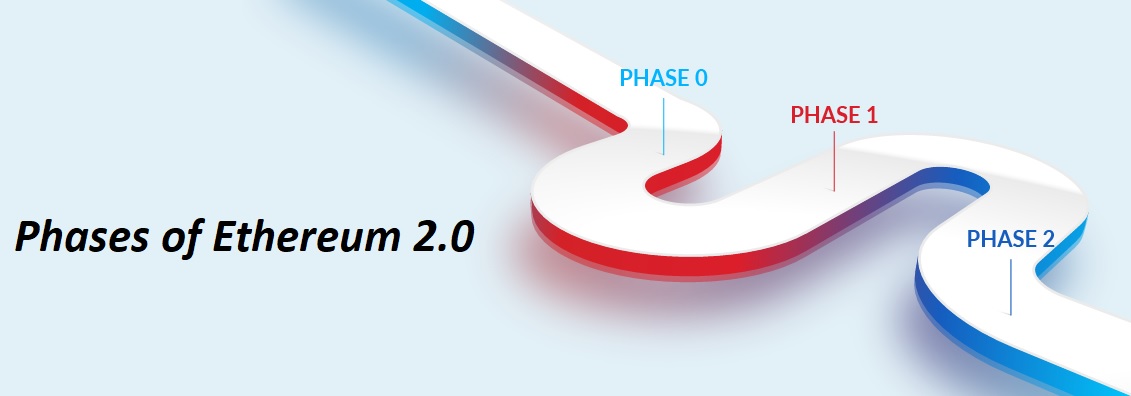
Ethereum 2.0 is launching in several phases, with the first upgrade, called the Beacon Chain, having gone live on December 1, 2020. The Beacon Chain introduces native staking to the Ethereum blockchain, a key feature of the network’s shift to a PoS consensus mechanism. As the name suggests, it is a separate blockchain from the Ethereum mainnet.

The second phase, called The Merge, is expected in the first or second quarter of 2022 and will merge the Beacon Chain with the Ethereum mainnet.

The third phase is called as sharding, The blockchain will see its first divisions of processing, enabling parallel transaction validation for the first time.

PoW to PoS

Ethereum was launched by making use of the proof-of-work (PoW) consensus protocol which is just similar to Bitcoin. The PoW data essentially does two things:

  • Allows computer nodes, which secure and guard the platform, to agree on the validity of the information published on the Ethereum network.
  • Thwarts any economic attack on the network.

Proof of Work, however, is not perfect, and the flaws which including slow transaction times and hefty gas fees and this became too big problem. The emergence of the Ethereum-based CryptoKitties game is one good example for that. The game, which introduced an early version of non-fungible tokens (NFTs), became so popular that it made the Ethereum network to clog, delaying transactions and causing fees to skyrocket.

The rise of decentralized finance, or DeFi, is yet another use case that has underscored the importance of an efficient network.

This is the main reason why Ethereum 2.0 comes in. In order for developers to avoid shooting themselves in the foot with their own innovation, they are building Ethereum 2.0. This is a massive upgrade of the existing network to one that is more scalable and could hasten the adoption of the blockchain among the mainstream.

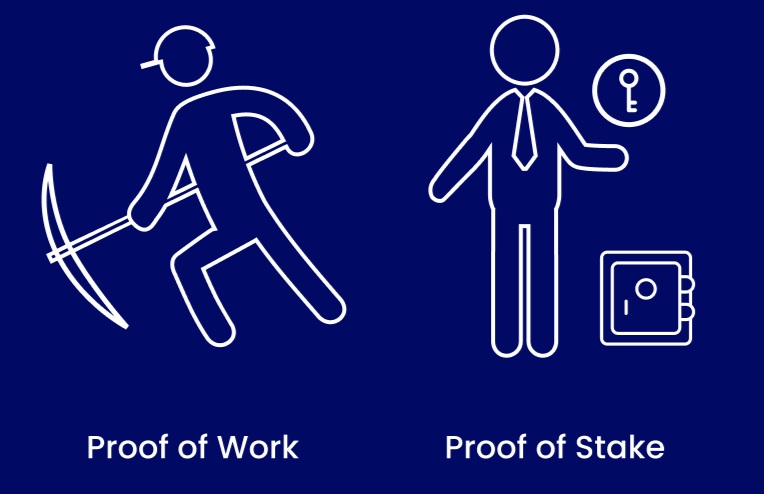
In Ethereum 2.0, Chief among the changes is a switch in the consensus protocol from PoW to proof-of-stake (PoS). Staking will lead to greater participation in securing the Ethereum network, which in turn will create a more decentralized blockchain

In the PoS system, Nodes, or stake pools, are chosen which is based on the size of the “stake” it holds. In other words, the more coins a stake pool holds the more likely it is to be chosen to forge a block and get rewards. To ensure that the wealthiest pools do not always win, other criteria, like the amount of time coins have been staked, can factor into the selection process. Holders of the coin can “stake” their holdings to a stake pool and when a pool (node) is selected to forge a block the reward it receives is distributed among the individual stakers. 

Some PoS blockchains have added a degree of randomization into the process so that older and larger stakes do not always win. So, in PoS, miners are replaced with stake pools where people stake their coins. Individuals can “stake,” or place their coins with various stake pools, just the same as miners joining a mining pool to earn more rewards. 

PoS also improves Ethereum’s efficiency and ability to scale, In PoW all data that is added to the chain has to undergo verification by all participating nodes. That means that the processing speed of the entire system is limited by the speed of its slowest participant. It creates a haphazard that led to the increase in the transaction costs and decreases throughput.

With a mixup of Staking, Ethereum 2.0 can increase the efficiency of its resource usage in a big way. The new system will accomplish this by breaking data verification tasks up among sets of nodes and each will be responsible for verifying just the data it’s received. That allows the whole blockchain to make use of parallel processing, which could increase overall capacity several times over. Between this added technique and the switch to proof-of-stake, the new Ethereum blockchain should be far faster and more efficient than its predecessor.

Benefits of Ethereum 2.0

Ethereum 2.0 will deliver a host of key benefits that are likely to attract even more developers to the network. The three key improvements include:

  • Greater scalability: The most important advantage of Ethereum 2.0 is its scalability. With Ethereum 1.0, the network can only support around 30 transactions per second in turn this causes delays and congestion. Ethereum 2.0 promises up to100,000 transactions per second. This increase will be achieved through the implementation of shard chains.
  • Greater security: Ethereum 2.0 has been devised with keeping security in mind. Most PoS networks have a small set of validators, which makes for a more centralized system and decreased network security. Ethereum 2.0 requires a minimum of 16,384 validators, making it much more decentralized – and thus, secure.
  • Greater sustainability: A lesser carbon footprint has become a major theme in the cryptocurrency industry. The PoW consensus algorithm consumes a great deal of energy. Ethereum 2.0 will be better for the environment as there will be no more mining involved. According to Ethereum Co-Founder Vitalik Buterin, Ethereum’s energy consumption will be diminished “by a factor of more than 1,000” with PoS.


Phases of Ethereum 2.0:

Ethereum 2.0 comprises three separate upgrades, each of which holds its own importance.

  • Beacon Chain: Launched in 2020, this technology introduced staking to the network and paved the way for future upgrades. While the Beacon Chain is in testing mode, it is live and will eventually be the cornerstone of Eth2.
  • Merge: The Ethereum merge is expected for either late 2021 or sometime in 2022. This is where the Beacon Chain will be combined with Ethereum’s mainnet and it will make staking on the Ethereum blockchain a reality while marking an end to mining.
  • Shard Chains: This represents the splitting of the Ethereum network, which will occur in phases will result in a greater capacity for processing transactions and storing data. Sharding chains are planned for 2022.


Final words:

Ethereum is one of the biggest crypto currencies standing second only to bitcoin. The transition to Ethereum is a wide series of events that happen in stages. As each stage happens, the developers intend to perform thorough tests to make sure that the system is both secure and stable. This helps the users time to adjust to the specifics of the new blockchain implementation.

If the stages go over without any issues the new Ethereum 2.0 will emerge from the process in a great position and will finally end Bitcoin’s long reign as the cryptocurrency king. It will be a trusted system with far fewer scalability issues and a much larger feature set than its primary competitors.

Its only the time that will answer the question?  if the launch of the upgrade will be the signal of a new blockchain era, but one sure thing is that a new day is dawning for Ethereum.

Loonie dips on CIBC comments

USD/CAD hovers around 1.2590 during Friday’s Asian session. The pair has refreshed the multi-day peak on Thursday. Rebound of US dollar and bank holiday in Canada underpinned this move.

The strength of the US dollar can be linked to the Fed rate hike chatters and the sluggish prices of Canada’s main export item, WTI crude oil.

US Dollar Index (DXY) bulls has defended the 95.00 threshold and stayed around the highest level since July 2020, recently easing to 95.12 amid Friday’s Asian session favoring the US dollar.

Over a three-decade high in US inflation propelled Fed rate hike concerns and favored the US dollar of late.

Elsewhere, The Organization of the Petroleum Exporting Countries (OPEC) on Thursday had cut its world oil demand forecast for the fourth quarter by 330,000 barrels per day from last month’s forecast, as high energy prices curb the recovery from COVID-19. This news also favors the USD/CAD bulls.

According to CIBC, “markets have overpriced Bank of Canada (BoC) action in 2022, and underestimated the Federal Reserve post-2022”. “A recalibration”, continues the bank, “will leave the CAD out of favor with investors”, before concluding “we see USD/CAD drifting above the 1.30-mark next year, as it becomes clear that Canada’s central bank will not be outgunning the Fed”.

“Softer crude prices and a return to Canada’s usual travel deficit as tourism restarts will weigh on the country’s trade balance, which has been supportive for the loonie in recent quarters.”

USD/CAD 4 Hour Chart:

Support: 1.2501 (S1), 1.2426 (S2), 1.2378 (S3).

Resistance: 1.2623 (R1), 1.2671 (R2), 1.2745 (R3).

Amidst all the catalysts favoring greenback against loonie, we expect a bullish trend for USD/CAD.