Ethereum is an open-source public service that makes use of blockchain technology to facilitate smart contracts and cryptocurrency trading securely without a third party. There seem to be 2 accounts available through Ethereum: externally owned accounts (controlled by private keys influenced by human users) and contract accounts.
Ethereum was created with the purpose to enable developers to build and publish smart contracts and distributed applications (dApps) that can be used without the risks of downtime, fraud, or interference from a third party.
Ethereum is also described as “the world’s programmable blockchain.” It distinguishes itself from Bitcoin as a programmable network that serves as a marketplace for financial services, games, and apps, all of which can be paid for in Ether cryptocurrency and are safe from fraud, theft, or censorship.
Ethereum is the second-largest cryptocurrency by volume, but its many uses can create a much larger learning curve for new investors than Bitcoin.
Ethereum founders:
Ethereum was launched in July 2015 by a small group of blockchain enthusiasts. The group included Joe Lubin, founder of ConsenSys, a blockchain applications developer that uses the Ethereum network. Another co-founder of the Ethereum is Vitalik Buterin who is credited with originating the Ethereum concept and now serves as its CEO and public face. Buterin is also described as the world’s youngest crypto billionaire.

According to Buterin, bitcoin was very much limited in functionality. In an interview, he compared bitcoin to a pocket calculator that “does one thing well,” On the other hand, he said Ethereum is more like a smartphone with multiple applications you can use.
That’s the main premise of Ethereum. Same like bitcoin, it is also built on blockchain technology – essentially a distributed computer network that records all cryptocurrency transactions. But stands different from bitcoin, people can build apps on top of Ethereum.
In Buterin’s own words, Ethereum is “a blockchain with a built-in programming language” and the “most logical way to actually build a platform that can be used for many more kinds of applications.”
The Ether cryptocurrency was designed to be used within the Ethereum network. However, like Bitcoin, Ether is now an accepted form of payment by some merchants and service vendors.
Can Ethereum overtake Bitcoin:
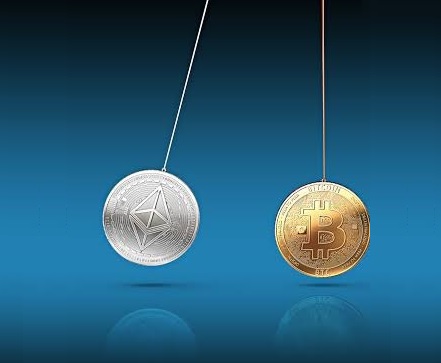
Can Ethereum overtake Bitcoin? To answer this question, let’s first understand the difference between Bitcoin and Ethereum. Bitcoin is a system which allows the people to send value between one another without the need for banks. It is built on a technology known as blockchains, which are online ledgers and the transactions are checked and recorded by a decentralised network of computers which is known as validators.
Ether works in the same way as Bitcoin, but Ethereum is different. It is a worldwide software platform without any host, on which developers are building thousands of blockchain-based applications. Thus it means that these applications can run without being controlled by a company. Examples of this includes cryptocurrency exchanges, insurance systems, and new kinds of gaming.
In the centre of the platform is the idea of smart contracts which are automated agreements that ensure that money and assets change hands when certain conditions have been fulfilled. All transactions on the platform ultimately use ether, and the success of the platform is the reason for ether to be the second-largest cryptocurrency after bitcoin for the past few years.
Like any other popular cryptos, Ethereum was built on the basic principle of decentralized finance, because the products and services that live on Ethereum are available to anyone who know the access of the internet.
Build Application: Smart contracts allows the creators to build decentralized applications that serve different purposes. These applications include financial tools like cryptocurrency exchanges, decentralized lending platforms, and data services which searches multiple cryptocurrency exchanges for the best prices. However there are also categories of dapps for things like buying and selling digital artwork, gaming, and developer technology.
New Cryptos: The open source of Ethereum concept allows the developers to build entirely new cryptocurrencies on top of it, like Chainlink and XRP, which are known as tokens. Some of these assets come in the form of different cryptocurrencies you may have heard of, like Tether (USDT), Uniswap (UNI), or USD Coin (USDC).
NFTs: Cryptocurrencies aren’t the only digital assets that can be created on Ethereum – recently NFTs, or non-fungible tokens, are another example of something created using Ethereum. These digital tokens are powered by Ethereum and are used to represent ownership of unique items, according to Ethereum’s website.
- Large, existing network: Ethereum are a tried-and-true network that has been tested through years of operation and billions of value trading hands. It has the largest ecosystem in blockchain and cryptocurrency.
- Range of uses: Apart from being used as a digital currency, Ethereum can also be used to process other types of financial transactions, for execution of smart contracts and store data for third-party applications.
- Continuous innovation: Big community of the Ethereum developers is constantly looking for new ways to improve the network and develop new applications
- No intermediaries required: The decentralized network promises to let users leave behind third-party intermediaries, like lawyers who write and interpret contracts, banks that are intermediaries in financial transactions or third-party web hosting services.
- Increasing cost: The growing popularity of Ethereum has led to higher transaction costs. Unlike Bitcoin, where the network itself rewards transaction verifiers, Ethereum requires those participating in the transaction to cover the fee.
- No limit: Ethereum has an annual limit of releasing 18 million Ether per year but there’s no lifetime limit on the potential number of coins. Thus it means that as an investment, Ethereum might function more like dollars and may not appreciate as much as Bitcoin, which has a lifetime limit on the number of coins.
- Difficult for developers: Ethereum can be difficult for developers to pick up as they migrate from centralized processing to decentralized networks.
- Uncertain future: Ethereum continues to evolve and improve, and the ongoing development of Ethereum 2.0 holds out the promise of new functions and greater efficiency. But this major update to the network, however, is creating uncertainty for apps and deals currently in use.
Criticism on Ethereum
Like any other crypto, Ethereum is far away from perfect. Scalability is one of the biggest issues with the Ethereum network today. It currently operates using a proof-of-work protocol, similar to bitcoin. This means that cryptocurrency miners with purpose-built computers have to compete to solve complex mathematical puzzles in order to validate transactions.

This has led to criticisms of both bitcoin and Ethereum from those who are worried about the massive amounts of energy consumed by their networks.
Another problem with Ethereum is the gas fees have become very expensive in the last couple of years because the network has become so popular and is therefore very congested.
Validators prioritise users who are willing to pay the highest fees for their transactions.
Still, some skeptics remain unconvinced by digital currencies like bitcoin and ether.
Conclusion:
In a nutshell Ethereum is an open-source public service that makes use of blockchain technology to facilitate smart contracts and cryptocurrency trading securely without a third party which has several adavantages and is in the developing stage which is facing many criticism and to overcome that Ethereum is undergoing an ambitious upgrade called Ethereum 2.0.