Euro trades cautiously ahead of ECB

Euro shows a cautious move against the greenback in early Asian session. The pair recovered from the recent lows. Euro gained some support from Germany’s GFK Consumer Confidence, which showed an improvement from 0.4 to 0.9 in October, beating market expectations of -0.4. Also, the EU reported September Money Supply, which increased by 7.4%, below the market consensus.

The US 10-year Treasury yields gained two basis points (bps) to regain 1.55% after dropping the most since mid-August the previous day. The consolidation of the US Treasury yields portrays the market’s rush for risk-safety ahead of the preliminary US Q3 GDP and monetary policy meeting of the European Central Bank (ECB). The US Q3 GDP is expected to have eased from 6.7% to 2.7% during the preliminary forecast, which would  allow the Fed to take some time before announcing the details for tapering.

As far as US data is concerned, The US Durable Goods Orders fell 0.4% in September which is better than the -0.5% expected. The preliminary estimate of the September Goods Trade Balance posted a deficit of $96.3 billion, larger than the previous and expectation $-88.1 billion.

Traders are now waiting for the European Central Bank (ECB) monetary policy decision. The ECB is widely anticipated to maintain its dovish stance but policymakers might prepare for a tighter monetary policy.

“We think ECB President Christine Lagarde will use all her diplomatic skills to moderate the diverging views of hawks and doves within the Governing Council on Thursday” said ING analysts in a note, adding they anticipate a neutral message which “may ultimately defy some of the market’s hawkish expectations”.

EUR/USD 4 Hour Chart:
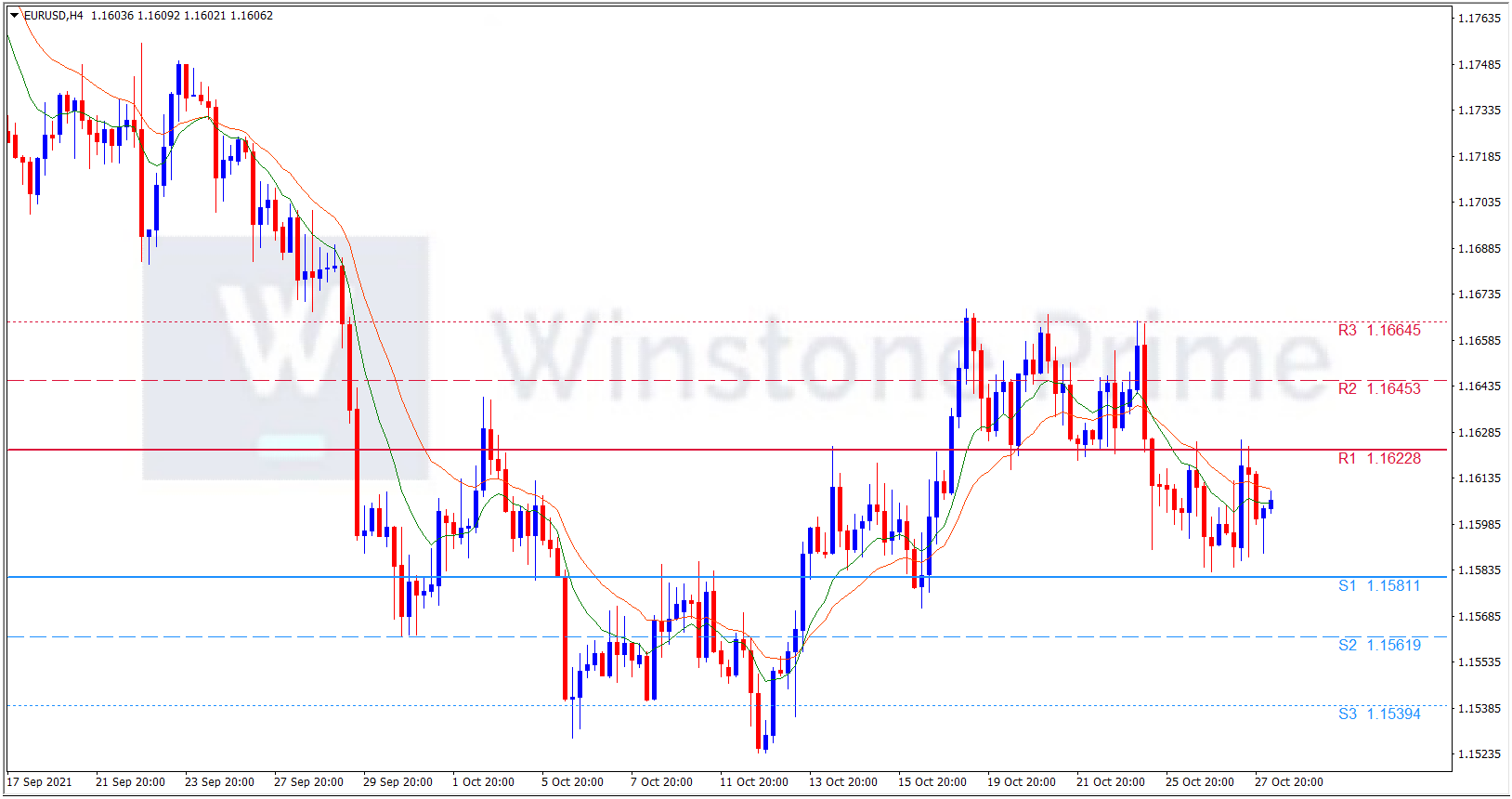
Support: 1.1581 (S1), 1.1562 (S2), 1.1539 (S3).

Resistance: 1.1623 (R1), 1.1645 (R2), 1.1665 (R3).

Now traders are eargely waiting for the Eurozone Consumer Confidence, ECB Interest Rate Decision, US Gross Domestic Product (GDP), and Initial Jobless Claims to take fresh trading impetus. In the meantime we expect a mid trend for EUR/USD.


Bitcoin ETFs

What are Bitcoin ETFs?

Bitcoin ETFs are the exchange-traded funds that track the value of Bitcoin and trade on traditional market exchanges rather than cryptocurrency exchanges. Thus allowing the investors to invest in bitcoin without having to go through the hassle of using a cryptocurrency exchange while providing leverage to its price.

With an ETF, an investor won’t need to manage multiple digital wallets just for acquiring and tracking different cryptocurrencies.

How does it work?

In traditional ETFs, the fund provider owns assets (stocks or commodities) that are to be tracked. Shares from these are sold to investors. Similarly, an organisation providing Bitcoin ETF and managing the funds needs to own the underlying assets (a digital token or currency) that it wishes to track.

The fund is exposed for purchase by potential investors. Thereafter, the ownership of these tokens is given as shares. By owning the shares of the fund, investors directly own the tokens.

1. Easy and Convenient

Investing in a bitcoin ETF provides leverage to the price of bitcoin without a need to know about how bitcoin works, having to sign up for a cryptocurrency exchange, and taking on the risks of owning bitcoin directly. For example, bitcoins are purchased and held in a wallet, and if an investor loses the password to the wallet, their bitcoin is lost forever. A bitcoin ETF simplifies the process of investing in bitcoin.

2. Safe

 Since they’re traded to traditional exchanges, all ETFs are highly regulated. This means regulators can monitor and analyse their performance and protect against price manipulation within the ETF markets. However, the Bitcoin price can still be manipulated through unregulated crypto exchanges. Crypto exchanges and wallets are also susceptible to hacking attacks and theft. Bitcoin ETFs protect against these risks as you don’t own any actual Bitcoin.

3. Diversification in the investment

An ETF can hold more than just one asset. A Bitcoin ETF could include bitcoin, Apple stocks, Facebook stocks, and more—providing investors with the opportunity to mitigate risk and diversify their portfolio. Similarly, by trading on a regulated market exchange, a bitcoin ETF would provide investors with the chance to diversify their existing equity portfolios.

4. Cheaper 

ETF fees are also generally lower than those of traditional managed funds.

5. Tax efficiency

As the bitcoin is unregulated and decentralized, the majority of the world’s tax havens and pension funds do not allow for purchases of bitcoin. On the other hand, a bitcoin ETF trading on traditional exchanges would likely be regulated by the SEC and eligible for tax efficiency.

1. Fees

Usually ETFs charge management fees for the convenience they provide for. Hence owning a significant amount of shares in a bitcoin ETF can lead to high management fees over time.

2. Lacks ownership

Cryptocurrency ETFs do not make the shareholder owner of a cryptocurrency. This imposes some limitations on cryptocurrency use. i.e benefit from the decentralized financial system provided by cryptocurrencies

3. Inaccuracy of the ETFs

ETFs track the price of an underlying asset, they can also have multiple holdings in a bid to diversify the portfolio. But this suggests that a 50% rise in the price of bitcoin may not be accurately reflected in the value of the exchange-traded fund due to its other holdings. Therefore, while an ETF provides leverage to bitcoin’s price, it may or may not be an accurate tracker of its price.

4. Limits to cryptocurrency trading

Bitcoin can be used to trade other cryptocurrencies like Ethereum, Litecoin, XRP, and more. But a bitcoin ETF cannot be used to trade other cryptos, as it is not a cryptocurrency but just an investment fund that tracks the price of bitcoin.

ARK Next Generation Internet ETF

ARKW is an actively managed ETF that seeks long-term growth of capital by investing under normal circumstances primarily (at least 80% of its assets) in domestic and U.S. exchange traded foreign equity securities of companies that are relevant to the Fund’s investment theme of next generation internet.

ProShares Bitcoin Strategy ETF

ProShares Bitcoin Strategy ETF (BITO) is the first U.S. bitcoin-linked ETF offering investors an opportunity to gain exposure to bitcoin returns in a convenient, liquid and transparent way. The Fund seeks to provide capital appreciation primarily through managed exposure to bitcoin futures contracts.

  • The fund does not invest directly in bitcoin
  • The price and performance of bitcoin futures should be expected to differ from the current “spot” price of bitcoin


Simplify US Equity PLUS GBTC ETF

The Simplify US Equity PLUS GBTC ETF seeks to provide an efficient way for asset allocators to add Bitcoin exposure to portfolios. T­he fund targets a 100% investment in the US equities while simultaneously providing a 10% exposure to Bitcoin via the Grayscale Bitcoin Trust (GBTC).

Bitwise Crypto Industry Innovators ETF

BITQ is a traditional, regulated exchange-traded fund, giving you simplicity and ease-of-use. It is widely available today. Bitwise is one of the largest cryptoasset managers, with over $1.5B in AUM*. The index leverages Bitwise’s industry expertise to identify what they believe are the right companies in the space.

Viridi Cleaner Energy Crypto-Mining & Semiconductor ETF

The Viridi Cleaner Energy Crypto-Mining & Semiconductor ETF is an actively managed exchange-traded fund that is focused on investments within the cryptocurrency mining and mining infrastructure industries. RIGZ was created by Viridi to align profit with purpose – a growing number of investors are keen to gain exposure to the cryptocurrency sector through regulated investment vehicles, but also want to see active leadership and commitment to environmental sustainability.

Scope of Bitcoin ETFs

After the introduction of Bitcoin ETFs, Investments into crypto funds and assets continue to roll with even more impressive strides as investors put a record $1.47 billion into digital asset investment products in just a week. 

Moreover, the total crypto assets under management (AUM) also reached a new record of $79.2 billion during the week before closing the weekend at $76.7 billion, according to the data shared in the digital asset management firm CoinShares’ weekly report on digital asset fund flows. The surge in investments and AUM, as per the report, has been on the back of all-time high growth witnessed in Bitcoin prices.

Vikram R Singh, Founder Antier Solutions  tells that “The crypto community was longing for a regulatory acceptance to crypto-tied financial services. With U.S. SEC approving bitcoin ETFs, this is huge and a step in the right direction. This will elevate the scope of cryptocurrencies in mainstream financial services that were previously confined to buying/selling only. There’s a rally of cryptocurrencies following up. Wait & watch.”

Conclusion:

In short, A bitcoin ETF is an ETF that mimics the price of the most popular digital currency in the world. This allows investors to buy into the currency without going through the complicated process of trading bitcoin itself. The recent U.S. listings of futures-based bitcoin exchange-traded funds (ETFs) expand the range of channels for investors looking to obtain cryptocurrency exposure. However, synthetic or direct fund exposures present trade-offs around risk transparency, pricing, operational complexity and the evolving path and scope of regulation. While the new asset is “just the tip of the iceberg,” it’s unclear on how the path of the Bitcoin ETFs will be ahead.

Dollar’s strength pushes down the yellow metal

Gold prices retreated further on Wednesday due to the  robust dollar. The US dollar showed strength from the beginning of the day  against its commodity-rival, getting a boost early in the American session from upbeat US data, higher U.S. bond yields and rallying equities.

The US Richmond Fed Manufacturing Index showed an improvement to 12 in October, which is much better than the previous -3 and the expected 3. New Home Sales increased by 14% MoM in September and CB Consumer Confidence unexpectedly bounced in October, printing at 113.8 from an upwardly revised 109.8. As per the official report, “the proportion of consumers planning to purchase homes, automobiles, and major appliances all increased in October—a sign that consumer spending will continue to support economic growth through the final months of 2021.”

US inflation expectations jumped to the highest levels last seen during May 2006, which marks acute pressure on the Fed policymakers to consolidate the easy money streams. The same propels the US 2-year Treasury yields to the highest since May 2020.

Adding to it, the news of the US ban on China telecom over national security concerns and the Chinese summoning of the property companies to gauge the financial risk  further puts downside pressure on the gold prices.

Analysts said the dollar might continue to hold steady pending a slew of central bank meetings and economic data that could shift views on interest rates, inflation and growth rates. “It is almost certain that a start to the Fed taper will be announced and U.S. yields should start to move higher as will the greenback and gold will struggle to hold near $1,800 in this environment.” Said an Analyst.

In the absence of any Fed communication, it will be the U.S. data that the market concentrates on this week. Now the market focus will be on 3Q GDP release on Thursday and the September core PCE deflator on Friday which will attract the most attention.

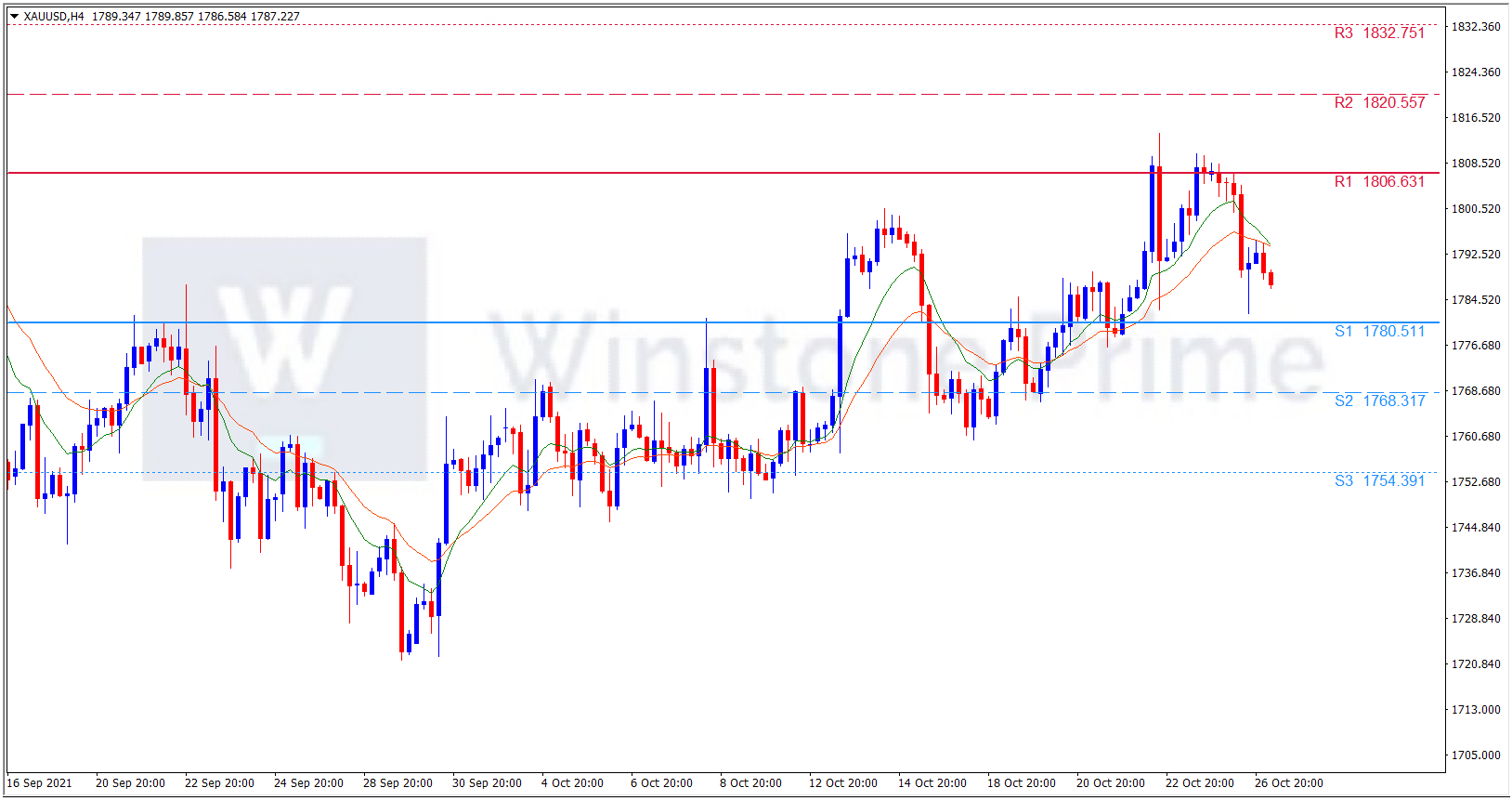
XAU/USD 4 Hour Chart:

Support: 1780.5 (S1), 1768.3 (S2), 1754.4 (S3).

Resistance: 1806.6 (R1), 1820.6 (R2), 1832.8 (R3).

In the current market scenario where greenback shows strength against the yellow metal, we expect a bearish trend for XAU/USD.

Earning report from US companies favors dollar

The US dollar was up against the Japanese yen in today’s early trading Asian session. The improvement in strength of the dollar comes amid the rise in the US stocks after favorable earning report from US companies.

U.S. stocks has rose to another record high as traders have geared for a string of earnings reports from technology heavyweights which includes Facebook Inc., also keeping in mind inflation concerns and rising COVID-19 risks.

Various sectors like Consumer discretionary, energy and materials sectors led the S&P 500 to an all-time high. PayPal Holdings Inc. has rose after the company said it isn’t pursuing an acquisition of Pinterest Inc., ending days of speculation over a potential US$45 billion deal. Tesla Inc. made an advancement after receiving an order for 100,000 cars from Hertz Global Holdings Inc.

Principal Global Investors Chief Strategist Seema Shah. said “This year, broad market indices have benefited from robust earnings growth—the rising tide lifts all boats adage has been in full effect.” “But as the economy slows and market conditions become more challenging, selectivity will be key. Staying overweight equities, with a focus on factors such as quality, will be increasingly important for investors aiming to balance portfolios in the market environment ahead.”

Fed officials are set to wind down their $120 billion-a-month bond-purchase program in November, but queries on how soon inflation pressures will fade are creating more uneasiness inside the central bank. Fed’s move also favors a cautious optimism for US dollar.

Looking on the yen, The yen’s recent slip to a nearly four-year low against the U.S. dollar coupled with a surge in U.S. oil prices to a seven-year high had threatened to cut into household spending even as it still feels the impact of COVID-19.

The yen’s weakening led to the increase in price of imported products, such as oil, which puts Japan at serious risk at a time when the resource-scarce county saw import prices rising at the fastest pace in four decades last month. Whereas, Wholesale prices have also been gaining sharply, which weighs on the the tolerance of Japanese companies that have opted to absorb higher costs.

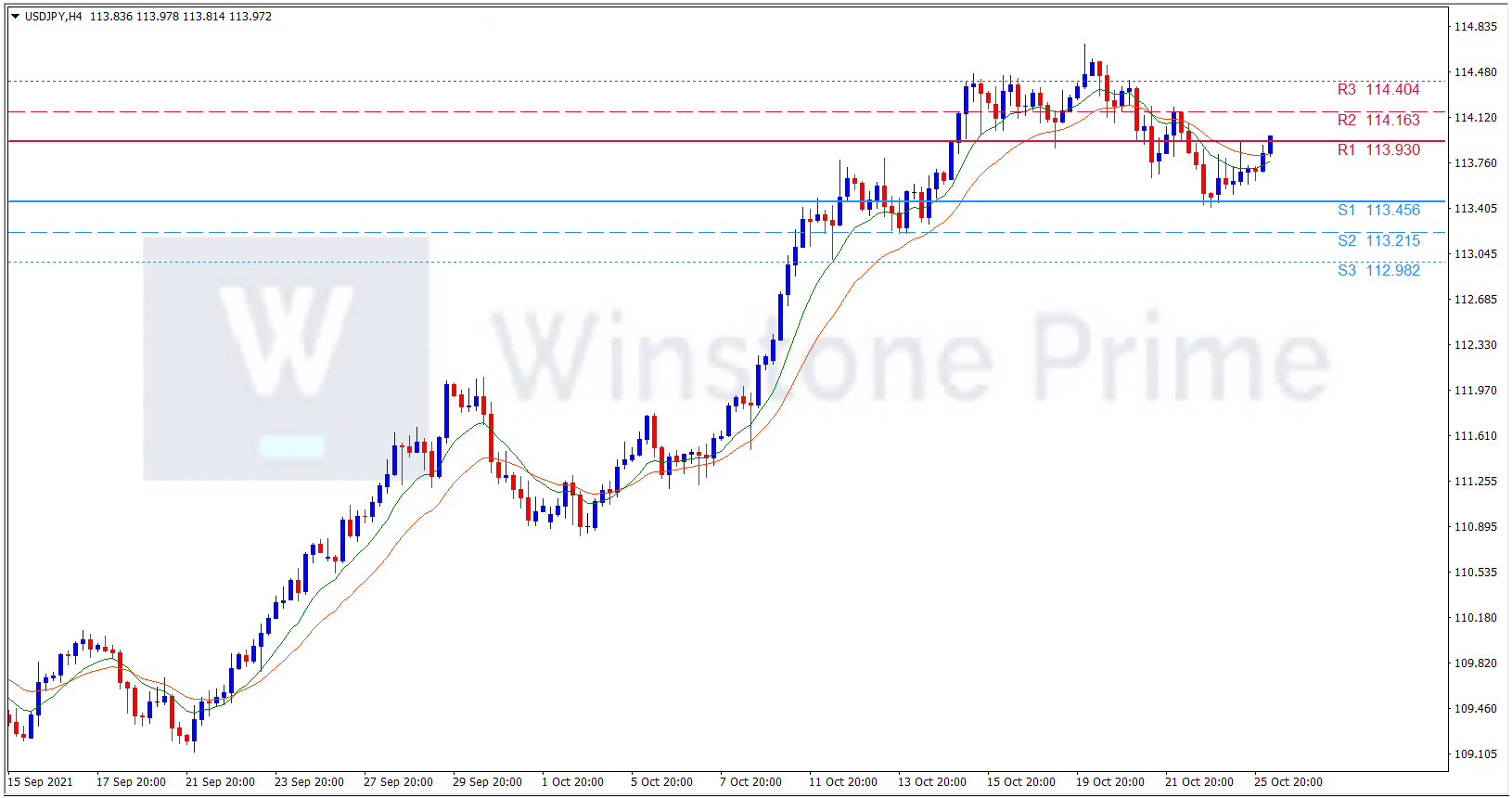
USD/JPY 4 Hour Chart:

Support: 113.46 (S1), 113.22 (S2), 112.98 (S3).

Resistance: 113.93 (R1), 114.16 (R2), 114.40 (R3).

Amidst all the catalysts favoring the US dollar against the Japanese yen, we expect a bullish trend for USD/JPY.