Questions on Fed tapping plan impacts USD

Aussie pair is trading high against greenback amid US dollar weakness and a brighter mood to refresh the multiday high the previous day.  Global market sentiment improved on Tuesday after the declining US housing number, Fed’s questioned tapping plans. The Reserve Bank of Australia (RBA) monetary policy meeting minutes and the easing of corona virus fears at home came as no surprise to Aussie.

Investors accepted the minutes of the Reserve Bank of Australia (RBA)’s latest monetary policy meeting. The RBA has reversed its position that there will be no interest rate hike before 2024, but the Fed expects the economy to return to a recovery path in December and reach pre-pandemic growth levels by mid-22. In addition, higher commodity prices supported the upside rally of the Australian dollar. In addition, New South Wales, Australia’s most populous state, removed the mask orders and allowed large groups inside and outside as the full vaccination rate reached 80%. The market ignores the Westpac leading index, which fell 0.02 in September on an annual basis.

Meanwhile Federal Reserve Governor Christopher Waller said on Tuesday that if inflation continues to rise at the current pace in the coming months without falling as expected, Federal Reserve policymakers will have to accept a “more serious policy response” next year. For now, Waller told the Stanford Institute for Economic Policy Research, the economy has seen the most recent corona virus waves, labor and other supply shortages will ease over time and “inflation will be temporary,” and inflation is moving toward the central bank’s 2% target next year.

According to a Reuters report, raising the central bank’s key policy interest rate to close to its current zero is “just a matter of time,” he said, with a view to synchronizing with most of his colleagues. The central bank’s most recent “dot plot” policy depicts rate-rise expectations from analysts, halving the central bank’s rate hikes by the end of next year, with the other half expected to be raised by the end of 2023. More time is needed for the economy to reach full employment, another part of the central bank’s dual mandate. To accommodate such action, the Waller Fed will began to reduce its $ 120 billion monthly asset purchases if necessary.

On Tuesday, he said the economy was ready for such a move, calling for it to start next month and finish by the middle of next year. In particular, the “mind-boggling” reduction in unemployment from the 14.8% pandemic to 4.8% now shows that the labor market is approaching pre-pandemic strength, especially after counting 2 million people who retired during the crisis, he said, and is unlikely to return. Most central bank policymakers agree with Waller that it is time for Taper soon, and it is widely expected that they will announce a decision when they meet in early November.

AUD/USD 4 Hour Chart:
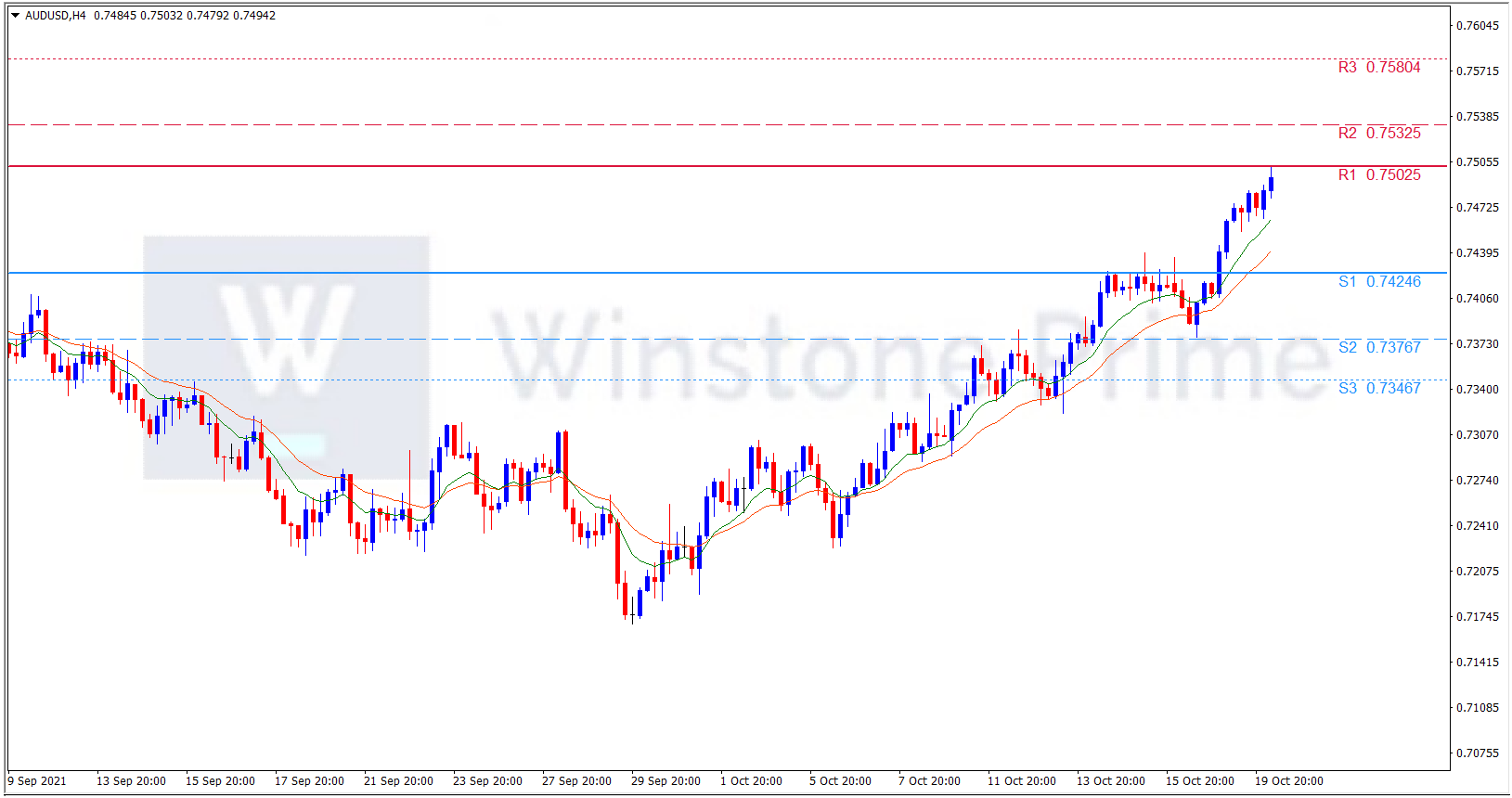
Support: 0.7425 (S1), 0.7377 (S2), 0.7347 (S3).

Resistance: 0.7503 (R1), 0.7533 (R2), 0.7580 (R3).

Amidst these above catalysts the Aussie seems uptrend amid rising in commodity prices and the risk sentiment due to Fed Governor speech. We expect a bullish trend for AUD/USD.

Cable is trading high ahead of Summit

The cable pair is showing positive moment today ahead of foreign investment, this will create 30000 jobs in and around UK.  Boris Johnson announces $ 10 billion in foreign investment as he rolls the red carpet for business leaders and he welcomes nearly 200 business leaders to the London summit. Microsoft co-founder Bill Gates attends the World Investment Summit at the Science Museum in the capital. The Queen-backed summit is hailed by the government as an opportunity to see the role of the private sector in reducing carbon emissions.

Britain said it had attracted nearly 10 billion pounds ($13.72 billion) from global investors to fund its green regeneration agenda, as it hosted an investment summit involving 200 of the world’s top financiers and executives. The event comes at a time when Britain’s green credentials are in the spotlight, two weeks before it hosts the U.N. COP26 climate summit, where Johnson will try to broker a complex international deal to stall rising global temperatures. Ministers hope to use the event to change summit in Glasgow, as a means of highlighting investment opportunities in the UK in sustainable industries. The Prime Minister will begin the summit on Tuesday with International Trade Secretary Anne-Marie Trevelyan. He will also take part in a discussion with Mr Gates on global efforts to transition from fossil fuels to renewable energy and the role of businesses in climate change.

The £9.7bn of foreign investment being announced by Mr Johnson is a package of 18 deals ranging from wind and hydrogen energy, to carbon capture and storage. Some £6bn of the foreign investment relates to Spanish energy firm Iberdrola confirming its intention to invest in offshore wind through Scottish Power’s East Anglia hub. Subject to planning approval, the scheme aims to generate enough electricity to power more than 2.7 million homes.

The dollar, on the other hand, was in a weak mood yesterday, with production in US factories falling the most in seven months in September, destroying earlier gains in expectations that the Federal Reserve will be closer to raising interest rates than previously expected. U.S. manufacturing output has been hit by a series of global semiconductor shortages, and motor vehicle output has declined, providing further evidence that supply growth barriers are hampering economic growth. Supply disruptions add to concerns about high inflation and increase expectations that the US Federal Reserve will take action to stem inflation.

GBP price action is far more centered on the Bank of England at the moment. Same time yesterday after Bank of England Governor Andrew Bailey sent a fresh signal that the central bank is gearing up to raise interest rates as inflation risks mount.

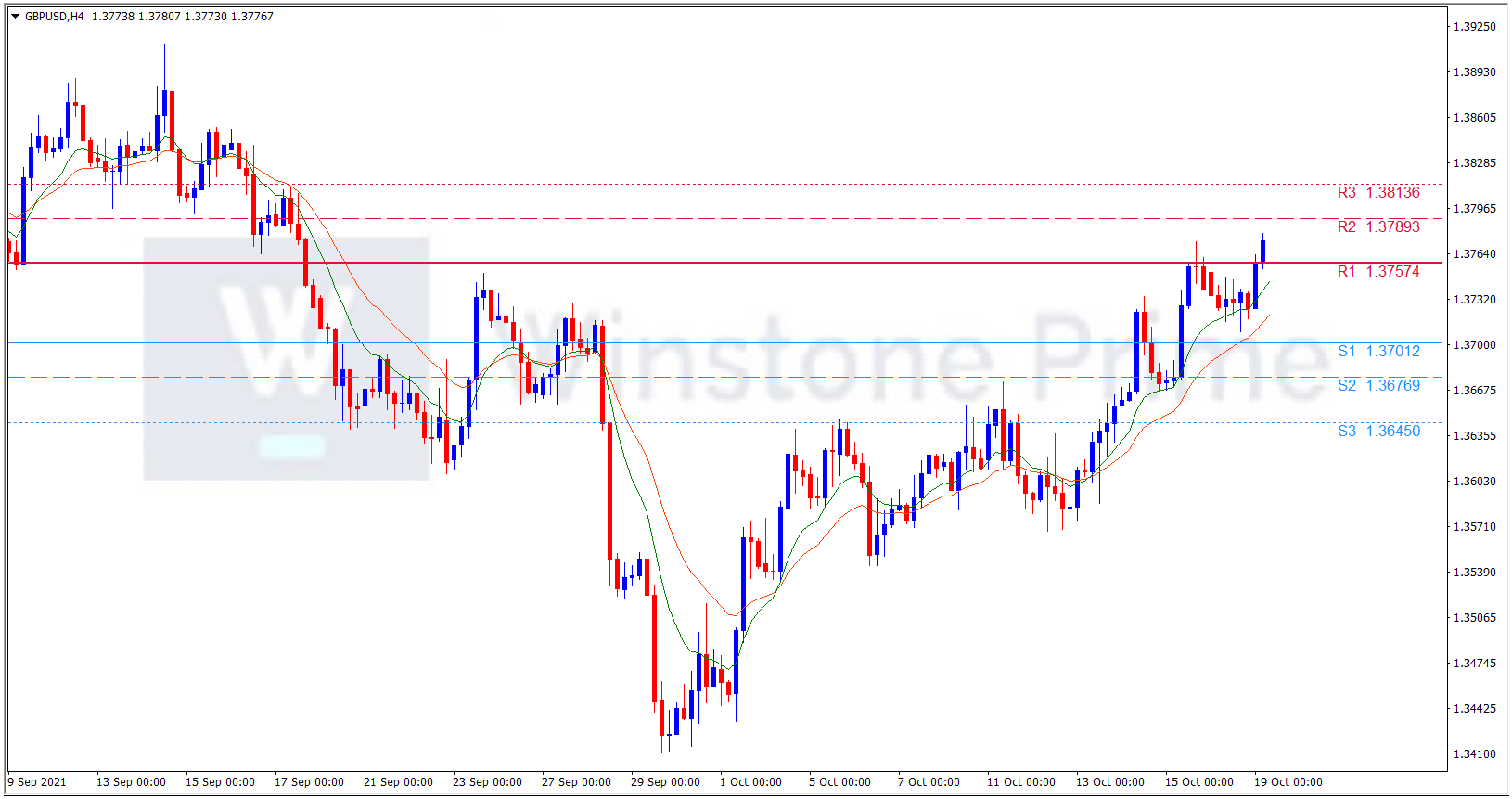
GBP/USD 4 Hour Chart:

Support: 1.3701 (S1), 1.3677 (S2), 1.3645 (S3).

Resistance: 1.3757 (R1), 1.3789 (R2), 1.3814 (R3).

Amidst this above catalysts the cable pair is on strong positive moment, we expect a bullish trend for GBP/USD.

How to trade Crytpocurrencies

Crytpocurrencies are the one of the most popular investment in this moment and Cryptocurrency trading has boomed in recent years. High volatility and trading volume in cryptocurrencies suit short-term trading very well. Crypto assets are high risk investments. If you’re not careful and don’t have the right strategies in place, you will just lose all of your investment capital. While most analysts agree that there is no “right” trading strategy, there are three well-known methods that are most suitable for start-up traders.

Here we provide some tips for trading crypto, including information on strategies for well known traders as well as specific things new traders need to know, such as taxes or rules in certain markets. 

What are the differences between investing and trading cryptocurrencies? 

Investing typically refers to longer term holding of cryptocurrencies while trading implies more frequent buying and selling of crytpocurrencies. Investing is often based on fundamental research and analysis of crypto projects including their use – case, tokenomics, product roadmap, competition, founders, mining network, level of decentralization, token supply, on-chain data, etc. 

Cryptocurrency trading is driven by various strategies including news driven, sentiment driven, technical analysis, arbitrage, etc.

Cryptocurrency Trading

Cryptocurrency trading is the act of speculating on cryptocurrency price via buying and selling the underlying coins through an exchange. The market of Cryptocurrency is decentralized, meaning they run across a network of computers and are not backed by a central authority. The underlying technology behind Cryptocurrency is Blockchain which is a peer-to-peer, decentralized distributed ledger technology.

What are the basic strategies used in trading crypto’s

There’s a myriad of strategies to trade cryptocurrencies but here are three basic trading strategies for traders with any level of experience:

1. Moving average crossovers

2. Pullback in Uptrend

3. Trading crypto chart patterns

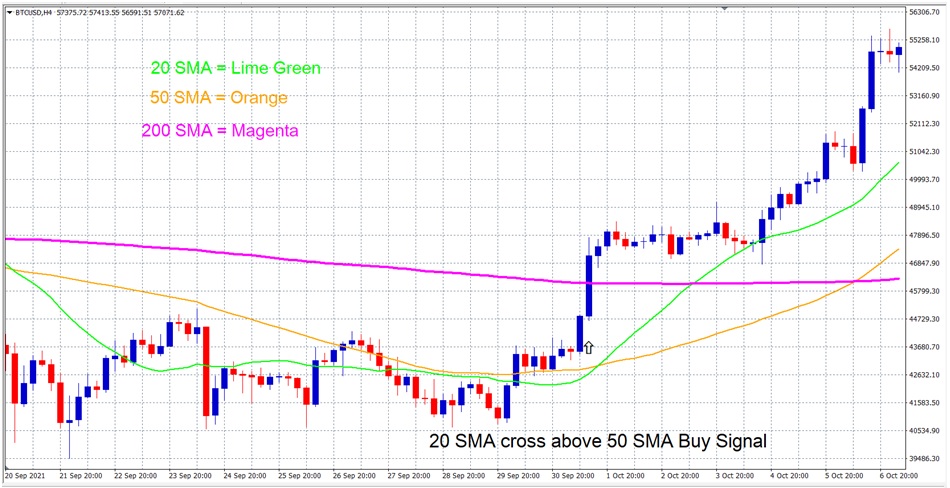
Many times it’s been told that Trend is your friend. It’s a simple and powerful trend trading strategy and following it can lead to offer big gains. Moving averages are used to spot trends. Beginner traders should stick to trend trading strategies. That means, find an uptrend, and ride it for potentially big gains and the trend can be identified by using moving averages. Moving averages are used to spot trends.  Simply put, if a moving average is upward sloping, the trend is up and if it sloping down the trend is down.

Rules to be followed

  • Buy when shorter Moving average crosses above longer Moving averages. In the above chart, Buy signal was generated when SMA (20) crossed above SMA (50).
  • Sell when shorter Moving average crosses below longer Moving Averages.

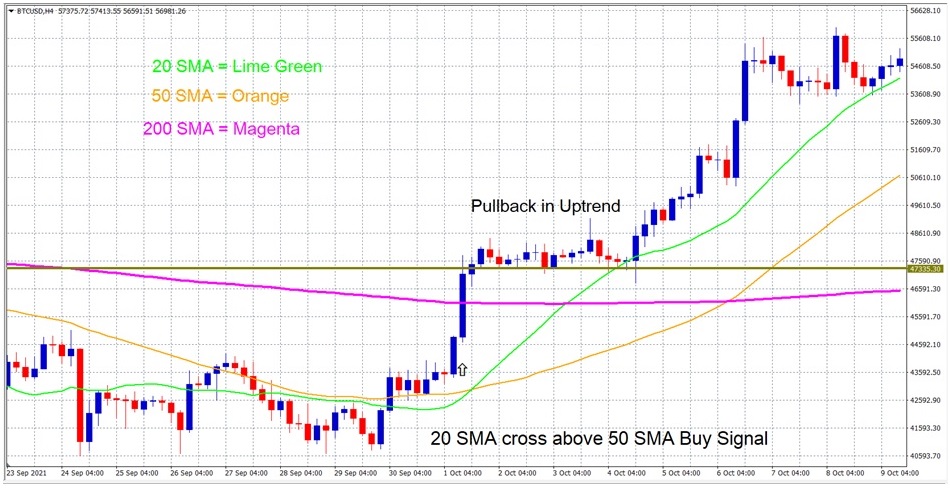
This is another simple trend following strategy but it’s very useful. Pullbacks can often provide opportunities to jump on an established trend. It’s difficult to catch a trend in early phases and conservative traders prefer to jump in midstream, once a trend is established. Even in an Uptrend, prices never go straight up, day after day. There are times when price consolidates, pulls back, and then resumes an Uptrend. These corrections are opportunities to join a trend. And this applies to Downtrends as well, for those who like to Short Sell.

Ideally, during a pullback, price touches and bounces off a support level.  This is potentially a good entry point.  Some traders prefer to wait for price to surpass prior high, as an indication that Uptrend will continue.

Rules to be followed

  • Find the crypto currencies in an Uptrendbut have had atleast 5%+ pullback (a correction, consolidation)
  • Identify a Support Zone. This is often prior Resistance Zone or prior high point.
  • Selling volume dries up during the pullback.
  • Buy if the price is near or touches a Support Zone.

Chart patterns appear when traders are buying and selling at certain levels, and therefore, price oscillates between these levels, creating chart patterns.  When price finally does break out of the price pattern, it can represent a significant change in sentiment. Patterns that emerge over a longer period of time generally are more reliable, with larger moves resulting once price breaks out of the pattern.

  • Ascending/Descending Triangle
  • Head and Shoulders, Inverse Head and Shoulders
  • Channel Up/Down
  • Falling/Rising Wedge
  • Double Bottom/Top
  • Triple Bottom/Top


Therefore, a chart pattern that develops on a daily chart is expected to result in a larger move than the same pattern observed on an intraday chart, such as a 1 Min, 15 min, 1h, 4h, 1d chart.

Conclusion

As we have explored some of the most common trading techniques, let’s explore how to master the Cryptocurrency market by starting trading. Investing in and trading cryptocurrencies can be a risky game, which is a fact that puts off many potential investors. But if you know the right strategies and are able to make appropriate judgments when following the market, there’s nothing stopping you from finding success.

ECB’s dovish comments pressurises euro

The euro pair remains under pressure today. Today Greenback shows strong progress amid high U.S. 10-year benchmark Treasury yields. High inflation, energy prices and bullish US retail data have made bond yields even higher. Investors are ready for the central bank’s tapering in November, while the European Central Bank (ECB)’s Dovish position weighs on the Euro pair.

Christine Lagarde, president of the European Central Bank (ECB), said current inflation was unlikely to rise, promising that the eurozone would continue to help the economy as the pandemic continues to fall. “Inflation is largely volatile,” she said after presenting at the International Monetary Fund’s annual meeting on Saturday, October 16, 2021. The ECB is “paying very close attention” to wage negotiations and other possible second-round outcomes, which could push prices up more permanently, she said.

The ECB predicts that inflation will cut its target in the medium term before falling to 2022 later this year. “Monetary policy will continue to support the economy in order to sustain inflation at the 2 percent inflation target for the medium term,” Lagarde said. “Once the pandemic emergency is over – it is approaching – our pioneering guidance on rates and property purchases will ensure that monetary policy supports achieving our goal in a timely manner,” Lagarde said.

On the other hand global markets are gearing up for more earnings this week, following a stronger-than-expected start to the earnings season in the U.S. last week. U.S. stock index futures were mostly unchanged during overnight trading on Sunday, after the major averages posted their best week in months last week, amid a positive start to earnings season. In addition to better-than-expected earnings from Goldman Sachs on Friday, positive economic data also boosted the greenback. Retail sales rose 0.7% in September, the Census Bureau said Friday, while economists surveyed by Dow Jones were expecting a decline of 0.2%.

Meanwhile, overnight in the Asia-Pacific region, stocks were mostly trading lower as investors responded to the release of key Chinese economic data showing 4.9% growth in China’s GDP in the third quarter. The 5.2% expansion was below analysts’ expectations in a Reuters poll. Contrary to expectations in a Reuters poll of 4.5%, industrial production fell 3.1% in September, beating expectations.

Elsewhere on the economic data front Eurozone industrial output fell 1.6% in August, following a revised 1.4% growth in July. For now, traders are waiting for U.S. industrial production data and U.S. Fed Quarles Speech for new predictions.

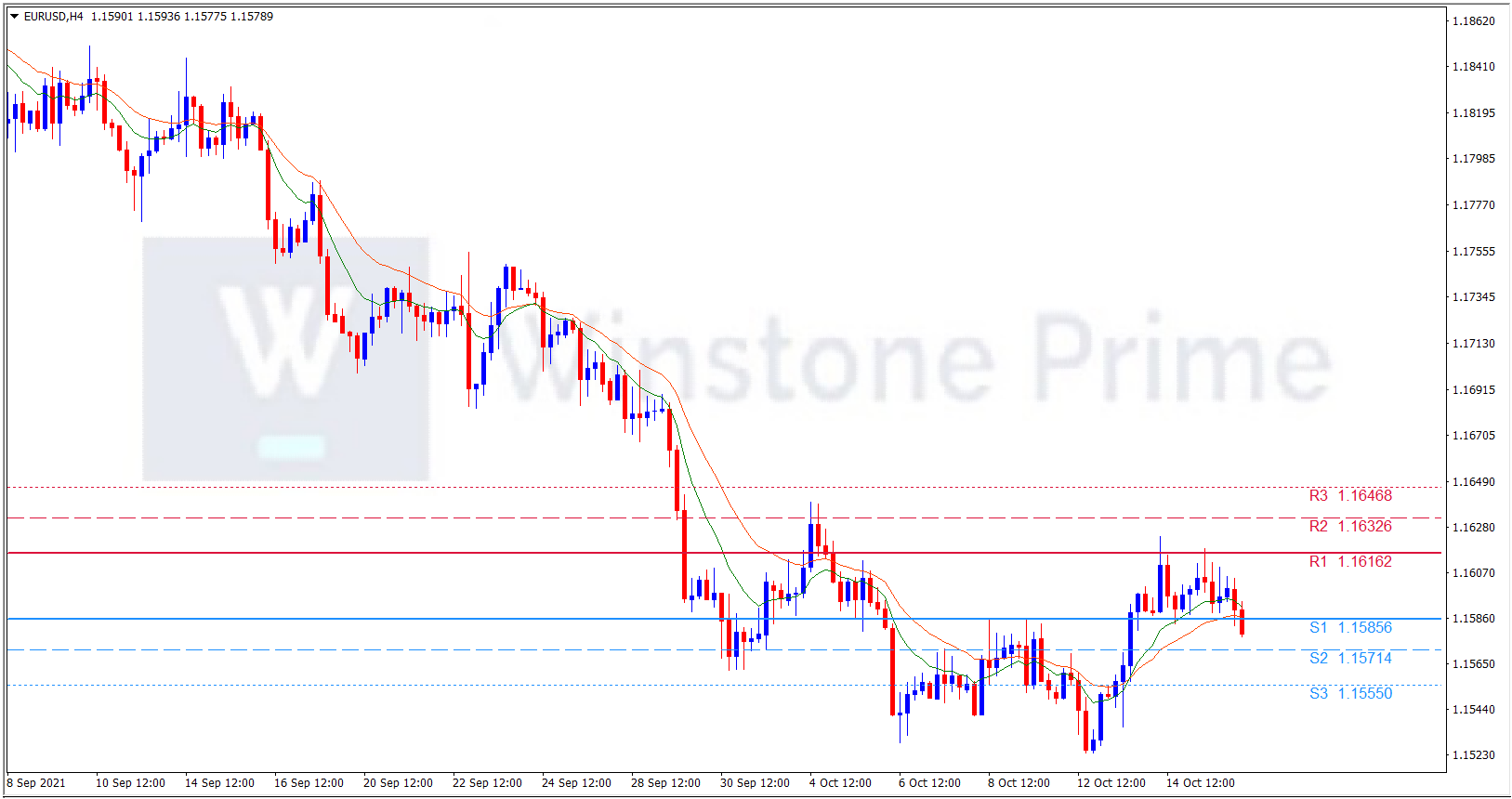
EUR/USD 4 Hour Chart:

Support: 1.1586 (S1), 1.1571 (S2), 1.1555 (S3).

Resistance: 1.1616 (R1), 1.1633 (R2), 1.1647 (R3).

ECB’s Dovish comments and stronger US data weighs on the pair. We expect a bearish trend for EUR/USD.