
Don’t add to a losing position (unplanned)

It is important to always seek confirmation before taking a position for Forex Traders. This is also true when adding to the existing position when placing in the initial position.  There is one thing in all financial markets, it is never add to a losing position.  That means never “average down” a losing long position or “average up” a losing short position.  This is even more important when using leverage.  There is a very well-know saying, “your first loss is your best loss.”  What this means is you are best served taking a small loss before it becomes a larger loss, or even worse, a loss that eats up a majority of your trading capital. 

In order to avoid this major trading mistake, we must first understand why traders add to losers, why traders should not do this, and what they can do to stop it from happening.

Why is it said to be never add to a lose position

When a trader is in a losing position, the market inform him about he is on a wrong position. The market is the sum total of psychological, technical and basic knowledge. The market is the sum total of all investor knowledge and market ideas. These include Institutional money, sovereign wealth fund, hedge fund managers, trend following funds, business hedging interest and every participant large and small.

If a trader maintains a losing position after being told that the market is wrong, the trader is basically right in saying that the sum or the remaining market is wrong. In other words, the global consensus is that the world is round for the trader, while the trader insists that the world is flat. This can always lead to huge losses. Bullish markets tend to trade higher, and bear markets tend to trade lower. That market requires a substantial base or technology to change the trend.

Example:

As traders are losing money, they figure that if they add to the losing position, they can bring the average cost of the position down.  For example, let’s say a trader wants to be short Crude Oil and he sells 1 contract of Crude Oil at $75.00.  Crude is now trading at $80, and the trader is down $5 in crude ($5000).  The trader then decides to sell short an additional 2nd crude oil contract at $80.  The average short position is $77.50 (the average of $80 and $75).

The trader now only needs Crude Oil to go $2.50 in his favor to get to breakeven at $77.50, instead of $75.00.  However, every tick Crude Oil goes against the trader past $80.00 a barrel is going to count twice a much, eating up available capital a double the rate.  To make matters worse, markets that are trending in one direction, tend to continue to trend in that direction.

Not only did the trader cut crude oil to $ 75, but he also doubled the price back to $ 80. The losses are now accumulating exponentially if he continues to add to the losing position. In addition, he has now doubled his leverage in bad trading. Meanwhile, if the trader stopped at $ 1 or $ 2 a barrel of crude oil, he would have taken his loss and finished trading. When he is in a losing trade he can make big losses and let go of other opportunities, admit what he did wrong and move on to the next opportunity.

Admit about wrong if you can’t be wrong, you’ll never be right about the markets

Admitting you are wrong and taking a loss is the first step to a successful trading. No one is right in trading. Taking a small loss is a small success in business. It means allowing successful trades and leaving the losers at a small loss. However, you can’t reach winners if you face big losses.

It is OK to be wrong.  Actually, it is great to be wrong.  Why? Because if you can’t be wrong, you’ll never be right about the markets.  Trading is about taking risks and managing risk. The trader, who can get out of a situation that goes against him in advance, gives up the change to get bigger success at the next opportunity.

Negative mindset forms losses

Have you ever noticed how one loss can lead to further loss? This is because after a loss, your mindset turns negative. It goes to the place of fear and clouds your judgment about your future trading systems. If you feel you made loss for this reason do retire from that trade. Negative mood is not limited to perceived losses. Losses not felt in the form of a loss state can cause the same negative energy.

Therefore, adding a loss level is equivalent to opening a new business immediately following a series of losses, which is a recipe for disaster.

However, there are ways to measure openness to achieve higher profits. But there is no way to add to the losing position.

Trade on Positive Positioning

The only way to achieve greater profits on a single trade idea is to capitalize on positive positioning. It means adding to a profitable position, also called pyramiding – a strategy that looks to capitalize on a profitable position by strategically adding additional positions. Which means adding positions once a market moves in the intended direction and breaks beyond the next support or resistance level.

Benefits of adding into positive positioning

  • You aren’t adding to a position while in a negative mindset. This allows you to properly evaluate the market so you can be strategic about adding new positions. With positive energy on your side, you can operate based on logic rather than fear, thus increasing your odds of success.
  • You are waiting for the market to confirm your trade idea. When you average down, you are increasing your risk without first having confirmation from the market. By waiting for the market to first move in the intended direction, the marketis giving you a reason to add to your position.
  • You aren’t increasing your risk. When you average down, you are taking on additional risk due to the fact that you aren’t able to reposition your stop loss. However when you wait for the market to move in the intended direction before adding to a position, you give yourself an opportunity to minimize risk by moving your stop loss to a more favorable position as the market moves in your favor.


Conclusion

The advice to never add to a losing position cannot be overstated. It is far and away one of the most damaging mistakes a Forex trader can make, but it’s also one of the easiest to correct. Will the average ever play in your favor? Of course, you can occasionally make a profit if you buy or sell a currency pair blindly. But the detrimental effects of adding lost positions to continuing trading outweigh the positive impact it can have.

On the other hand, adding a winning position through pyramiding is the best way to increase your profitability. Keep in mind that the number one rule when building a pyramid is, always, always, not adding a losing position.

Aussie is trading upside ignoring evergrande crisis

The Australian Dollar has been traded on the peak mostly during Friday’s trading session. Reports from Evergrande USD bondholders did not yet receive interest payments mere hours before the deadline. That roughly amounts to US$83.5 million. There was no immediate reply from the company as the world continues watching China for a potential liquidity crisis.

On the other hand the International Monetary Fund’s (IMF) downgrade of Australia’s GDP forecast for 2021 gains major attention. The market’s anxiety as traders await Evergrande’s scheduled bond coupon payment. Furthermore, comments from China’s National Development and Reform Commission (NDRC) suggesting issues of rising raw material prices and power limits tame the Aussie bulls.

Market’s anxiety before Evergrande’s scheduled bond coupon payment joins comments from China’s National Development and Reform Commission (NDRC) suggesting issues of rising raw material prices and power to probe the bulls. On the same line are the scheduled speeches from the US Federal Reserve (Fed) officials, including Chairman Jerome Powell and Vice Chair Clarida.

On the IMF staff concluding statement that Australia is signatory of the Comprehensive and Progressive Agreement for Trans-Pacific Partnership (CP-TPP) and the Regional Comprehensive Economic Partnership (RCEP) and has been strengthening its network of bilateral free-trade agreements. The strong support of the WTO process is helping to buttress the rules-based international trading system. Australia’s recently amended foreign direct investment framework aims at safeguarding national security.

Sametime Australia’s trade minister Dan Tehan will visit India next week to advance talks on a free trade agreement called the Comprehensive Economic Cooperation Agreement (CECA), an early harvest deal of which is to be concluded by December 2021. For Australia, there are significant growth opportunities in critical minerals, infrastructure, energy and technology, Tehan said in his address Wednesday. “Both countries are committed to achieving an early harvest announcement on an interim agreement to liberalise and deepen bilateral trade in goods and services, and pave the way for an early conclusion of full CECA,” he said.

Moving on, a slew of Federal Reserve (Fed) speakers, including Chairman Jerome Powell, are slated for speeches during Friday, likely making the dull active going forward. Also important is the US New Home Sales for August, expected 0.7M versus 0.708M prior, as well as headlines relating to China’s embattled real-estate firm and US stimulus.

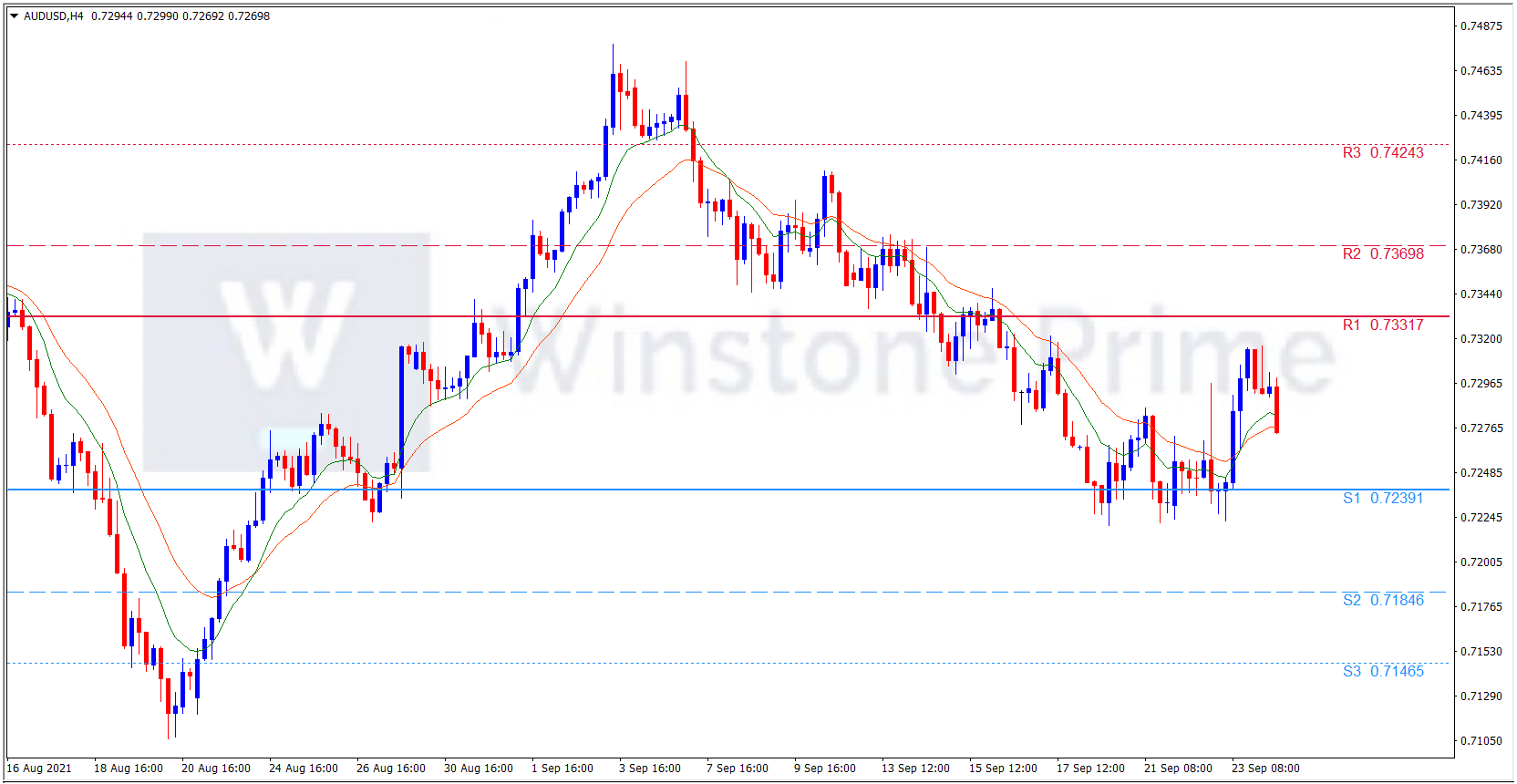
AUD/USD 4 Hour Chart:

Support: 0.7239 (S1), 0.7185 (S2), 0.7147 (S3).

Resistance: 0.7332 (R1), 0.7370 (R2), 0.7424 (R3).

Amidst this above catalysts Aussie dollar is on uptrend. We expect a bullish trend for AUD/USD.

FOMC’s statement favors the greenback

Gold prices shaded off today after the U.S. Federal Reserve signalled easing its monthly bond purchases by next year and a sooner-than-expected interest rate hike, which could increase the opportunity cost of holding the non-yielding bullion. Yesterday afternoon’s statement from the Federal Reserve’s Open Market Committee (FOMC) was deemed mostly neutral on U.S. monetary policy and actually rallied the gold market after that it fell to the downtrend on the same day. Still now its trading near low,due to the FOMC statement as the Federal Reserve holds back on releasing its plans to reduce its monthly bond purchase for at least another meeting.

The FOMC statement said that the U.S. economy continues to recover from the pandemic, but the rise in Covid cases has slowed the recovery. The statement said that a tapering of the central bank’s bond-buying program (quantitative easing) is on the table for discussion. The delayed tapering plans come as the Federal Reserve also leaves interest rates unchanged at the zero-bound range, as expected. However, the U.S. central bank is still looking to tighten its monetary policies. The Fed said the 2021 inflation forecast is 4.2% and that inflation will remain above the Fed’s target rate of 2.0% until 2024. According to the latest economic projections, it sees the first potential interest rate hike in 2022.

Despite the comments in the monetary policy statement, the central bank committee has downgraded its growth expectations for the rest of 2021. According to updated economic projections, the Federal Reserve sees the U.S. gross domestic product growing 5.9% this year, down from 7% forecasted in June. Economic growth next year has been revised higher to 3.8%, up from the previous projection of 3.3%. The economy is expected to grow 2.5% in 2023, up one tick from June’s estimate of 2.4%. In the first look for 2024, the central bank sees GDP growing 2%.

The U.S. central bank is also paring back its optimism in the labor market. For 2021 the unemployment rate is expected to fall to 4.8%, compared to December’s forecast of 4.5%. In 2023 the unemployment rate is expected to fall to 3.5%, also unchanged from June’s estimate. The U.S. central bank is also forecasting higher inflation pressure. The projections show that the Personal Consumption Expenditures Index (PCE) is expected to rise 4.2% in 2021, up from June’s estimate of 3.4%. Inflation pressures are expected to continue to grow in 2022, with PCE increasing 2.2%, up from June’s estimate of 2.1%. In 2023, the Federal Reserve expects inflation to hold at 2.2%. By 2024 consumer prices pressure are expected to moderate, rising 2.1%.

Core inflation expectations, which strip out volatile food and energy prices, are expected to rise 3.7% this year, up compared to the previous estimate of 3.0%. In 2023, inflation is expected to rise to 2.2%, up from the previous estimate of 2.1%. Inflation is expected to moderate to 2.1% in 2024. 

The troubled Chinese property giant, Evergrande, is still on traders and investors minds, but many believe the situation will not turn into a worldwide contagion and that the Chinese government will not let Evergrande fail. The company said it would make its latest debt payments—at least one of them anyway. The marketplace will continue to keep a close eye on the matter. China’s markets reopened today after a public holiday, with the Chinese stock market a bit weaker but not showing any stress.

Looking forward, Evergrande headlines may entertain gold traders, as well as the preliminary readings of September PMIs. Should China fail to tame Evergrande default and the US activity numbers come in stronger, as expected, gold will have a further downside to track.

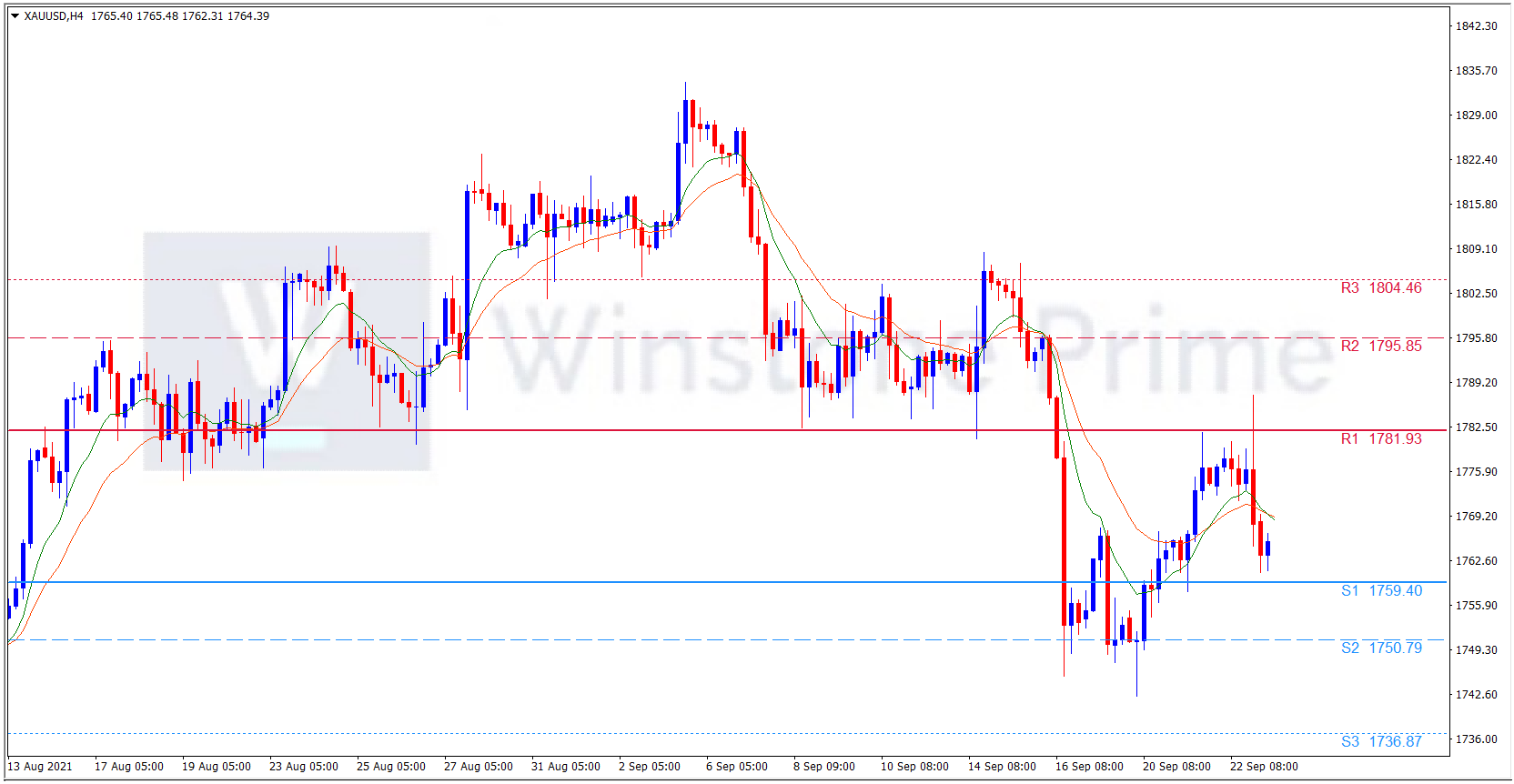
XAU/USD 4 Hour Chart:

Support: 1759.4 (S1), 1750.8 (S2), 1736.9 (S3).

Resistance: 1781.9 (R1), 1795.9 (R2), 1804.5 (R3).

US dollar trades to the upside which keeps the yellow metal into downtrend. We expect a bearish trend for XAU/USD.

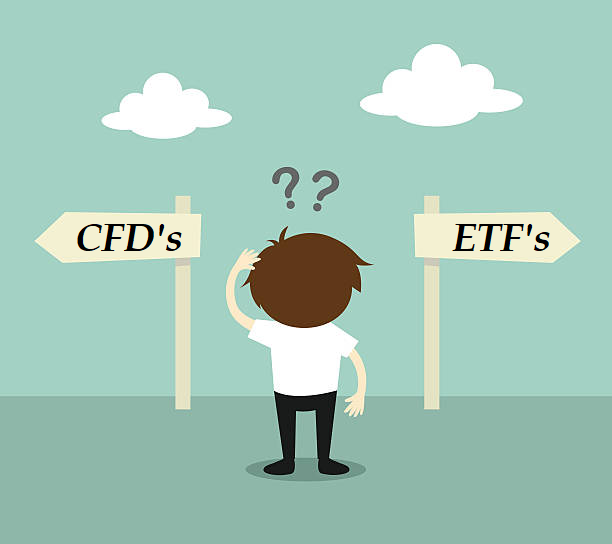
Difference between CFD & ETF trading

The way traders, investors and brokers interact in the market has also positively changed many devices, securities and technological developments. Investment and trade in recent years have brought many new ways. Also, even if you want to trade stock market indices, there are plenty of alternatives to choose from. Gaining exposure to a stock index is one of the best ways to invest in the stock market. It is easy, cost effective and provides instant diversification.

Not everyone is comfortable directly investing in an index, especially new traders. If you also belong to this lot, you can consider an indirect investment. If you are still wary of investing directly in an index, there are two ways to indirectly invest – Index ETFs and Index CFDs.

Let’s explore the two alternatives individually to conclude which one is better. What are crypto CFDs and ETFs, how do they work and why do they matter? Find the answers to these questions in this article.

CFD’s and ETF’s

The Contract for Differences (CFD) and the Exchange-Traded Fund (ETF) are two financial instruments and the most traded products on the financial markets. This is justifiable since the characteristics of the two instruments are perfectly tailored for short-term traders, as opposed to long-term investors. Long reserved for institutional investors, these products are now attracting an increasing number of retail and professional traders that are drawn to their relative simplicity.

Index ETF’s

ETF stands for Exchange Traded Funds. These are similar to mutual funds that can be traded on an exchange similar to common stocks. Index ETFs or Exchange Traded Funds have been praised as an ideal investment and trading instrument ever since their inception. In simple terms, ETFs are just like mutual funds and are traded on exchanges, like any common stock, thus deriving their name.

Index ETFs represent the ownership of underlying assets, such as bonds, stocks, commodities and currencies. When it comes to index ETFs, assets with a common characteristic are usually clubbed together, such as energy stocks, agriculture instruments and so on. So, you can choose a sector-specific ETF for your investment. They normally provide higher daily liquidity and lower fees than mutual funds, which has made them an attractive option for investors.

Here, the investor does not own the underlying asset. They merely speculate on the movement of the index. Index ETFs can be used to make short term profits, although it is important to also remain aware of the associated risks. They are also great for long term investments.

The advantages of trading Index ETFs include diversification, high liquidity, relatively low fees and easy trading, since ETFs are traded on public stock exchanges. Other benefits offered by index ETFs include capital gains tax exemption, special dividend treatment and reasonable liquidity. Brokers also offer low commission rates to ETF traders.

Index ETFs are perfect for investors who are not looking for high leverage, have high capital and are looking for a trading experience to utilise the capital. The components of an ETF balance each other out. If one instrument’s value goes down, another instrument’s value might go up and even things out.

Index CFD’s

CFD’s stands for Contract for Difference. Index CFDs are a more recent addition, as compared to Index ETFs. A CFD is a contract between a buyer and seller for a particular asset, where one party agrees to pay the other the price difference between the opening and closing price of the contract. Index CFDs are derivatives, where you usually have to just pay 5% to 10% of the price of the underlying asset to take a position.

Index CFDs helps spread the risk across an entire segment rather than investing in on a single company. This diversifies the investment and takes care of most of the factors that could affect the share price of a single company. Index CFDs are available with both instant and market execution. Your orders are executed without any delay, leading to fast and efficient trading.

Trading CFDs involves speculation on the direction of movement of an index, where the investor agrees to exchange the difference in price between the start of the contract and its end date. Allowing traders to participate in the global financial markets, an Index CFD is a collection of the biggest stocks registered on a specific stock exchange. The best part is that one can speculate on both rising and falling markets.

Which could be the best one?

The answer to this depends on what you want from your trading experience – it’s usually a balance between financial returns and risk, and you need to become an informed investor/trader to see which trading instrument works best for you.

  • Index ETFs have been around for longer than Index CFDs.
  • In Index ETFs, you have to pay the full price of the underlying asset, whereas in Index CFDs, you agree to receive or pay the difference in price between the opening and closing dates of the contract.
  • With Index ETFs, you can never lose more than your initial investment. However, with Index CFDs, the use of leverage means that both profits and losses will be multiplied.
  • Index CFDs are usually used for short-term strategies, whereas Index ETFs are usually used to yield smaller gains over a longer period of time.
  • Index CFDs have high risk and high reward potential, whereas Index ETFs are usually meant for smaller gains over a long period of time.


CFDs are a derivative, giving you substantial gearing of your investment, which means you can control and profit from the change in price of a much higher value of security than you could buy with the same money. Typically you will only have to pay 5% to 10% of the value of the underlying. While some ETF’s can manipulate the paybacks, they are not leveraged as such, and you need to pay the full price for them.

The other difference, arising from this, is that CFDs are subject to interest charges for the period that you hold them. Because they are a margined product, you are also open to the broker requesting more money from you, a margin call, if the value falls. If you have an active interest in trading, and intend to take profitable positions, then the leverage of CFDs far outweighs these disadvantages when compared to ETF’s.

Conclusion

While concluding this article it is generally accepted that ETF trading may be better-suited for opening long-term positions, whereas many traders turn to CFD trading for more short-term operations, as they simply want to trade on the asset for a quick profit and not own the underlying security. These types of traders use short-term strategies such as scalping, day trading and swing trading. For most investors, therefore, CFDs are opportunities that are used for speculation purposes. As for ETFs, the long-term investment is the only option. Both opportunities are great options for investors who are acquainted with the markets. It is nevertheless, important to understand the risks in the market before making investments in either market.