
Introduction
Holding a position depends on your trading strategy and plan. Swing traders might hold a position for days or even weeks, while scalpers might hold it for a few minutes. When holding a position, the price of the currency pair you’re trading isn’t the only price you need to watch; you should also be aware of the swap or funding charge. When traders open a margin account, they reach some sort of agreement with their Forex broker: they will borrow funds from it and when trading is done, return it.
But, it’s not like such loans come without additional requirements. Here is where the swap meaning in Forex comes in.
Definition of Swap Charges
Swap is an interest fee that is either paid or charged to you at the end of each trading day. Swap are paid or charged either in pips or points. When trading on margin, you receive interest on your long positions, while paying interest on short positions. The net interest difference is known as the carry and traders seeking to profit from this are known as carry traders.
Positive carry results when you receive more in interest than you are required to pay, and is added directly to your account. If the carry is negative, it is subtracted from your account. If you open and close a trade within the same day, the trade has no interest implications.
Example of Swap charges
Let’s take a quick example of how the actual loan work and how it is similar to margin trading. Let’s imagine you want to borrow $5,000 from your bank. You go there and talk to the loan officer, who tells you that the interest rate for your loan will be 2%.
So, you get the loan and start paying it monthly. Let’s say you made the application for a year, which means you have to pay a monthly fee 12 times. You would imagine that the payment must be around $417 per month (5,000/12) and you should return that $5,000 back to the bank. However, that is not how the financial system works. Because you borrowed funds from the bank, which means it gave you $5,000 from its budget, you also need to pay for the service. So, not only should you bring $5,000 back, you also have to put additional interest on top of that. Because the interest rate was 2%, this means that you’ll be returning $5,100 to the bank, where those 100 US dollars will be a service payment. So, that’s basically how swaps work in Forex margin trading. Forex brokers can be considered as banks and traders as borrowers. Swaps are interest rates for leveraged funds.
Types of Swaps
Forex swap is not actually a physical swap. Instead, a swap in Forex is an interest fee which needs to either be paid in or will be charged (added) to your account when the day’s trading comes to an end. So you will either be paid out at the end of the day or you will have to pay in.
There are two types of swaps. The first swap is a long swap. This relates to keeping long positions open overnight. With the long swap, you will likely earn interest on your positions. The other type of swap is a short swap. This one keeps short positions overnight. As you will earn interest on the long positions, you will have to pay interest when you have a short position.
How and When Swap is charged
Based on the fact that the procedure for exchanging a financial asset or liability is carried out in two stages, as we managed to notice earlier, at the last stage, the swap transaction will be closed. True, with one clarification – only if the transaction is not made on one trading day, but is postponed to the next day. That is when making a buyback, let’s say currency, the next day a swap occurs.
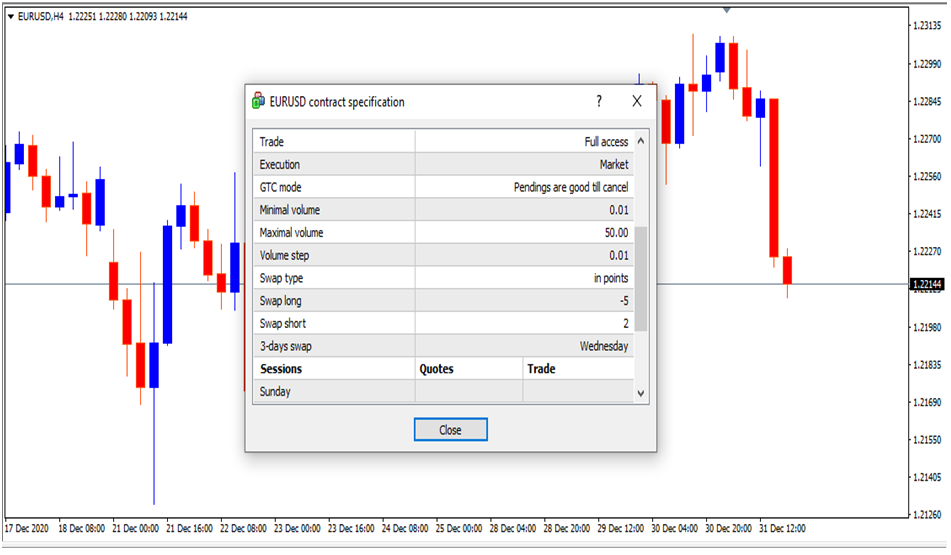
The exact moment at which the swap is charged to your trading account will depend on your broker. For most brokers, it is charged at around midnight, most commonly between 23:00 – 00:00 server time. Something which is not always known, is that sometimes the swap will be charged for maintaining a position over the weekend, even when it is not held over the weekend. To compensate for the fact that the markets are closed over the weekend, the weekend swap is charged on either Fridays or Wednesdays, depending on the specific market. Swap charges might change day to day.
In other words, if you hold your position overnight on the day that weekend swaps are applied, three times the normal swap will be charged on your trade.
To confirm when exactly your broker makes a swap charge on your trading account and on which day 3 days swap are charges, it is best to either look at the contract specifications for the instrument you are trading, or to ask your broker directly.
Scalpers and intraday traders, working exclusively within the same trading day, do not encounter this concept at all. The topic concerns only those who prefer to hold trading positions for a day or more.
Can you avoid paying a swap Charges?
Losing money is the last thing any trader wants to have to deal with, but with Forex trading, it can happen every close of day if you are consistently having to pay in the difference. Luckily, this can be completely avoided.
Yes you can avoid Swap charges in two ways.
- Close your position before the end of day. All trade closes at a certain time and once it is closed, you won’t earn interest but you also won’t have to pay in any money.
- Only trade in a positive interest. This can be easier said than done, especially if you are new to the process and not quite sure about how to only place beneficial trades.
How can make money from swap in Forex trading?
If you’re interested in placing a carry trade, the first step is finding a high yielding and low yielding forex currency pair. Some examples of low yielding (or funding currencies) are the Japanese Yen (JPY), the Swiss Franc (CHF) and the Euro (EUR). As far as high yielding currencies go, the Dollar (AUD) and New Zealand Dollar (NZD) are popular, though more advanced carry traders might look to the South African Rand (ZAR) or other exotic currencies.
Let’s use the Euro and Dollar: rates in the Eurozone are currently below 0, whilst interest rates in are relatively higher, currently 2%. This means that there is an opportunity to earn carry buying AUD with EUR ie going short EURAUD.
Great, simple right?
Sadly it’s not that easy – there is no point earning a pip a day in swap if the pair is moving against you 100 pips / week. That is, if we wanted to perform a carry trade on EURAUD, we would wait until the pair was trending down, sell into any strength and hold for the length of the down trend. Think of swap as an added bonus or incentive for holding a trade long term (or in the case of negative swap, a deterrent).
Want to trade with the best swaps ? Open a Winstone Prime live account today.
Happy Trading!!